

This will help overcome the "gap" between general education and vocational training, and improve their effectiveness in practice.
Lessons from the past
Mr. Tran Quang Tu, Director of the Ba Tri Continuing Education and Vocational Training Center ( Vinh Long ), believes that several important lessons can be learned from the practical experience of similar vocational high school models in the past. Firstly, the training objectives were unclear, primarily targeting students with weak academic abilities who did not meet the requirements to study the high school curriculum, thus failing to become a preferred choice for the people.
Furthermore, the learning outcomes and value of diplomas are not fully recognized, lacking rigor and clarity, making it difficult for learners to progress to higher levels of education. The separation of vocational training and general education at the high school level also gives rise to a discriminatory view between "literacy education" and "vocational training" in society.
Furthermore, the teaching staff and facilities of educational institutions are still weak and insufficient, failing to meet the requirements of reform; there is a lack of connection between schools and businesses and the labor market.
Drawing lessons from previous technical and vocational high school models, according to Mr. Pham Kim Thu - Principal of Huu Nghi College ( Nghe An ), the biggest lesson is the lack of a clear definition of learning goals and pathways for students. Previous programs were often "stuck" between general education and vocational training, lacking the cultural foundation for further education and the skills necessary for sustainable employment in the labor market.
Furthermore, the lack of clear learning outcomes and diploma recognition mechanisms is a fundamental limitation. This lack of standardization makes it difficult for learners to transfer credits, switch careers, or enter the labor market, reducing the attractiveness of these programs in society.
Another important lesson Mr. Pham Kim Thu pointed out is that the conditions for ensuring quality have not met the requirements. Many institutions lack teachers with the capacity to teach integrated culture and vocational skills, have outdated facilities, and their training models are not closely linked to businesses and production practices.
"Based on those experiences, it can be affirmed that vocational high school education under the amended Vocational Education Law can only succeed if it is implemented as a complete educational level, with clear output standards, a smooth learning and career path, conditions to ensure commensurate quality, and is recognized by society in its proper place."
"Renaming or 'technical adjustments' without fundamental changes in thinking and program design will inevitably repeat the limitations of past models," commented Mr. Pham Kim Thu.
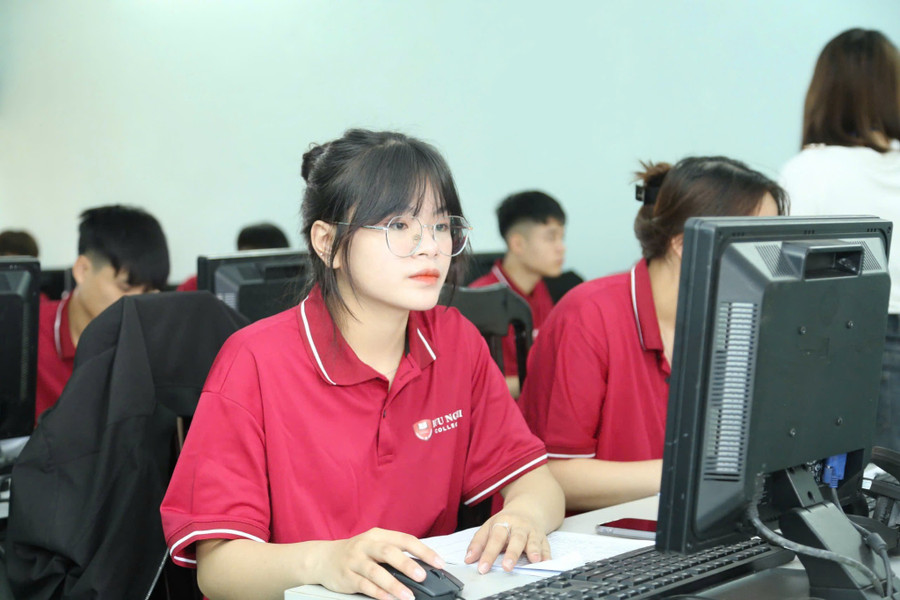
Ensuring the conditions for implementation.
To effectively implement the vocational high school model, one of the solutions emphasized by Mr. Le Van Hoa, Director of the Center for Continuing Education, Informatics, and Foreign Languages in Quang Tri province, is to redesign the vocational education system by merging vocational education and continuing education centers with public vocational secondary schools in the area to form vocational high schools. Doing so would utilize existing facilities, equipment, and technology to avoid waste and streamline the management structure.
With such a merger, the newly established vocational high school will have both qualified high school-level general education teachers and a team of skilled vocational teachers, along with modern equipment. This will also resolve unnecessary competition in student recruitment.
A vocational high school that fully meets the requirements for quality education and vocational training will gain the trust of the people and businesses. Even underperforming vocational colleges could be converted into vocational high schools to streamline operations, improve service efficiency, and provide career guidance aligned with socio-economic development needs.
Mr. Tran Quang Tu prioritizes the improvement of institutions and legal frameworks; clarifying the position of vocational high schools within the national education system. Along with this, he emphasizes developing the teaching staff; investing in and developing facilities and practical training; and closely coordinating with businesses to ensure students have access to practical training and internships during their studies. These are fundamental conditions for the successful implementation of the vocational high school model in practice.
Setting out the fundamental conditions, Mr. Pham Kim Thu also suggested that timely issuance of sub-legal guiding documents is necessary to clarify the legal position of vocational high schools within the national education system, especially their relationship with general education and vocational education at higher levels. This is an important basis for unifying understanding and avoiding situations where each locality and each institution interprets and implements it differently.
Simultaneously, a national framework and output standards for vocational high schools should be developed, integrating culture, vocational skills, and fundamental skills, ensuring articulation between levels. Output standards must be clearly defined, measurable, and comparable to national and international standards, overcoming the situation of "graduating but not knowing where to stand" as in previous models.
Furthermore, the teaching staff should be prepared in an integrated teaching approach. Vocational high school teachers should not only be traditional vocational teachers, but also receive additional training in age-appropriate pedagogy, core general education, career guidance skills, and competency-based teaching methods. Simultaneously, a mechanism should be in place to flexibly utilize experts, engineers, and technical workers from businesses to participate in teaching.
“Another important condition is to leverage the existing infrastructure and business network of the vocational education system, avoiding scattered and superficial investments. Businesses need to be identified as entities directly involved in the training process, from curriculum development and practical training to vocational skills assessment.”
Finally, appropriate financial and communication policies are needed to ensure fairness among different types of schools, while changing social perceptions of vocational high schools as a legitimate educational option with long-term development prospects, not a "secondary path" after lower secondary school," said Mr. Pham Kim Thu.
"Vocational training must be linked to the labor needs of businesses. Students at vocational high schools should receive practical training directly in the workshops and factories of businesses."
"This is a crucial condition for students to truly experience vocational training from experts, highly skilled workers, and master craftsmen, and it also serves as a channel for connecting with the labor market through information on recruitment needs of businesses. This approach also helps solve the problem of investing in equipment and technology at training centers, which is very expensive and difficult to utilize effectively," Mr. Le Van Hoa stated.
Source: https://giaoducthoidai.vn/dinh-vi-trung-hoc-nghe-post763454.html

















































































Comment (0)