

 |
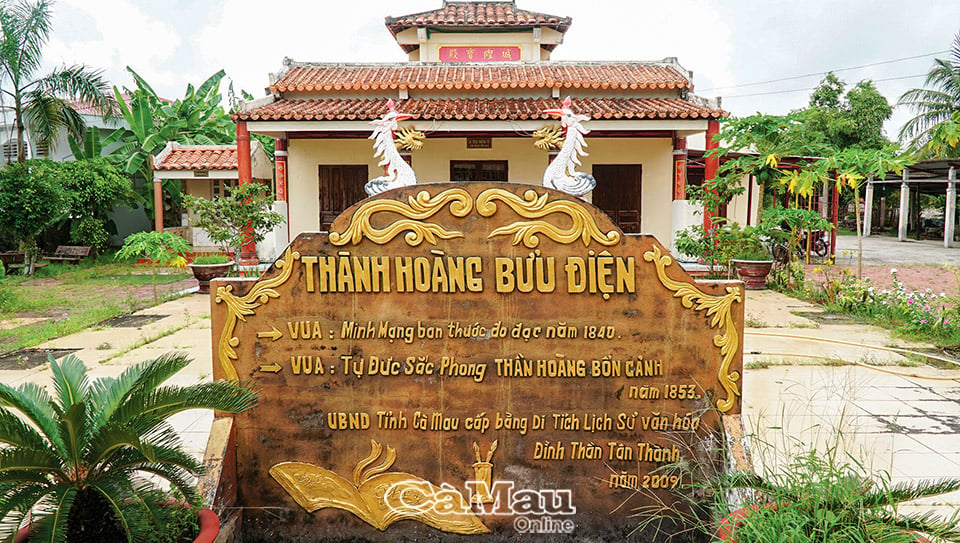
| The screen in front of Tan Thanh communal house (Tan Thanh ward, Ca Mau city) clearly indicates the historical date of the communal house. |
As for the Than Minh Temple in Ward 4, Ca Mau City, the screen depicting a unicorn carries significant feng shui meaning. The unicorn symbol is very special, with its graceful details creating an awe-inspiring atmosphere for the temple. According to the temple elders, this unicorn has the head of a dragon, the back of a turtle, the body of a snake, and the legs of a horse… a blend of several symbols. These originate from real animals, objects, and natural phenomena to form an image and develop into a symbol. These images are preserved in memory through spiritual beliefs and are then depicted. “Cultural symbols are formed on the basis of geographical culture,” Mr. Thach Nam Phuong explained.
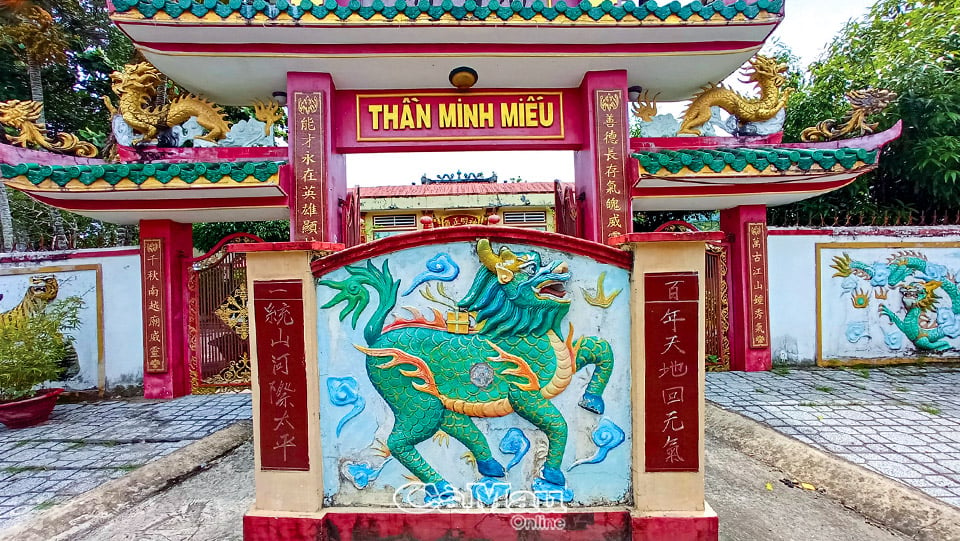 |
| The screen architecture featuring the unicorn symbol at Than Minh Temple (Ward 4, Ca Mau City) signifies peace and prosperity. |
According to Mr. Huynh Dai Hai, Supervisor of the Management Board of Than Minh Temple and Tan Xuyen communal house: “The screen is like a curtain, like the one used when entering the rooms of ancient kings and emperors, therefore it also carries the meaning of protection and privacy. On either side of the screen are the images of a unicorn, a dragon, and a tiger, symbols of the temple's traditional architecture, harmoniously balanced and adding to the screen's beauty. Depending on the conditions and location of the communal house, the screen has different dimensions; currently, the screen at the temple is 1.5 meters wide and about 1.6 meters high, with solemn and respectful patterns…”
Located next to the Than Minh Temple is Tan Xuyen communal house. Previously, the communal house had a screen wall in the shape of a tiger. Later, due to road planning and urbanization, this screen wall is no longer there. Currently, the elders have built a tiger shrine to worship and preserve traditional values.
Mr. Thach Nam Phuong stated that, according to the Heritage Law, for temples and shrines that have been recognized as historical relics, road construction must avoid the screen wall and preserve its original state. Furthermore, many temples and shrines in Ca Mau have screen walls depicting a tiger (sculpted in relief and painted) that serve to protect the temple or shrine, with an altar dedicated to the God of Agriculture behind it.
Furthermore, there are many screens, each with different architectural styles and imagery, found in religious places of worship. These screens are not only traditional architectural works imbued with folk beliefs, but also carry historical value reflecting the ups and downs of life. Preserving this identity is essential so that these spiritual values may forever remain a timeless beauty.
Nhat Minh
Source: https://baocamau.vn/doc-dao-kien-truc-binh-phong-a26142.html
![[Image] Close-up view of the interchange connecting the two expressways and Long Thanh Airport.](https://vphoto.vietnam.vn/thumb/1200x675/vietnam/resource/IMAGE/2026/05/25/1779703378210_ndo_br_z7863716673926-224453a31600126cce10622af6290afd-4549-jpg.webp)


![[Image] Hanoi's urban life under the challenge of a "scorching hot" environment](https://vphoto.vietnam.vn/thumb/1200x675/vietnam/resource/IMAGE/2026/05/25/1779706979265_nang-nong-t5-2026-minh-duy-7-4636-jpg.webp)
































































Comment (0)