

(To Quoc) - The Drum Beating Festival is held once a year on the 16th and 17th of January and is considered the most important festival of the Ma Coong ethnic group.
The Ma Coong people (also known as Mang Coong, Mong Kong, Muong Kong...) are a local group of the Bru-Van Kieu ethnic group in Quang Binh province. According to ethnic history researchers, the Ma Coong are indigenous people with characteristics similar to the Laotians. Therefore, their cultural life is heavily influenced by Laotian culture in terms of language, architecture, housing, clothing, religion, etc.
Currently, the Ma Coong people are the largest group in the Bru - Van Kieu ethnic group in Quang Binh, with 545 households, 2,566 people [1] , residing mainly in Tan Trach and Thuong Trach communes, Bo Trach district, Quang Binh province.
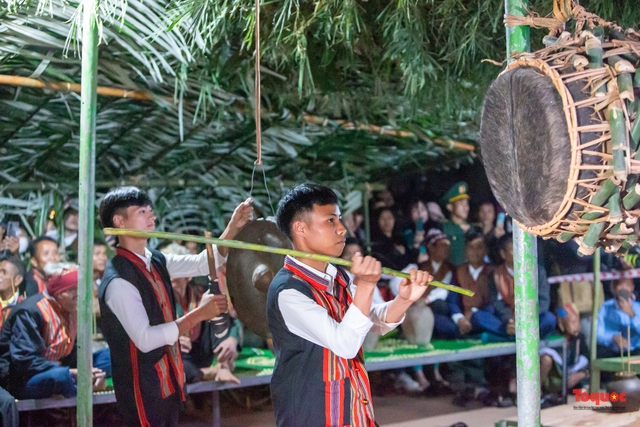
The Drum-Beating Festival of the Ma Coong people (Quang Binh)
The Drum-Beating Festival is held once a year on the full moon of the first lunar month (the 16th and 17th of January) and is considered the most important festival of the Ma Coong people. Before the festival, people contribute whatever they can, but sticky rice is essential for the village to make Hieng wine (a type of wine made from upland sticky rice with leaf yeast, milky white in color, used only for offerings and to entertain honored guests). The village also cannot do without chicken and sticky rice for the offerings.
The ceremonial committee usually consists of five people, including the heads of the five clans in the region. These are the clans that played a key role in developing the land where the Ma Coong people currently live. They have the hereditary right to preside over the ceremony annually. In this sense, the Drum Beating Festival of the Ma Coong people clearly demonstrates community cohesion and unique historical and cultural values, deeply rooted in the identity of the Ma Coong people.
According to legend, in ancient times, a vicious yellow monkey appeared in the land where the Ma Coong people lived. Every night, it would enter the villagers' fields to eat corn, destroy rice, and ruin fruit trees. Since the appearance of the evil monkey, the Ma Coong people suffered from continuous crop failures, famine, and persistent illness. They tried many ways to drive the monkey away, but without success. The night before the full moon of the first lunar month, the village elder dreamt that Giàng (the god of the sky) appeared and told him that to drive away the monkey, they had to make a drum with a resonant sound and beat it on the brightest moonlit night, when the evil monkey would come to destroy the crops. The next day, the Ma Coong men quickly completed a beautiful drum with a loud, warm sound that echoed deep into the Trường Sơn mountain range. Waiting for the monkey to arrive precisely on the brightest moonlit night of the 16th lunar month, the young men took turns beating the drum. Frightened by the sound, the evil monkey fled the land and never returned. To commemorate the village elder, the ancestor of the Ma Coong people, and to repay the gratitude to the spirits, the finest delicacies from the Ma Coong land are selected and arranged for elaborate sacrificial ceremonies.
The Drum-Beating Festival is held annually in the first lunar month, after the harvest is complete and people are preparing for a new planting season. They pray to heaven and earth for favorable weather, bountiful harvests, and good health and prosperity for the people. According to the Ma Coong people's belief, on this day, the spirits of all things are free, not subject to the control of any supreme being. Therefore, humans and nature are in harmony, responding to the rhythm of the drums and the dances celebrating the new rice harvest during the festival night. This is truly a festival for the Ma Coong community in particular, and for the Bru, Arem, and Van Kieu ethnic groups in western Bo Trach, Quang Binh in general.
The Drum-Beating Festival is usually held in the middle of the village square. On the largest square in the village, under the shade of ancient trees, the villagers erect a row of small thatched houses. In the main house, which serves as the ceremonial place, a drum is solemnly hung. At night, after the preparations are complete, everyone waits for the moon to rise. When the moon rises over the mountain range behind the village, the offerings are brought out and arranged. The offering tray for the spirits includes Hieng wine, chicken cooked with young rattan shoots, fish, sticky rice, rattan shoots, sections of palm tree trunks, a little rice... Each village has one tray, and there must be 18 such trays in the ceremony. The responsibility for preparing the trays belongs to the family members of the village elders.
The drums of the Ma Coong people are unlike those of the people in the lowlands. The drum body is made from the Chi Cup tree – a hollow medicinal tree that lives for decades in the deep forest and can be used year after year. The drumhead is covered with the skin of a large, strong buffalo. During festivals, the drums are bound together with crisscrossed rattan ropes, then secured tightly with bamboo wedges, giving the drumhead a peculiar shape like a "spiky ball".
According to the customs of the Ma Coong people, after the ceremonial rituals with their strict regulations, comes the lively and boisterous Drum-Beating Festival. Under the moonlight, groups of people take turns beating drums, dancing, and drinking wine by the flickering firelight. Not only the Ma Coong people but also people from all over come here to celebrate the festival. When the drums are broken, symbolizing the strength of ethnic unity and solidarity in protecting the village, the lively scene temporarily subsides. At this time, young men and women who have secretly admired each other are allowed to go to the stream or the forest to talk privately. However, they must return home before dawn to resume their daily lives and promise to meet again at the festival next year .
Through time and transformation, the Drum-Beating Festival of the Ma Coong people has retained its enduring historical and cultural values, deeply rooted in fertility beliefs and reflecting the community's cultural life, aiming to achieve harmony between yin and yang in life. With this significance, the Drum-Beating Festival of the Ma Coong people was recognized by the Ministry of Culture, Sports and Tourism as a National Intangible Cultural Heritage (in 2019).
Source: https://toquoc.vn/doc-dao-le-hoi-dap-trong-cua-nguoi-ma-coong-20241206124037901.htm


![[Image] Hanoi's urban life under the challenge of a "scorching hot" environment](https://vphoto.vietnam.vn/thumb/1200x675/vietnam/resource/IMAGE/2026/05/25/1779706979265_nang-nong-t5-2026-minh-duy-7-4636-jpg.webp)





























































Comment (0)