

In the US, two male mountain lions that were relocated from the eastern Sierra Nevada to the Mojave Desert have starved to death while trying to return home.
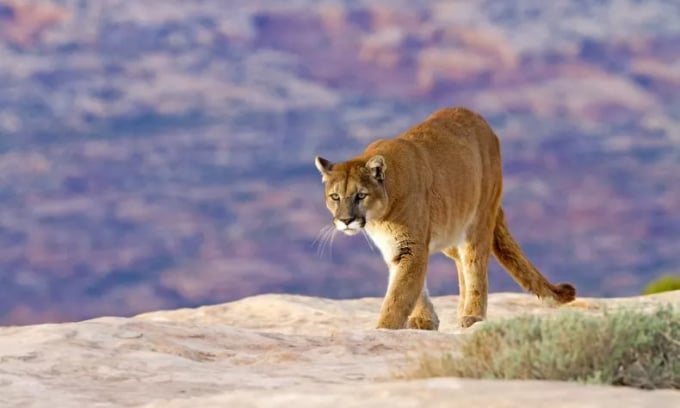
Mountain lions are territorial creatures. Photo: iStock
The California Department of Fish and Wildlife (CDFW) relocated two mountain lions, L147 and L176, to a new habitat approximately 320 kilometers away in 2021. However, they attempted to return to their original home, possibly to their mates, and were unable to survive the journey, Newsweek reported on August 31.
According to the California Department of Fish and Wildlife (CDFW) annual report on the Sierra Nevada Bighorn Sheep Recovery Program, L147 was found on March 29, 2021, in a emaciated state, indicating that starvation was the cause of death. Meanwhile, L176 was found near death and was euthanized on May 12, 2021.
The report stated that both L147 and L176 used dedicated tunnels to cross I-15, demonstrating the importance of dedicated wildlife crossings on major highways. According to the report, the relocation of the mountain lions was a test to see if they would cross I-15 and return home. However, according to the Los Angeles Times , this is inaccurate, and a new report on bighorn sheep from 2021-2022 reveals that they were actually moved as an alternative to euthanasia.
Mountain lions hunt bighorn sheep, an endangered species in the Sierra Nevada. Only 125 sheep lived in the area as of the 1990s. This spurred conservation efforts, helping to increase the population to 277 in 2022.
"At the time, CDFW was exploring alternatives to killing the mountain lions on-site. We regret that the mountain lions died in this way and will learn from this incident," said Jordan Traverso, a spokesperson for CDFW. CDFW currently has no plans to relocate mountain lions in this manner in the future.
"Mountain lions are territorial creatures, living in harmony with their surroundings. Relocation can cause severe disorientation and stress, leading to reduced survival rates, decreased hunting success rates, and a higher risk of disease due to the unfamiliar environment," said Zara McDonald, a biologist with the Bay Area Mountain Lion Project.
Thu Thao (According to Newsweek )
Source link

![[Photo] General Secretary To Lam visits the exhibition space showcasing books, photo exhibitions, and achievements of digital transformation in journalism.](/_next/image?url=https%3A%2F%2Fvphoto.vietnam.vn%2Fthumb%2F1200x675%2Fvietnam%2Fresource%2FIMAGE%2F2025%2F12%2F19%2F1766110879215_1766110240024-jpg.webp&w=3840&q=75)

![[Photo] Enchanting ancient rose garden on the mountainside in Nghe An](/_next/image?url=https%3A%2F%2Fvphoto.vietnam.vn%2Fthumb%2F1200x675%2Fvietnam%2Fresource%2FIMAGE%2F2025%2F12%2F19%2F1766109900916_vuon-hong-chin-do-thu-hut-du-khach-toi-check-in-o-ha-noi-3-20162778-1671624890024-1671624890104198100259.jpeg&w=3840&q=75)




































































































Comment (0)