

Bringing services closer to those who need support.
In many mountainous communes of Dien Bien province, there were times when people undergoing Methadone treatment had to travel dozens of kilometers through hilly terrain every day to reach the medication dispensing facility. The long distances made maintaining daily treatment a significant burden for many HIV/AIDS patients.
The unique characteristics of the mountainous region and the scattered population are among the reasons why the health sector implemented and continues to maintain the multi-day Methadone dispensing model in Dien Bien. According to the Department of HIV/AIDS Prevention and Control (now the Department of Disease Prevention, Ministry of Health ), reducing the number of visits to treatment facilities makes it easier for patients to maintain treatment, especially in remote areas.
Due to these practical difficulties, current HIV/AIDS prevention and control efforts have undergone many changes compared to the past. While the initial phase mainly focused on awareness campaigns and treatment at healthcare facilities, now many activities are implemented with a direct approach to at-risk groups, reducing fear and encouraging patients to remain in treatment long-term.
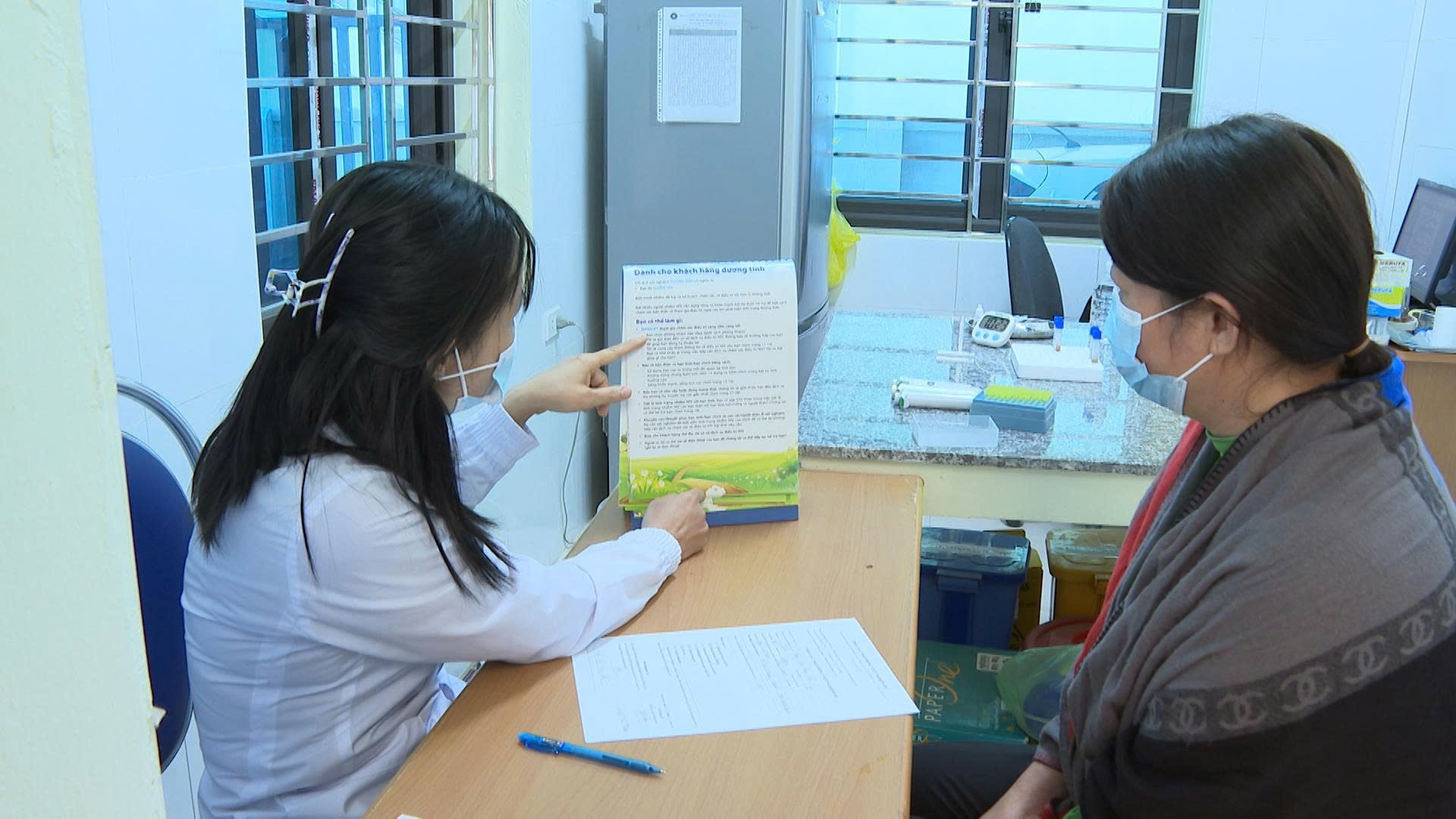 |
| HIV testing and counseling at the Dien Bien Provincial Center for Disease Control. (Photo: Dien Bien Provincial Center for Disease Control) |
According to the Ministry of Health, Vietnam provides HIV counseling and testing to approximately 3.4-3.5 million people annually, detecting around 13,000 new HIV infections. Over 96% of those receiving ARV treatment have viral loads below the suppression threshold. The PrEP program has now reached over 129,000 high-risk individuals, as HIV/AIDS is no longer concentrated in a few groups as before, but is increasingly appearing in various risk groups, especially young people, men who have sex with men, drug users, and partners of people with HIV.
Currently, many localities have expanded HIV testing activities in the community. Instead of waiting for people to go to health facilities, many localities and community organizations have implemented online counseling, mobile testing, support for self-testing for HIV, or connection through peer groups. This approach helps reduce reluctance to access services, especially for those who fear stigma or the disclosure of personal information.
Along with community-based testing, PrEP is also being expanded in many localities. According to the specialized agency of the Ministry of Health, if used correctly according to guidelines, PrEP can reduce the risk of HIV transmission through sexual contact by 96-99%. PrEP helps high-risk individuals be more proactive in disease prevention, instead of only seeking medical attention after potential exposure.
Several models of remote PrEP counseling and support via digital platforms are also being maintained, contributing to expanding access to services for young people or those in areas without direct access.
HIV treatment is now viewed differently than before. According to the health sector, people with HIV who receive good ARV treatment and have a viral load below the suppression threshold are almost certain not to transmit HIV through sexual contact. The message "U=U" (Undetectable = Untransmissible) is contributing to reducing stigma and encouraging early treatment.
More flexibility in mountainous areas
In mountainous provinces like Dien Bien, maintaining continuous treatment remains one of the major challenges in HIV/AIDS prevention and control.
According to health sector reports from 2023, HIV/AIDS is present in almost all districts, towns, and cities of Dien Bien province. Many remote, mountainous communes face difficulties in transportation and maintaining long-term treatment for patients.
In this context, the multi-day methadone dispensing model continues to be applied to reduce travel burden for patients. The Ministry of Health stated that allowing patients to take their medication home helps reduce travel time, lower treatment costs, and improve treatment adherence.
For many patients in mountainous areas, having to travel to treatment facilities daily used to lead to abandoning treatment midway or making it difficult to maintain stable employment.
Community organizations are also increasingly involved in HIV/AIDS prevention and control. In many localities, community groups support patients by connecting them to testing, providing counseling and treatment, and monitoring them after treatment.
According to health experts, this group has an advantage in reaching at-risk groups due to their proximity to and understanding of community characteristics.
In Dien Bien, a model mobilizing social organizations to participate in providing HIV/AIDS prevention and control services was piloted. This approach shows a trend towards increasing community participation in HIV/AIDS prevention and control activities, instead of relying solely on the public health system.
From the experiences in many localities, it can be seen that changes in HIV/AIDS prevention and control efforts today mainly focus on reducing barriers to accessing services, maintaining stable treatment, and supporting patients in their daily lives. In the context of Vietnam's goal of ending the AIDS epidemic by 2030, implementation tailored to the specific characteristics of each locality will determine the effectiveness of HIV/AIDS prevention and control in the coming period.
Source: https://thoidai.com.vn/doi-moi-cach-tiep-can-phong-chong-hivaids-221722.html
![[Photo] General Secretary and President To Lam and his wife begin their official visit to Thailand.](https://vphoto.vietnam.vn/thumb/1200x675/vietnam/resource/IMAGE/2026/05/27/1779881249412_anh-man-hinh-2026-05-27-luc-18-10-51.png)
![[Photo] The courage of new recruits of Brigade 144 on the training ground.](https://vphoto.vietnam.vn/thumb/1200x675/vietnam/resource/IMAGE/2026/05/27/1779881651341_anh-man-hinh-2026-05-27-luc-18-32-52.png)






























































![[Photo] The courage of new recruits of Brigade 144 on the training ground.](https://vphoto.vietnam.vn/thumb/402x226/vietnam/resource/IMAGE/2026/05/27/1779881651341_anh-man-hinh-2026-05-27-luc-18-32-52.png)





























Comment (0)