

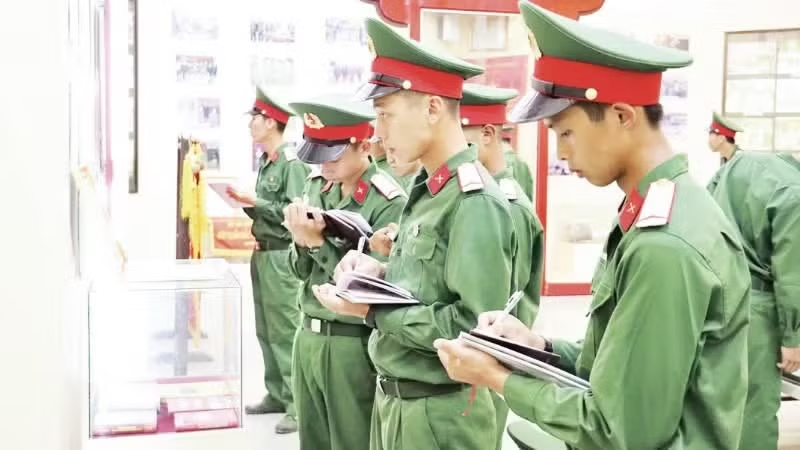
The promulgation of this regulation not only supplements and perfects the system of regulations on Party building, but also represents a significant shift in leadership thinking in the context of the country entering a new era of development with the requirement for breakthroughs in institutions, governance capacity, and the quality of human resources. In this overall context, political and ideological work continues to be identified as the foundation, the " xuyên suốt" axis ensuring unity of will and action, and at the same time, an important endogenous driving force promoting rapid and sustainable national development.
Looking back at the Vietnamese revolution, a consistent pattern emerges: in every stage, political and ideological work has always preceded and paved the way, playing a guiding role in shaping public awareness, strengthening national belief, and uniting the strength of the entire nation. From the years of struggle for independence and national reunification to the period of reform and international integration, ideological steadfastness has created immense spiritual strength, helping our country overcome countless difficulties and challenges. This demonstrates that when ideology is clear and belief is strengthened, all policies and guidelines have the conditions to be implemented effectively.
Entering a new stage of development, this role becomes even more crucial. The global and regional context is undergoing rapid, complex, and unpredictable changes. Globalization and international integration continue to open up many opportunities, but at the same time, they also pose numerous challenges, especially in strategic competition among major powers, profoundly impacting the development environment of each nation. Along with this, the Fourth Industrial Revolution, the explosion of digital technology , artificial intelligence, and cross-border social media platforms are fundamentally changing the information space and the methods of receiving and disseminating information in society.
The diversity and richness of information life is a remarkable achievement, but it also brings with it consequences that cannot be ignored. Misinformation, distortions, fake news, and harmful content spread rapidly, directly impacting social awareness and psychology, and even eroding trust if not identified and dealt with promptly.
In recent times, hostile and reactionary forces have continuously exploited the digital environment to propagate false views, distort the Party and State's guidelines and policies, incite discontent, and sow discord within the national unity. These manifestations of "self-evolution" and "self-transformation" within the Party, if not prevented early and from afar, could become a direct threat to political and social stability and the sustainable development of the country. This necessitates an urgent and more vigorous reform of political and ideological work towards a proactive, modern, and effective approach.
Regulation No. 19-QD/TW can be seen as a systematic adjustment aimed at meeting the requirements of a new stage of development. First and foremost, the regulation clearly reaffirms the fundamental position and role of political and ideological work within the overall work of Party building. This is not merely a field of propaganda and education , but a core element ensuring unity of awareness, will, and action throughout the Party and the entire political system; it is the basis for maintaining the socialist orientation in the development process.
Notably, the regulations clearly demonstrate a shift in thinking from "implementation" to "management" of ideological space in the digital society. Previously, ideological work primarily focused on disseminating policies and guidelines; now, it must shift to proactively anticipating and identifying trends, promptly guiding and directing public opinion. This is an essential requirement in a context of multi-directional information, rapid dissemination, and difficulty in controlling it, demanding greater sensitivity, flexibility, and professionalism.
Furthermore, Regulation No. 19 contributes to standardizing the requirements for substance in political and ideological work. It emphasizes the responsibility of Party committees, Party organizations, and leaders; strengthens discipline and order; and links it to specific inspection, supervision, and evaluation mechanisms, shifting from qualitative activities to measurable, criterion-based governance.
A significant new development is the regulation expanding the scope of political and ideological work, closely linking it to building culture within the Party, fostering public service ethics, and inspiring aspirations for national development. This shows that ideological work should not only focus on "maintaining" but also on "building," not only protecting the foundation but also contributing to the development of national soft power. When each cadre and Party member serves as an example of political integrity, ethics, and lifestyle, that becomes the most persuasive and effective form of propaganda.
However, for Regulation No. 19 to be effective in practice, the key issue remains its implementation. First and foremost, it is necessary to raise awareness among Party committees, Party organizations, and individual cadres and Party members about the particularly important role of political and ideological work. When awareness is correct and complete, actions will become proactive and voluntary, avoiding the situation where this is considered a "secondary" task or only belongs to a specialized department.
At the same time, it is necessary to continue to strongly innovate the methods of implementation towards a modern, flexible approach, tailored to each target group. The application of digital technology and the effective exploitation of new media platforms are essential requirements to enhance access, interaction, and dissemination of positive information. Simultaneously, it is necessary to strengthen dialogue, listen, and promptly address issues of public concern, thereby increasing persuasiveness and consolidating trust in society.
Experience has also shown that political and ideological work is only effective when closely linked to the lives and practical interests of the people. When policies and guidelines are concretized into programs and projects that yield tangible results and improve people's lives, trust will be strengthened sustainably. Conversely, ideological work easily becomes rigid and fails to create broad consensus.
Furthermore, it is necessary to strengthen inspection, supervision, and evaluation in a substantive and objective manner. Timely commendation of good models and effective practices, while strictly handling violations, will contribute to creating motivation and discipline in implementation. This also serves as a basis for continuously improving methods and enhancing the quality of political and ideological work in the new situation.
It can be affirmed that, in the current period, political and ideological work is not only a top priority but also a guiding pillar and intrinsic driving force of the development process. Regulation No. 19 has created an important framework to improve the quality and effectiveness of this work. The remaining issue is the synchronized, decisive, and creative involvement of the entire political system, so that political and ideological work truly plays the role of a "leading banner," contributing to the rapid and sustainable development of the country in the new era.
According to Dr. PHAM NGOC HUNG (NDO)
Source: https://baogialai.com.vn/doi-moi-cong-tac-chinh-tri-tu-tuong-post586221.html
![[Photo] General Secretary and President To Lam and his wife begin their official visit to Thailand.](https://vphoto.vietnam.vn/thumb/1200x675/vietnam/resource/IMAGE/2026/05/27/1779881249412_anh-man-hinh-2026-05-27-luc-18-10-51.png)

![[Photo] The courage of new recruits of Brigade 144 on the training ground.](https://vphoto.vietnam.vn/thumb/1200x675/vietnam/resource/IMAGE/2026/05/27/1779881651341_anh-man-hinh-2026-05-27-luc-18-32-52.png)







































![[Photo] The courage of new recruits of Brigade 144 on the training ground.](https://vphoto.vietnam.vn/thumb/402x226/vietnam/resource/IMAGE/2026/05/27/1779881651341_anh-man-hinh-2026-05-27-luc-18-32-52.png)















Comment (0)