

This is not just a journey to retain the trophy, but also a challenge to overcome our own historical limitations.
Short cycles
Winning the Southeast Asian title three times in 2008, 2018, and 2024 (when the tournament was called the ASEAN Cup) are milestones that affirm the increasingly stable position of Vietnamese football in the region, although it still lags behind Thailand with 7 titles and Singapore with 4.
However, a closer look at that journey reveals that the Vietnamese team has never successfully defended its title. In the two tournaments where they were the defending champions (2010 and 2021), the "Golden Star Warriors" were eliminated in the semi-finals.
The repeated setbacks after reaching the pinnacle of the AFF Cup show that the Vietnamese national team lacks the depth of squad to build a sustainable cycle of success. Looking back after the 2008 championship, Vietnamese football fell into a prolonged slump lasting nearly a decade, until coach Park Hang-seo appeared and created a historical turning point.
By 2018, the scenario seemed different: Vietnam won the AFF Cup, then went on to reach the quarter-finals of the 2019 Asian Cup and the third round of the 2022 World Cup qualifiers. However, even that seemingly brilliant period only lasted about three years before signs of fatigue appeared.
A readily apparent commonality in both periods is a clear reliance on a "golden generation." Once the players reached their peak in terms of skill and experience, the national team immediately achieved a significant leap in performance.
But football, inherently unforgiving in that it doesn't allow for prolonged periods of stagnation, quickly exposed the problem once that generation passed its peak. Therefore, the success of the Vietnamese national team often resembles short cycles of explosive growth across generations, rather than a solid foundation to maintain long-term dominance.
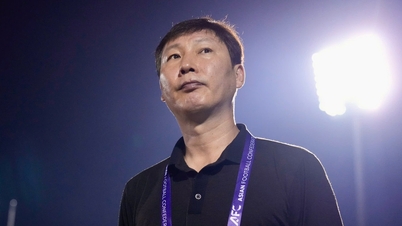
That is the weight of history resting on the shoulders of coach Kim Sang Sik and his team. The 2024 ASEAN Cup championship came from a team that knew how to capitalize on the right moment, notably the explosive form of naturalized player Nguyen Xuan Son with 7 goals, along with the clear imprint of the simple yet effective playing style, emphasizing directness and cohesion, which the South Korean strategist built in a short time, with a "peak performance" tailored to each specific campaign.
However, the 2024 championship title cannot yet be considered the "sweet fruit" of a systematic and sustainable player development process. Therefore, the true stability of the national team can only be verified when they successfully defend their title at the ASEAN Cup 2026, which starts this July.
Only by passing that rigorous test will the story not remain a moment of explosive success, but transform into a sign of a stable cycle, strong enough to shape the long-term position of Vietnamese football in the region.

Shaping power in depth
Therefore, coach Kim Sang Sik is gradually building a long-term squad for the 2026 ASEAN Cup, instead of just making adjustments at the last minute. His strongest lineup is being shaped through each match in the 2027 Asian Cup qualifiers, through continuous rotation, testing, and selection from the V-League, while also gaining new momentum from the U23 team.
It is within this process that personnel choices are gradually refined, the roles of each position become clearer, and at this point, the core framework of the team has largely emerged. This is no longer a team assembled for each tournament, but is shifting towards a strategically oriented approach, where each player is placed in a specific position within the long-term strategy.
Compared to two years ago, Kim's squad has significantly upgraded in both quality and depth. Nguyen Xuan Son remains a crucial pillar in attack, while the arrival of valuable players like Hoang Hen in midfield has made the team structure more balanced and control-oriented. Conversely, Dinh Bac's explosive form provides a new, young, and unpredictable attacking force, capable of making a difference in major regional matches.
It's noteworthy that the generational transition is unfolding quite smoothly. While key players from the 1996-1999 age group maintain their fitness and form, many young talents have already risen to prominence, making their mark with the Vietnam U23 team in continental youth tournaments. The blend of these two generations of players, coupled with the addition of naturalized players and overseas Vietnamese, is giving the Vietnamese national team a more diverse pool of talent than ever before.
This diversity provides the "material" for coach Kim Sang Sik to create many different tactical approaches, instead of relying on a few individuals or a fixed generation as before. If implemented correctly, this could be the foundation for the team to avoid the old cycle: bursting with activity followed by a rapid decline in performance when key players falter.
Ahead of the 2026 ASEAN Cup, the Vietnamese national team is expected to continue its training camp in South Korea with a more rigorous, demanding, and competitive selection process. In this context, there is no room for complacency.
The key players must maintain their top form if they don't want their positions threatened by the wave of youth development, as well as by Vietnamese expats and foreign players who have integrated or are about to complete the citizenship process, all of whom are ready to create real competitive pressure.
This competition is necessary, even vital, to build internal strength for the Vietnamese national team. Because at the national team level, a championship title does not equate to absolute stability or an unchanging core team.
History has shown that both times the team failed after winning the AFF Cup, it stemmed from maintaining a personnel structure that had reached its peak for too long. Therefore, Kim needs to avoid repeating that mistake and instead aim for a team capable of constantly adapting to practical demands.
According to the draw for the ASEAN Cup 2026, Group A consists of Vietnam, Singapore, Indonesia, Cambodia, and the winner of the play-off match between Brunei and Timor-Leste. Meanwhile, Group B includes Thailand, Malaysia, Philippines, Myanmar, and Laos. In the group stage, the teams will play a round-robin format from July 24 to August 8, 2026. The semi-finals and final will then switch to a home-and-away format, starting on August 15 and ending on August 26.
Source: https://giaoducthoidai.vn/doi-tuyen-viet-nam-thu-thach-pha-loi-nguyen-post779659.html































































Comment (0)