


According to the "Vietnamese Dictionary": "Happiness is a state of joy because one feels completely fulfilled. For example: Because of the happiness of the children. The family is very happy." "Simplicity means having few components or aspects, not complicated or troublesome. For example: A simple calculation. A problem that cannot be solved simply."
A century ago, writer Nguyen Tuan (1910-1989) wrote: "Happiness in life is a reward made specifically for simple people, to compensate them for other disadvantages." Clearly, Nguyen Tuan's compassionate and empathetic summary reveals two very important ideas about human life. Firstly, if one lives simply, without excessive ambition or overcomplicating life, they will find happiness. Secondly, the happiness found in this simple way of life is a natural compensation for the difficulties and disadvantages that each person endures in daily life.
In the eyes of modern psychologist Dale Carnegie, there is a difference between "success" and "happiness." He wrote: "Success is getting what you want. Happiness is wanting what you get."
Happiness in life is a reward crafted specifically for simple people, to compensate them for other hardships they may have faced.
Nguyen Tuan
To make it clearer and easier to understand, the philosopher La Cordaire (1802-1861) defined happiness as follows: "Happiness is merely the pursuit of man." If so, then "happiness" has no specific address; in reality, the simplest, easiest to find, and most attainable things are those that are within one's capabilities and strength. Why do some people foolishly complicate their lives, constantly creating difficulties of their own making, so that they never find happiness, or even lose half their lives?
The philosopher De Sivry bluntly stated: "To confuse money with happiness is to mistake the means for the end. It's like thinking that a knife and fork make your meal delicious." That's a fascinating and apt example.
Another Western author views "happiness" as a house that is too large but filled only with waiting rooms.
The philosopher Gustave Droz described happiness in a very simple and understandable way: "One attains happiness only by carefully gathering up tiny fragments of happiness." This statement deserves to be repeated daily because it is the key, the secret, to happiness.
"Every little bit of happiness" that we experience daily comes from the joy of striving in our studies and work, whether in the countryside or the city. It is also about gratitude for our homeland, our country, our grandparents, our parents, and our neighbors who have helped us overcome difficulties and grow step by step. Those who have gratitude have happiness.
Once we do something good, something beneficial, helping the poor, the needy, and those in need overcome a specific difficulty or hardship, those are fragments of happiness, as Gustave Droz taught.
Our ancestors often advised us: "Love others as you love yourself," or "The healthy leaf protects the withered leaf," or "Oh gourd, have pity on the pumpkin. Though different kinds, they grow on the same vine"... these are teaching us how to accumulate the little bits of happiness that we can obtain if we try hard.
Mother Teresa of Calcutta, from India, was a saint of compassion. She dedicated her entire life to the poor and the sick. She once said, "We are small people; we cannot do great things, but we can accomplish small things with great love." This sacred teaching of Mother Teresa of Calcutta has inspired millions of working people around the world to persevere and overcome difficulties to secure a better life for themselves and their communities.
To clarify the distinction, philosopher Emile de Giradin (1806-1881) specifically stated: “There are two kinds of happiness. Material happiness and emotional happiness. One is social in nature, the other is internal in nature.”
Oh, how noble is Giradin's way of distinguishing happiness, for it has comforted even the most suffering members of society, and has encouraged and inspired honest citizens to live peacefully amidst the ironies and hardships of everyday life. It is this inner happiness that truly belongs to humanity, to the specific circumstances of "Here and Now."
"Now and here" is a concrete, simple way of thinking for everyone who truly wants to strive to achieve their dreams and happiness through their own efforts, through their own self-motivation and persistent striving. It will be more sustainable and less likely to be destroyed than relying on help from others or external influences.
At this point, one can think of a simple habit that can be applied in daily life, such as when we eat, speak, and think. With the old French proverb that many have learned, know, and memorized: "People eat to live, not live to eat." Therefore, the essence of eating and drinking should be sufficient, on time, slow, chew thoroughly, cooked food, and boiled water. If someone places too much importance on daily meals, indulging in alcohol and excessive drinking, they will suffer the misfortune of illness, as the ancients taught, "illness enters through the mouth," meaning that people contract various diseases through their diet.
When speaking, one should learn to think carefully before speaking. It's better to say one thing than two. Words should be concise, clear, and concise, ensuring the other person understands the issue and can easily respond. Avoid rambling, meaningless metaphors, or lengthy, drawn-out conversations that dull the conversation and yield no results.
When thinking, one should also learn to look directly at the problem, not to think aimlessly or ramblingly. For example, if your academic performance is poor, focus on graduating from 12th grade to reach the milestone of completing high school. Once you have the diploma, you can think about and plan the next steps. Some students with poor academic performance force their parents to sell land and houses so they can go to the city to attend various exam preparation classes. In the end, they lose money and suffer consequences, wasting years away from home, aimlessly and uselessly.
Learning how to eat, speak, and think concisely are skills that will stay with us throughout our lives.
The great French poet Nicolas Boileau (1636-1711) once advised: "Be simple in thought. Be noble without pride. Be naturally beautiful without makeup." Of course, this is a benchmark for all endeavors, but it is also easy to understand, very practical, and applicable to everyday life.
In programs praising good people and good deeds, one thing is clear: these are ordinary people, working-class people struggling to make a living every day. But the great difference in each of these people is their love for their homeland, their affection for their compatriots in remote areas, and their love for those who are still working hard and facing hardships.
That sense of brotherhood is the strength that helps the emulation fighters and labor heroes strive and contribute, just as Boileau analyzed: "Noble without arrogance." We will forever be grateful to those who have brought happiness to others in our "one for all" society.
The philosopher Ralph Waldo Emerson asserted, "No one can give you peace and happiness except yourself." The more we analyze and dissect this quote, the truer it becomes. Why? Because it guides people towards a higher skill: "from giving to oneself to being oneself."
Once a person transitions from adolescence to adulthood and then through middle age, they become very stable and have experienced firsthand that the mechanism of "self-reliance" is entirely correct and authentic. Any reliance, dependence, or support will fail miserably if the individual cannot stand firm against the harsh realities of time, natural changes, and social circumstances.
To conclude this article on "Simplicity and Happiness," remember the famous quote by William Hazlitt (1778-1830): "The essence of simplicity is the natural conclusion of profound thought." Because it is the natural conclusion of profound thought, "simplicity" is difficult to find and see in the daily lives of ordinary people. The only way is to strive, persevere, and patiently learn to think simply in all matters to achieve happiness for ourselves.
Source: https://daidoanket.vn/don-gian-va-hanh-phuc-10278480.html
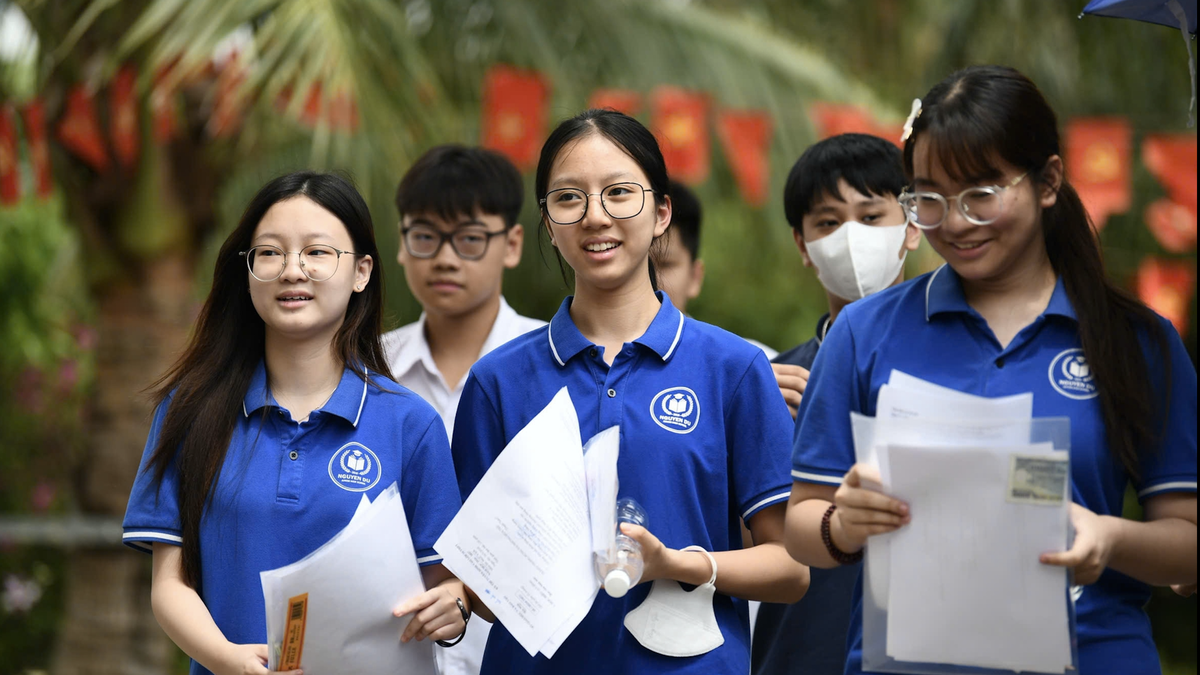


![[Image] Nearly 125,000 Hanoi students completed the Literature exam for the 10th grade entrance exam.](https://vphoto.vietnam.vn/thumb/1200x675/vietnam/resource/IMAGE/2026/05/30/1780117233041_ndo_br_thiet-ke-chua-co-ten-2-png.webp)



























































































Comment (0)