

 |
| Vietnam and ASEAN have significant potential to boost bilateral trade growth. Photo: Duc Thanh |
The mark of trade cooperation
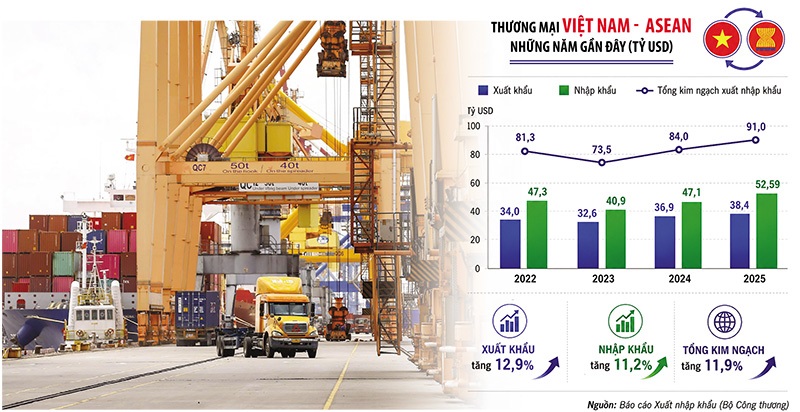
Bilateral trade between Vietnam and ASEAN is expected to exceed US$91 billion in 2025. Thailand, Singapore, and the Philippines, in particular, maintain strong and close trade ties with Vietnam, with import and export growth rates consistently in double digits in recent years. Statistical data shows that the value of trade between Vietnam and these three markets last year was approximately US$36 billion.
Thailand is currently Vietnam's largest trading partner in ASEAN, with bilateral trade reaching US$21.9 billion in 2025. Of this, Vietnam's exports are expected to reach nearly US$8.8 billion, a 12.7% increase, while imports are projected at US$13.3 billion, a 6.7% increase. However, Vietnam has recorded a trade deficit with Thailand for the 13th consecutive year, with a net deficit of US$4.5 billion last year.
In recent years, economic relations between Vietnam and Thailand have recorded impressive figures. Vietnam is Thailand's second-largest trading partner in the region. Both sides are promoting the development of concrete measures to implement the Three Connectivity Strategy, which includes connecting supply chains, connecting businesses and localities in both countries, and connecting sustainable growth strategies.
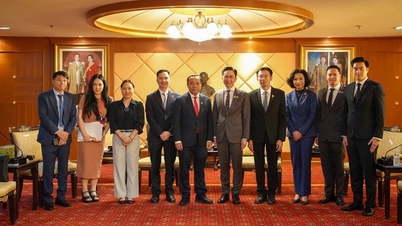
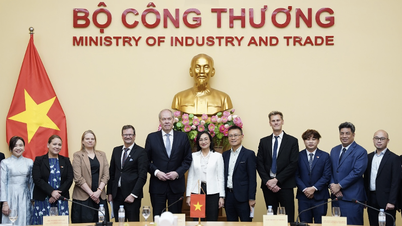
Just a few days ago, Olivier Langlet, CEO of Central Retail (Thailand's leading retailer), stated during a meeting with Minister of Industry and Trade Le Manh Hung that the group has invested in 44 shopping malls and 330 stores in 26 provinces and cities of Vietnam, with the proportion of Vietnamese goods in Central Retail's retail system reaching nearly 95%. The group is implementing a plan to further expand its modern retail model and increase sales in Vietnam.
 Economic and trade relations between Vietnam and ASEAN are developing strongly, with bilateral trade reaching a record high of US$91 billion in 2025. ASEAN is not only a major export market but also a strategic supply source, contributing to strengthening supply chain linkages and boosting Vietnam's trade growth.
“We not only support manufacturers, suppliers, small and medium-sized enterprises… in penetrating modern distribution systems, improving packaging and designs, and enhancing product quality…, but also open up export opportunities for Vietnamese goods through Central Retail’s retail network in many markets,” said Olivier Langlet.
Reportedly, in March 2026, Central Retail Vietnam facilitated trade connections between 50 Vietnamese businesses and importers from the United States and South Korea.
In the first four months of 2026, Vietnam-Thailand trade continued its upward trend, increasing by 24% compared to the same period in 2025, reaching nearly US$8.6 billion. Of this, Vietnam exported US$3.76 billion, an increase of 39%; and imported nearly US$4.84 billion, an increase of 15%.
According to the Vietnam Trade Office in Thailand, the two countries' trade structures are complementary, but the balance of trade is primarily skewed towards a trade deficit with Vietnam. Thailand is a major supplier of machinery, raw materials for manufacturing, automobiles, raw plastics, metals, chemicals, etc., serving both domestic consumption and exports for Vietnam. Vietnam, on the other hand, mainly exports high-tech goods, components, and agricultural products.
“The two countries need to connect more closely in supply chains, especially since Thailand has strengths in regional and global supply chains. This connection is very helpful for expanding Vietnam’s trade relations with the world ,” said Vietnamese Ambassador to Thailand Pham Viet Hung.
Although the value of trade exchange is not as large as with Thailand, Vietnam's import and export with the Philippines has also grown considerably, reaching over 8 billion USD. Of this, Vietnam's exports have increased significantly, creating a trade surplus of billions of USD annually thanks to increased consumer demand and food security in this market, reaching 5.4 billion USD.
Rice continues to be Vietnam's most important strategic commodity. Despite fluctuations and a short-term decline at the end of 2025, the total amount of Vietnamese rice sold to the Philippines for the entire year still reached over 3.2 million tons, generating revenue of over US$1.57 billion. The Philippines maintained its position as Vietnam's largest rice buyer.
In the last two years, Vingroup 's products and services have created and gradually affirmed a new position for Vietnamese products, goods, and services in the Philippine market, contributing to boosting export turnover and building the image and reputation of Vietnamese products in a market of over 120 million people.
For Singapore, in the first four months of 2026, Vietnam maintained its position as the country's 10th largest trading partner. The potential for expanding Vietnamese exports to Singapore remains significant, especially in the processing industry, electronics, and technology equipment sectors.
"The trend of trade growth reflects the increasingly close integration between the production networks of the two economies, in which Vietnam is playing an increasingly important role in the regional value chain," said Cao Xuan Thang, Vietnam's Trade Counselor in Singapore.
Seize the opportunity from a market of 700 million people.
Vietnam and ASEAN have significant potential for boosting bilateral trade growth. According to the Ministry of Industry and Trade, the ASEAN market holds great potential for Vietnamese businesses due to several factors, including a population of over 700 million people, ranking third in the world when considered as an economic entity; a large and open market; close geographical proximity, saving businesses on transportation and warehousing costs; and similar consumer habits and preferences.
Agricultural products are considered easily accessible, but highly competitive. To increase competitiveness and add value to products, investment is needed in deep processing; standardization of packaging, trademark registration; increased traceability; and development of distribution networks.
Specifically for Thailand, Singapore, and the Philippines, the outlook for trade with Vietnam is considered positive as these countries continue to promote linkages and implement intra-bloc cooperation initiatives. At the same time, businesses are increasingly effectively utilizing tariff preferences from FTAs, including the ASEAN Trade in Goods Agreement (ATIGA) and the Regional Comprehensive Economic Partnership (RCEP).
In particular, Vietnam and Thailand upgraded their bilateral relationship to a Comprehensive Strategic Partnership in May 2025, demonstrating the two countries' determination to deepen and expand cooperation in all aspects. The two countries have established a joint working group to leverage the global shift in production and supply chains to strengthen supply chain connectivity between the two nations. With this upgraded cooperation, bilateral trade turnover is expected to soon reach the target of US$25 billion.
With the Philippines, building on the foundation of a Strategic Partnership, which is expected to be upgraded to an Enhanced Strategic Partnership, the two countries are boosting trade cooperation with the goal of soon increasing bilateral trade to $10 billion.
Vietnam is a major global supplier of goods, with its trade volume nearing $1 trillion. Exports are a crucial pillar of growth, alongside investment and domestic consumption. However, looking at the $38.4 billion in export turnover to ASEAN in 2025, it is clear that this figure still falls short of its potential.
Exports to ASEAN still have significant potential, but the region is increasingly demanding higher quality standards for goods. Each ASEAN country has different and increasingly stringent non-tariff barriers, especially regarding traceability, technical standards, and product labeling. The growing trend of applying trade defense measures puts pressure on Vietnamese exports.
In particular, Thailand leads among ASEAN countries in applying the most trade defense measures against Vietnamese goods, with dozens of cases, mostly in the iron and steel, aluminum, plastics, and textile industries.
The Trade Remedies Department (Ministry of Industry and Trade) recommends that businesses strictly adhere to rules of origin and have documentation ready to prove the origin of raw materials and production processes. In particular, Thailand is strictly controlling the process to prevent third-country goods from using Vietnam as a transit point to evade trade safeguard duties.
Source: https://baodautu.vn/don-trien-vong-thuong-mai-viet-nam---asean-d604441.html
![[Photo] Standing Committee member of the Party Central Committee Tran Cam Tu working with the Central Inspection Committee](https://vphoto.vietnam.vn/thumb/1200x675/vietnam/resource/IMAGE/2026/05/28/1779969579668_ndo_br_bnd-2495-jpg.webp)











































































Comment (0)