


In the context of the country's strong integration and development, cultural and human development is becoming a core requirement for creating a foundation for sustainable development. Implementing Resolution No. 80-NQ/TW of the Politburo , Hue City is facing the challenge of both achieving strong development and preserving the profound identity of a unique heritage city of Vietnam.
Beyond preserving traditional cultural values, Hue is gradually asserting its role as a major cultural center of the country, where culture becomes an intrinsic strength, a driving force for sustainable development, and people are the creative subjects who preserve the "soul" of the ancient capital.
Preserving the soul of Hue
Hue is not only famous for its ancient capital complex, royal court music, or distinctive festivals. The history of this former capital city has given Hue a unique system of cultural values, crystallized in its rich tangible and intangible heritage. What makes this land uniquely attractive also lies in the depth of its culture and the character of its people: elegant, calm, respectful of etiquette, compassionate, and profound in their conduct.
According to Hue cultural researcher Nguyen Xuan Hoa, what makes Hue's value enduring, besides its citadel, palaces, tombs, and court music, is the "living cultural space" present in the daily lives of its people. This includes the gentle accent, refined manners, elegance, studiousness, and respect for etiquette that have become unique characteristics of the people of Hue. Mr. Hoa affirms: "The most precious heritage of Hue is not only its tangible heritage but also its 'living heritage'—the people of Hue. If we lose that essence, it will be difficult to preserve Hue's unique identity amidst the flow of integration and modern development."
Over the years, along with the rapid pace of urbanization and the strong impact of the market economy , many traditional cultural values are facing the risk of disappearing. The space of ancient gardens is shrinking; many traditional crafts lack successors; and the fast-paced modern lifestyle is also somewhat altering the tranquil and refined way of life in the former imperial capital. According to many researchers, the most worrying issue is not the change in the urban landscape, but the impact of modern life, which risks eroding cultural identity if it is not preserved by the community itself.
In this context, the implementation of Resolution No. 80-NQ/TW of the Politburo on the development of Vietnamese culture and people in the new era is considered an important basis for Hue to continue promoting the role of culture in its local development strategy.
Hue City Party Secretary Nguyen Dinh Trung emphasized that the development of Hue's culture and people must be placed within the overall strategy of building the city as a centrally-governed city, based on preserving and promoting the heritage values of the ancient capital and Hue's cultural identity. Culture is the spiritual foundation of society and also an endogenous resource, a particularly important soft power for Hue's rapid and sustainable development.
According to Mr. Trung, Hue cannot develop by becoming a copy of other modern cities. Hue must develop with cultural depth, taking culture as the foundation and people as the center of all development policies. In all development policies, Hue must preserve the core characteristics of the ancient capital; building a new generation of Hue people who are modern and dynamic but still retain elegance, humanism, and the depth of traditional culture.
This perspective is also becoming a guiding principle in the city's current development strategy, especially as the Hue City People's Committee implements many specific action programs to carry out Resolution No. 80-NQ/TW of the Politburo on the development of Vietnamese culture and people in the new period. The biggest goal is to preserve heritage and build the image of the people of Hue in the new era: civilized, elegant, friendly, creative, while still maintaining the depth of traditional culture.
To achieve this, the city is focusing on building a healthy cultural environment from families and schools to residential communities; promoting traditional education, raising awareness of heritage preservation, and building a civilized urban lifestyle. Many programs to revive traditional festivals, develop Hue's ao dai (traditional Vietnamese dress), preserve Hue folk songs, royal court theater, traditional craft villages, and the "Green, Clean, and Bright Hue" movement are being implemented simultaneously to spread Hue's cultural values in contemporary life.
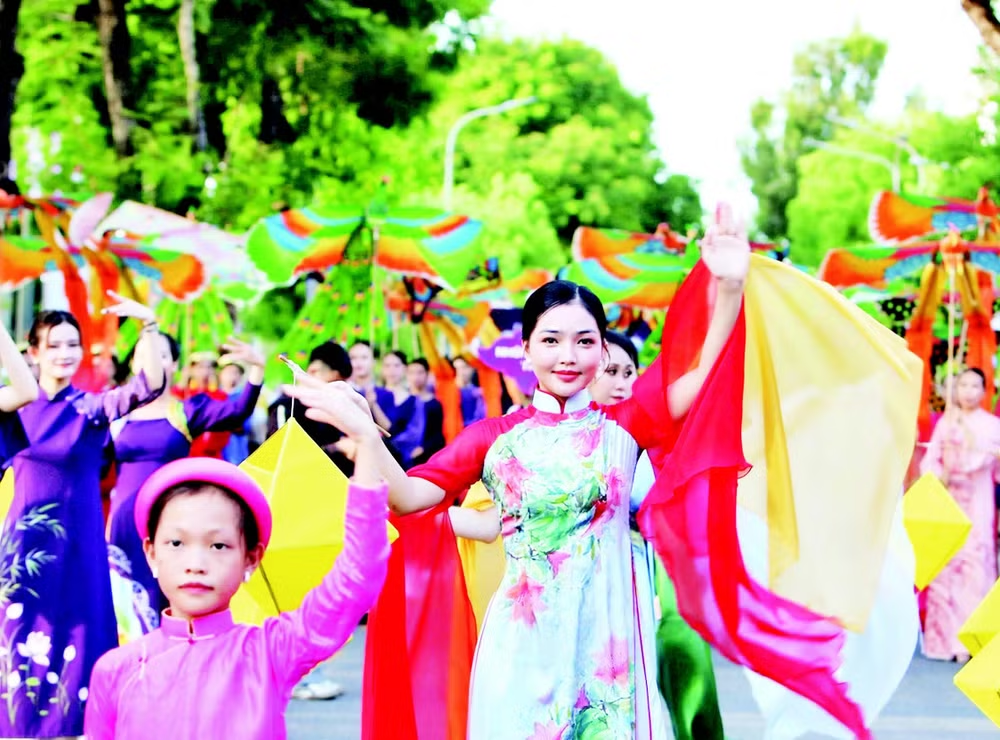
Unleashing the potential of culture and people.
In recent years, Hue has been gradually transforming its heritage values into resources for socio-economic development through heritage tourism, cultural industries, and creative industries. The most prominent highlight is the Hue Festival – a cultural brand of national and international significance for the city.
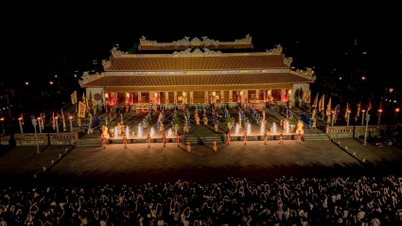
From a model of periodic festivals, Hue has shifted to organizing a four-season festival with hundreds of cultural and artistic activities taking place throughout the year. Programs such as the Ao Dai (traditional Vietnamese dress) festival, street art, light shows at the Imperial Citadel, community cultural spaces along the Perfume River, food festivals, royal court music, and international art exchanges have contributed to reviving the cultural space of the ancient capital in a more modern way, making it more accessible to the public and tourists.
According to tourism statistics, in 2025, Hue is expected to welcome approximately 6.3 million visitors, including nearly 1.9 million international tourists; tourism revenue is projected to reach around 13,000 billion VND. This is an impressive growth rate, reflecting the increasing appeal of Hue's cultural and heritage tourism. Beyond tourism, Hue is also gradually promoting the development of the cultural industry, linked to artistic creation, traditional crafts, cultural performances, and the digital transformation of its heritage.
Hoang Viet Trung, Director of the Hue Imperial City Heritage Conservation Center, shared: "Heritage conservation in the new era will not stop at mere restoration and protection, but needs to bring heritage closer to the community through technology and modern approaches."
In recent times, the Center has promoted the digitization of heritage data, applied virtual reality technology in tours of the Imperial Citadel, built an intelligent tour guide system, digitized artifacts, and promoted heritage on digital platforms to create new experiences for tourists, especially young people. The city also focuses on building creative spaces, night-time economy, pedestrian streets, community art, and distinctive cultural products to create new vitality for the heritage city.
However, many cultural experts also warn that if exploited without depth or if commercialized excessively, the heritage risks becoming "theatricalized," losing its original value. The biggest challenge for Hue today is not only rapid development, but also development in the right direction to avoid losing its unique identity.
Researcher Buu Y once argued that Hue must develop through cultural depth rather than chasing superficial values. A heritage city is only truly sustainable when culture is present in daily life and people become the subjects of cultural creation.
Chairman of the People's Committee of Hue City, Nguyen Khac Toan, affirmed that, in implementing Resolution No. 80-NQ/TW, the city will continue to prioritize resources for heritage preservation, cultural development, improving the spiritual life of the people, and building a healthy cultural environment. Hue does not choose the path of development at all costs, but steadfastly pursues the goal of harmonious development between preservation and modernization, taking culture as the foundation and putting people at the center of all development policies. This is also the city's overarching direction in the process of building a unique heritage city in Vietnam.
Source: https://nhandan.vn/dong-luc-phat-trien-do-thi-di-san-post965796.html
![[Image] Nearly 125,000 Hanoi students completed the Literature exam for the 10th grade entrance exam.](https://vphoto.vietnam.vn/thumb/1200x675/vietnam/resource/IMAGE/2026/05/30/1780117233041_ndo_br_thiet-ke-chua-co-ten-2-png.webp)










![[Photo] General Secretary and President To Lam visits the Singapore Railway Testing Centre.](https://vphoto.vietnam.vn/thumb/402x226/vietnam/resource/IMAGE/2026/05/30/1780126236874_7-jpg.webp)
![[Photo] The General Secretary, President and Prime Minister of Singapore attend the tree planting ceremony at the Singapore Botanic Gardens.](https://vphoto.vietnam.vn/thumb/402x226/vietnam/resource/IMAGE/2026/05/30/1780122934945_vna-potal-tong-bi-thu-chu-tich-nuoc-va-thu-tuong-singapore-du-le-trong-cay-8794687-jpg.webp)
![[Photo] Admire the coral "masterpiece" amidst the million-year-old heritage of Dak Lak province.](https://vphoto.vietnam.vn/thumb/1200x675/vietnam/resource/IMAGE/2026/05/30/1780107638639_y25-jpg.webp)


















































Comment (0)