


Beyond simply applying technology, this model is expected to create new management methods, optimize resources, and form growth poles based on data and innovation.
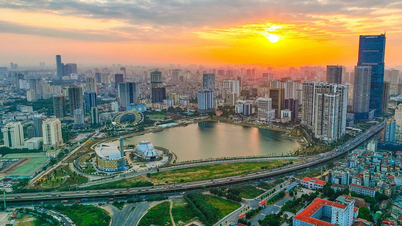
Currently, urban areas contribute approximately 70% of the country's GDP. However, the rapid pace of urbanization also brings with it significant pressure on transportation, the environment, energy, and population management. According to experts, if development continues according to the traditional model, the growth potential of urban areas will increasingly shrink.
Associate Professor Tran Dinh Thien, former Director of the Vietnam Institute of Economics, believes that to achieve high growth targets, Vietnam must create new development spaces based on technology and innovation. According to him, urban areas are the strongest hubs of data, knowledge, and labor productivity.
"Smart cities are not just about installing technology, but about changing the growth model, operating cities with data and modern governance," Mr. Thien stated.
One of the key requirements set forth in Resolution 57 of the Politburo on breakthroughs in national science, technology, innovation, and digital transformation is the standardization of digital infrastructure and the development of national digital data. This is also considered a prerequisite for the comprehensive and sustainable development of smart cities.
In 2026, the Ministry of Science and Technology will continue to promote the standardization of core areas of the digital economy. It is expected that 53 new standards will focus on data and data centers, online public services, urban data models, electronic transactions, and information security.
Notably, the group of standards for smart cities accounts for a large proportion, including standards on data sharing, information security, and information and communication technology infrastructure. According to experts, standardizing data will help avoid fragmented development and a lack of connectivity between localities.
Dr. Vo Tri Thanh, Director of the Institute for Strategic Brand and Competition Research, believes that the greatest advantage of smart cities lies in their ability to connect and utilize data to improve governance efficiency. In the digital economy, data is a new resource. Cities that manage data better will have a greater competitive advantage.
Experts believe that if transportation infrastructure is the "backbone" of traditional cities, then data and digital infrastructure are the "nerve center" of smart cities. From transportation and the environment to urban planning and public services, everything needs to be connected on a unified data platform to support management and decision-making.
By the end of 2025, the Ministry of Construction had launched the National Smart City Information Portal at smartcities.gov.vn to serve the management, monitoring, and promotion of digital transformation in urban areas nationwide.
According to Mr. Le Hoang Trung, Deputy Director of the Department of Urban Development (Ministry of Construction), this system will become a national-level central data platform, playing a role in connecting and integrating urban data sources. The system is developed in an open manner, synchronized with the State's information systems, supporting data-driven decision-making and promoting public-private cooperation.
For localities, the portal supports the development of roadmaps tailored to their specific conditions, while also creating a transparent environment to attract businesses and experts to participate in smart city development.
Despite initial achievements, the development of smart cities in Vietnam still faces many challenges such as scattered data, lack of connectivity, limited inter-sectoral coordination mechanisms, and a shortage of high-quality human resources.
Associate Professor Dr. Nguyen Vu Phuong - Deputy Director of the Academy of Construction Cadre Training Strategy (Ministry of Construction) - believes that many localities are still accustomed to managing based on traditional administrative experience, while smart cities require data-driven governance capabilities.
"To operate a smart city, administrators must know how to prioritize issues, read and analyze data, and evaluate policy effectiveness. Without this capacity, implementation can easily become merely a formality," Mr. Phuong said.
The coordination between planning, infrastructure, environment, and information technology is still not synchronized, resulting in many projects being implemented in a fragmented manner and struggling to achieve effectiveness.
From a business perspective, a representative from Viettel Solutions stated that human resources are a decisive factor in the operational efficiency of Smart City Operations Centers (IOCs). Therefore, the company approaches smart cities from the entire value chain, from research, consulting, and design to operation and human resource training.
To address bottlenecks, the Ministry of Construction advised the Government to issue Decree 269/2025/ND-CP on the development of smart cities. The Decree sets out regulations on standardizing digital infrastructure, technical infrastructure, and data to ensure consistency, interoperability, and connectivity between systems.
According to experts, this is a crucial foundation to avoid a situation where each locality develops its own system, leading to wasted resources and difficulties in future expansion.
In the long term, smart urban development is not just a technological challenge but also a process of restructuring urban development models. When data becomes the foundation of governance, public services are digitized, and decisions are made in real time, the competitiveness of cities will be significantly enhanced.
This is also seen as an important area for Vietnam to form new growth poles, improve labor productivity, and realize the goal of double-digit economic growth in the digital age.
Source: https://baotintuc.vn/kinh-te/dong-luc-tang-truong-tu-do-thi-thong-minh-20260518085603564.htm
![[Image] Close-up view of the interchange connecting the two expressways and Long Thanh Airport.](https://vphoto.vietnam.vn/thumb/1200x675/vietnam/resource/IMAGE/2026/05/25/1779703378210_ndo_br_z7863716673926-224453a31600126cce10622af6290afd-4549-jpg.webp)



![[Image] Hanoi's urban life under the challenge of a "scorching hot" environment](https://vphoto.vietnam.vn/thumb/1200x675/vietnam/resource/IMAGE/2026/05/25/1779706979265_nang-nong-t5-2026-minh-duy-7-4636-jpg.webp)
























































































Comment (0)