Cultural colors "awaken" from everyday life.
Early in the morning, the peaceful and beautiful Hai Tac (Pirate) Islands, part of Tien Hai commune, are a sight to behold. Fishing boats, after a night at sea, return to the harbor in a long line. On the smooth sandy beach, waves roll in and recede, leaving behind soft white foam like delicate threads. Near the harbor, a group of tourists, having just disembarked, eagerly put on life jackets and begin their journey to experience the life of the coastal inhabitants. They awkwardly try out the clam rake, enthusiastically touch the faded silver net, and excitedly ask each other about the age-old stories related to the name "Hai Tac" (Pirate).
The tour guide that day was Nguyen Hoang, a young man born and raised amidst the vast ocean waves of the Hai Tac archipelago. With sun-tanned skin, gentle eyes, and a clear, resonant voice, Hoang said that his love for this land was what led him to choose to start his business in his hometown. “The sea here is beautiful, and the people are kind and hospitable. I only tell you about the simplest things about my hometown, but everyone likes it,” Hoang said, his smile blending with the sound of the waves.
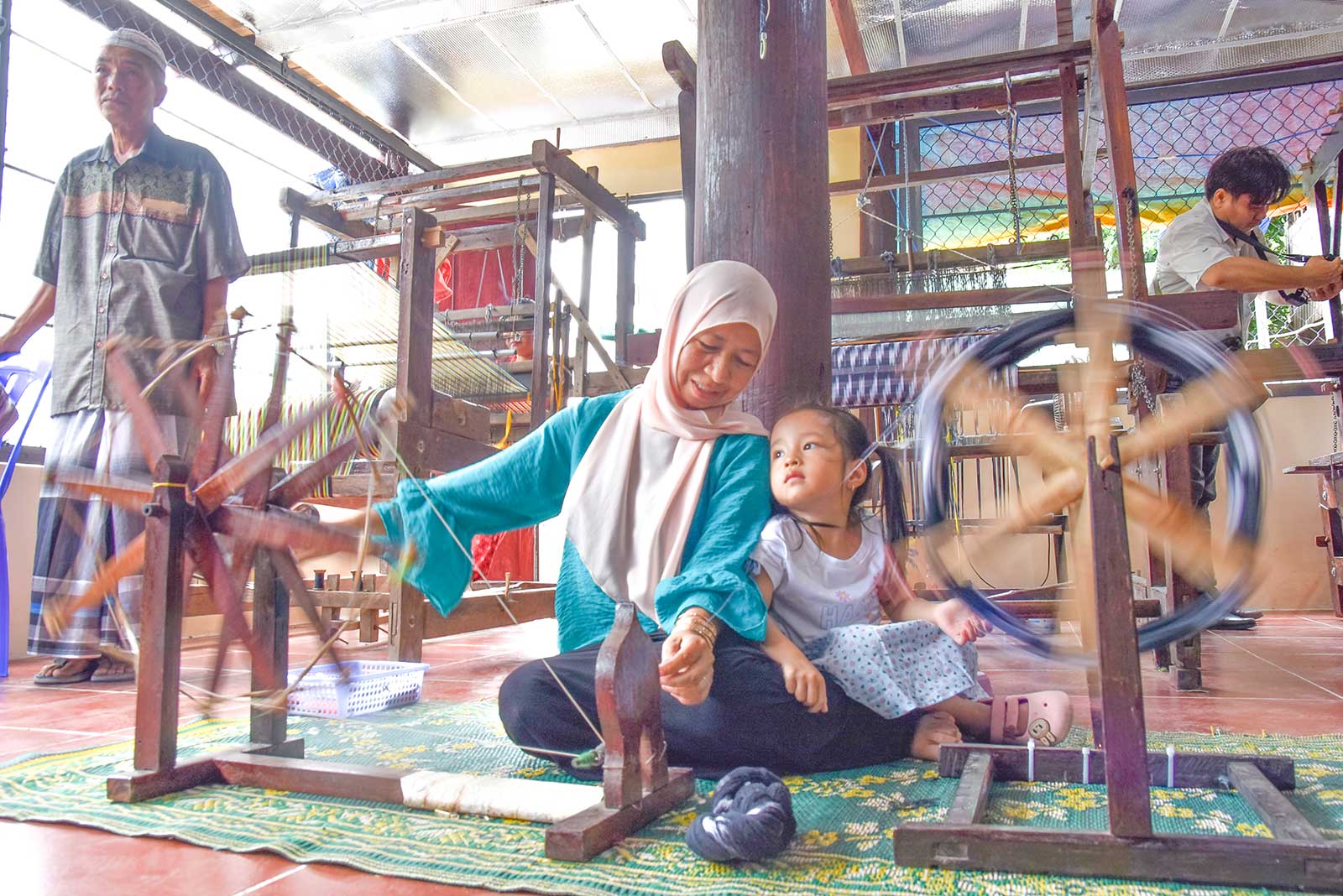
The Cham people in Chau Phong commune maintain the traditional brocade weaving craft to serve tourists. Photo: PHAM HIEU
More than just a guide, Mr. Hoang sees himself as a "cultural bridge." Throughout the morning, he continuously explained about each rocky beach and slope around the island, including anecdotes about ancient treasures and pirate gangs – the story that gave the island its name, "Hai Tac" (Pirates). "Community tourism on the island focuses on experiencing nature and daily life. Tourists can go fishing with fishermen, snorkel to see coral reefs, learn about aquaculture, eat fresh seafood, and enjoy the pristine beauty of the small islands. It's not about luxurious resorts, but about the feeling of living in harmony with the locals," Mr. Hoang shared.
Mr. Hoang added that the local government has been focusing on developing community-based tourism for many years, thanks to which transportation infrastructure, docks, electricity, water, and accommodation facilities have been significantly improved. People have gained additional jobs such as tour guides and seafood vendors, leading to increased income.
From the beach, the water is a crystal-clear turquoise, allowing you to see all the way to the bottom. Rows of coconut trees along the small road around the island sway in the sun and wind. Occasionally, the clear laughter of children rings out from someone's yard. The tranquility of Tien Hai island commune lies not only in its scenery, but also in its slow pace of life, the way its people cherish the sea, and their pride in where they live. They understand that preserving culture and developing tourism are not two separate paths. It is this unique identity that makes community tourism different and sustainable.
An Giang – a land of diverse ethnic groups including Cham, Khmer, Chinese, and Kinh – has long been a "cultural gold mine" of the Southwestern region of Vietnam. Besides the Hai Tac Archipelago, the province also boasts the Ba Chua Xu Temple on Sam Mountain, the Tra Su Melaleuca Forest, the floating villages at the Chau Doc river junction, Cam Mountain, Ong Ho islet, Gieng islet… Each landmark and each community contributes to the rich tapestry of community-based tourism in the province.

Pirate Island is peaceful and picturesque. Photo: PHAM HIEU
On a misty early morning journey, we traveled down the confluence of the Hau River to the Cham village in Chau Phong commune. What impressed me most wasn't the scenery, but the continuous clicking sound of the looms weaving brocade. Each "clunk - click - clack" sounded like the heartbeat of the village. In the airy stilt houses, many Cham women in their traditional brocade costumes were diligently weaving each vibrant thread, their hands nimbly threading, pulling, and tightening the yarn. Mrs. Say Mah, the owner of the Mohamad weaving workshop, said: "This job is very hard, but it's fun. Sometimes my hands get tired and I want to rest, but then I hear the sound of the looms and I remember, and I sit down to weave again. It's a joy when tourists like the finished product!"
With pride, Ms. Say Mah shared that the brocade weaving craft in Chau Phong has existed for over 100 years. Each pattern, each line, is a memory passed down from their ancestors. Thanks to local support in promoting her products, her brocade items have found a stable market. While each shirt costs 300,000 VND, the checkered scarves are priced from 50,000 to 70,000 VND each. For many Cham women, maintaining the brocade weaving craft is not only a means of livelihood but also a way to preserve their cultural identity and traditional values.
According to the People's Committee of Chau Phong commune, the Cham village welcomes approximately 10,000 domestic and international tourists each year. They come to see the mosque, listen to the Rappana drumming, buy traditional brocade products, and enjoy characteristic dishes such as tung lo mo (beef sausage), beef curry (ca ri ni), and grilled beef cakes. To capitalize on this potential, the Chau Phong Cham Village Community Tourism Cooperative was established in 2024 with 12 members. The cooperative offers well-designed experiential tours: walking through the village, visiting ancient houses, watching performances, listening to stories about customs, and trying their hand at brocade weaving.
Mr. Nguyen Van Hop, Vice Chairman of the People's Committee of Chau Phong commune, said: "We are collaborating with travel agencies to open training courses and guide people in developing civilized tourism. If we want more tourists, the culture must be preserved, the landscape must be beautiful, and the infrastructure must be good."
Towards sustainable development
An Giang boasts a rich cultural heritage thanks to the coexistence of Cham, Khmer, Hoa, and Kinh ethnic communities, whose cultural exchange has created a diverse system of heritage sites. According to Bui Quoc Thai, Director of the Department of Tourism, tangible and intangible heritage such as architecture, cuisine , festivals, and traditional crafts are also "treasures" for tourism. This represents great potential for the province to develop community-based tourism, but if not developed properly, tourism could disrupt the local cultural structure.
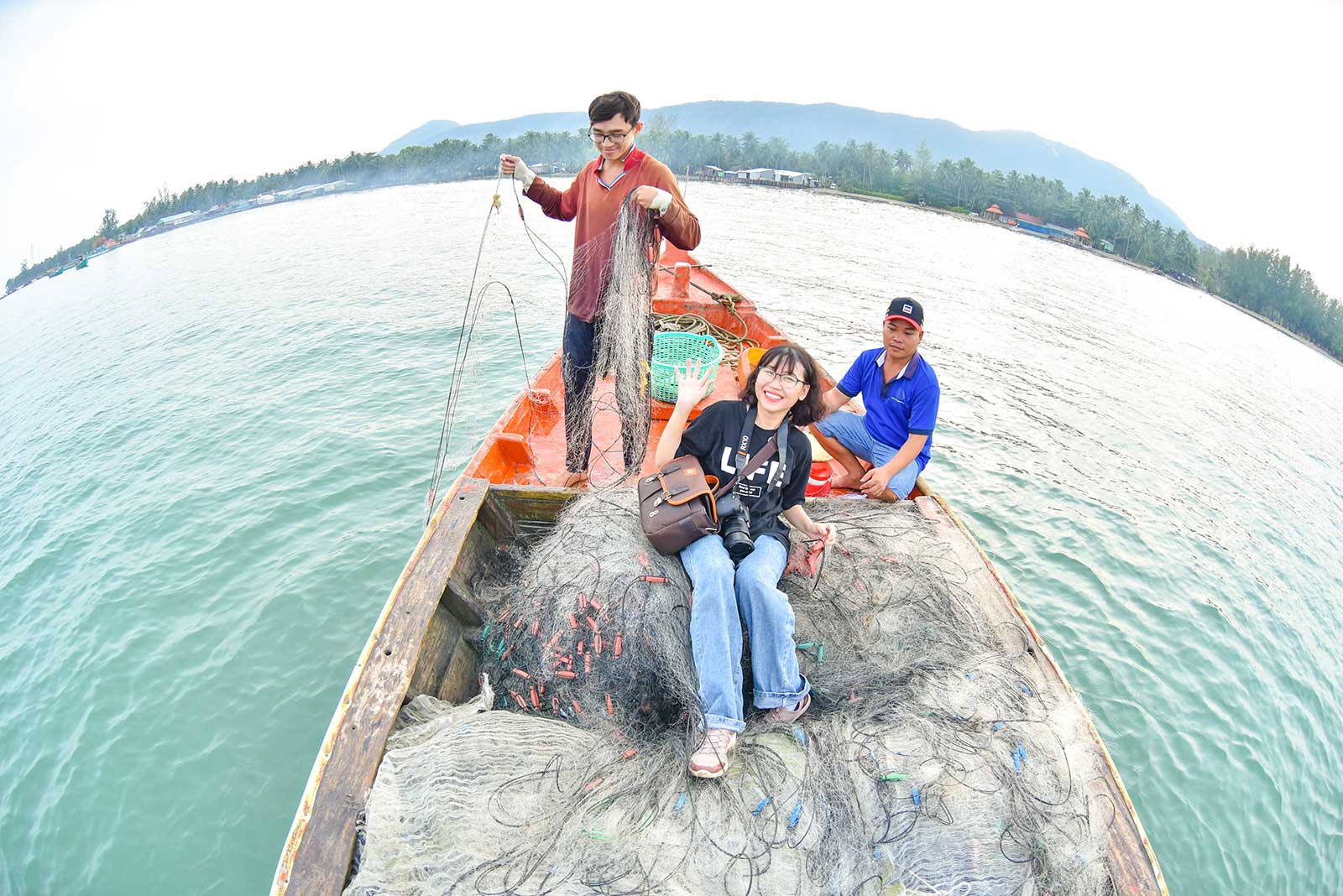
Tourists experience catching crabs with fishermen in the waters off Phu Quoc. Photo: PHAM HIEU
In reality, many community-based tourism models in the province are still spontaneous, copied from one another, lacking distinctive products, and with weak infrastructure. Some places chase after tourist preferences, building accommodation facilities indiscriminately, destroying the natural landscape that is the soul of the community. To develop properly, localities need to study the lives of residents, customs, cuisine, traditional crafts, identify core values, and then preserve and exploit them in the right direction. "Today's tourists want authentic experiences and are willing to pay for quality services. Homestay owners can cooperate with businesses to share benefits. This approach both preserves culture and enhances the quality of tourism," Mr. Thai said.
In Nui Cam commune, community-based tourism is considered a promising direction in the Bay Nui region. Thien Cam Son, also known as the "roof of the Western region," boasts a cool climate year-round, natural streams and lakes, and a rich ecosystem. At the summit stands a statue of Maitreya Buddha over 33 meters tall – a famous pilgrimage site throughout the region. The flood season further enhances its appeal with agricultural and eco-tourism products. However, according to Ms. Nguyen Thi Anh Tu, Chairwoman of the Board of Directors of Alden Travel, to attract high-spending international tourists, homestays here need to meet certain standards: "Foreign tourists like to stay in houses nestled against the mountain, grow their own vegetables, make pancakes, and pick wild herbs. If the service is good, we are ready to bring guests from Chau Doc and Tra Su Melaleuca Forest to Nui Cam."
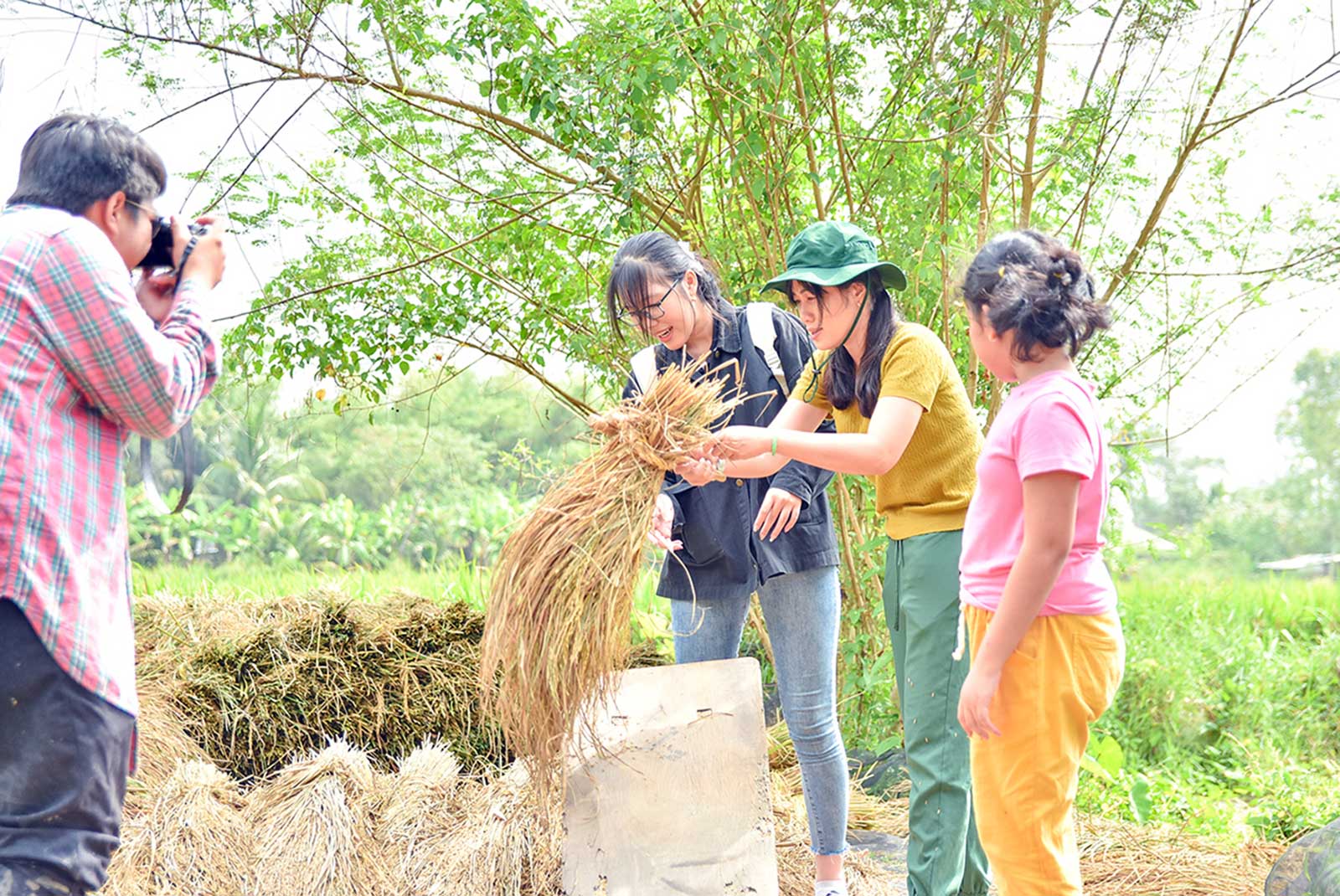
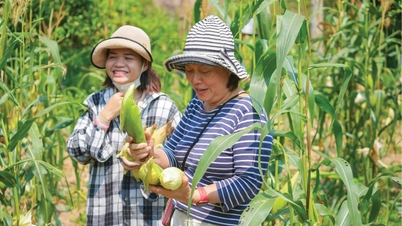
Tourists experience traditional agricultural production activities at Tu Viet Rice Farmstay. Photo: PHAM HIEU
Many experts assert that community-based tourism is only successful when the local people truly take ownership. Tourists come to experience the three aspects of "living together, working together, and eating together," while the locals tell the cultural stories of their homeland. Deputy Director of the Vietnam National Tourism Administration, Nguyen Thi Hoa, believes that a shift in mindset is needed from spontaneous to systematic. All services, from environmental hygiene, landscape, architecture to customs, must be preserved. "The model of weekend rural markets, culinary experience points, or homestays reflecting local identity is proving effective. Standardizing services, regional linkages, digital transformation, and human resource training are necessary for sustainable tourism development," Ms. Hoa stated.
As the afternoon sun slants by, along the road leaving the Cham village in Chau Phong, we saw a few children playing under a stilt house, next to a loom still pulsating rhythmically, the fragrant aroma of curry wafting in the breeze. All these simple things reveal the ethnic identity embedded in the very breath of life.
TU LY - MINH DIEN
Source: https://baoangiang.com.vn/dua-ban-sac-thanh-san-pham-du-lich-a470169.html


![[Photo] Life on both banks of the river returns to its bustling pace on the day the Long Bien Bridge opens to traffic.](https://vphoto.vietnam.vn/thumb/1200x675/vietnam/resource/IMAGE/2026/05/28/1779949763708_cau-long-bien-minh-duy-7-3610-jpg.webp)


![[Photo] The heat at the fireworks display site on the opening night of the Da Nang International Fireworks Festival 2026](https://vphoto.vietnam.vn/thumb/1200x675/vietnam/resource/IMAGE/2026/05/27/1779889741485_ndo_br_z7872039145157-fecaba5112f39e8352544099d7ef4738-5140-jpg.webp)















































































Comment (0)