

The ETH Zurich research team in Switzerland used laser beams to transmit optical data over a distance of 53 km between the mountain peak and the city of Bern.
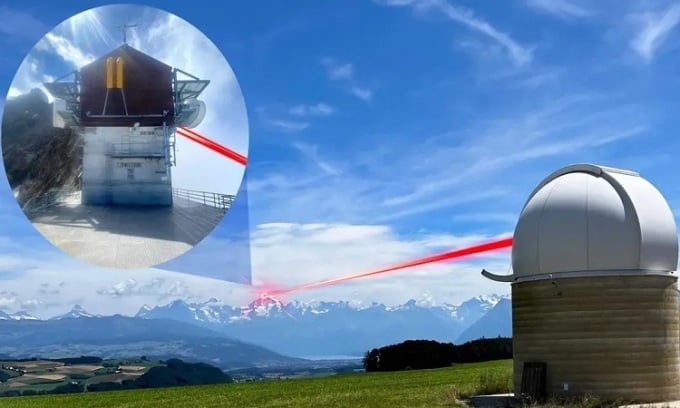
Data transmission experiment using laser beams at ETH Zurich University. Photo: ETH Zurich
Researchers at ETH Zurich, in collaboration with Thales Alenia Space and the French National Aeronautics and Space Research Agency (ONERA), have successfully transmitted optical data through the air using laser technology, Innovation Origins reported on June 22. The experiment, conducted over a distance of 53 km between the Jungfraujoch mountain peak and Bern, Switzerland, faced numerous challenges such as air turbulence and thermal phenomena.
Using a microelectromechanical systems (MEMS) chip with 97 adjustable mirrors, the research team corrected the error and achieved a bandwidth of one terabit per second (equivalent to 1,000 gigabits per second). The system can scale up to 40 terabits per second using standard technology, opening up the possibility of high-speed, cost-effective internet connectivity via near-Earth satellites.
When a laser beam travels through dense air near the ground, it faces numerous factors that affect the movement of light waves and data transmission. The biggest challenge researchers faced was the erratic turbulence of air particles over snow-covered high mountains, the surface of Lake Thun, densely populated metropolitan areas, and the Aare plane, causing errors in transmitted data. Additionally, air flicker caused by thermal phenomena disrupts the uniformity of light movement, which can be observed with the naked eye on hot summer days.
The project partner, ONERA, deployed MEMS to overcome this obstacle. Mirrors correct the phase shift of the laser beam based on the intersecting surface along the slope at a rate of 1,500 times per second.
By overcoming the technical limitations of laser systems, the research team at ETH Zurich was able to transmit more information per unit of time than the radio technology used in satellite internet connections. This new technology has the potential to significantly impact global internet infrastructure, particularly in remote areas. Because the experimental system can easily scale up to 40 channels and transmission speeds of 40 terabits per second, it is a promising alternative to current deep-sea cables.
An Khang (According to Innovation Origins )
Source link
![[Image] Pleasant weather helps students enter the 10th grade entrance exam with confidence.](https://vphoto.vietnam.vn/thumb/1200x675/vietnam/resource/IMAGE/2026/05/29/1780034401612_ngay-1-thi-lop-10-minh-duy-8-5009-jpg.webp)

![[Photo] Ba Lang An Lighthouse - the "eye of the sea" amidst the "rock museum" of Quang Ngai province.](https://vphoto.vietnam.vn/thumb/1200x675/vietnam/resource/IMAGE/2026/05/29/1780038698840_anh-man-hinh-2026-05-29-luc-14-10-42.png)







![[Photo] The heat at the fireworks display site on the opening night of the Da Nang International Fireworks Festival 2026](https://vphoto.vietnam.vn/thumb/402x226/vietnam/resource/IMAGE/2026/05/27/1779889741485_ndo_br_z7872039145157-fecaba5112f39e8352544099d7ef4738-5140-jpg.webp)







![[GALLERY] The million-dollar 007 blockbuster is causing a sensation on Steam, is it worth buying?](https://vphoto.vietnam.vn/thumb/402x226/vietnam/resource/IMAGE/2026/05/29/1780064112088_ta-2-png.webp)
















































































Comment (0)