

Many people are curious about unfamiliar accounts sending friend requests, but they still accept them because of attractive profile pictures and interesting posts that pique their curiosity.
"Pretty girls" befriend them, but end up losing money and getting into trouble.
Viet Hoang ( Hanoi ) had a normal Facebook account, but one day he suddenly received many friend requests from unfamiliar accounts. Most of these were from accounts with catchy names and profile pictures of beautiful, even revealing, girls.
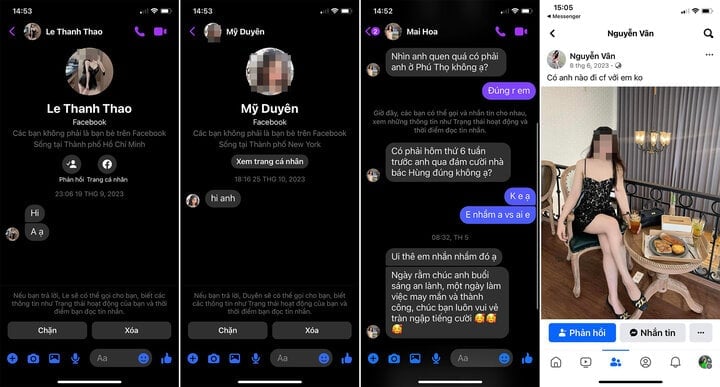
These "trivial" stories are used by fake Facebook accounts to lure victims.
Initially, Hoang said he suspected these accounts were "fake," but after randomly checking some, he found they had many friends, posts, and interactions. So, even though he didn't know who they were in real life, he still accepted their friend requests.
Like Viet Hoang, many Facebook users in Vietnam report occasionally receiving friend requests or very thoughtful messages from unfamiliar accounts using pictures of young, beautiful women. "Suddenly, in the evening, a stranger messages me asking if I'm home yet. After I reply, they chat about other things, like we know each other in real life, even though I don't know who they are, so I'm very wary of exchanging messages," said Tuan Anh, an office worker in Dong Da district, Hanoi.
Not only do scammers approach victims by pretending to have made a mistake, but they also engage in conversation and build trust by striking up a friendship. These accounts typically start conversations with brief greetings like "Hi," "Hello," or send emojis.
After receiving a response from the target, they will ask for probing information such as where they live, then pretend to have met at a specific local event (e.g., a wedding, a birthday party...).
When denied, they will switch to apologizing for a "mistake," thereby diverting the conversation to another topic to prolong the discussion. When encountering "sexy" or pretty account holders who approach and strike up conversations, many victims let their guard down and fall into the sophisticated trap that is set afterward.
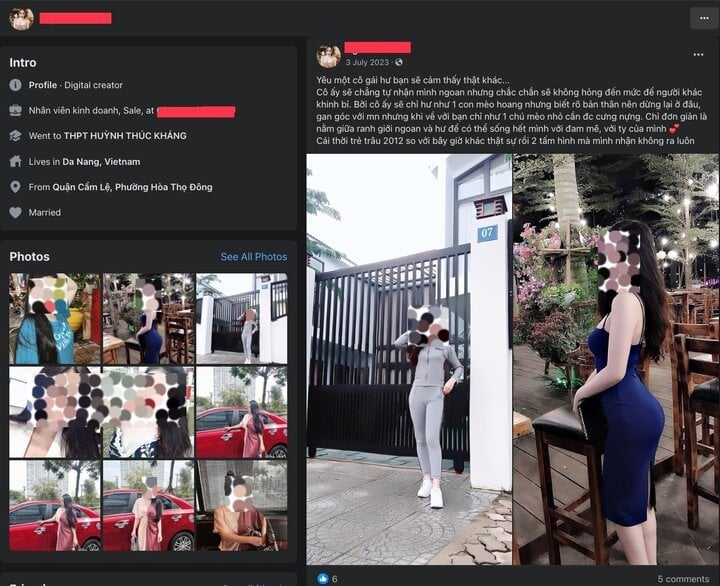
A "fake" Facebook account is created to spam and offer illegal services.
Recently in Da Nang , Chau Hoang Khang used a fake social media account impersonating a beautiful girl in a "single women" group to engage in romantic conversations with men and then trick them into transferring money.
At the police station, Khang confessed that in June he went to Cambodia to work for a company specializing in online fraud (the name and address are unknown). The company gave Khang two Facebook and Zalo accounts under the name Nguyen Thi Kieu Trang to carry out the fraud.
In October 2023, Khang used a fake online profile picture of a beautiful girl named Kieu Trang to befriend Huy in a "single women" group on social media. After a short period of closeness, Kieu Trang confided in Huy about her love life and tried to persuade him to invest in a business. After receiving money from the victim through multiple bank accounts, Khang cut off all contact. Khang was arrested in November 2023.
Individuals like Khang are not uncommon. Authorities have stepped in and continuously conducted investigations and arrested those who impersonate others on Facebook to commit fraud.
Winning sympathy
The most common characteristic of these accounts is the use of "eye-catching" images and elegant-sounding female names. The account owners frequently change their profile pictures, which may be of the same person and are mostly selfies or solo photos; it's rare to see them with other people in the picture.
Their posts are always set to public, but despite having a large number of friends, the interaction rate is extremely low – an unusual characteristic for a real Facebook account. Most comments on these photos are from male accounts praising the person in the photo, liking the post, and sometimes leaving offensive remarks, but none of them receive any response.
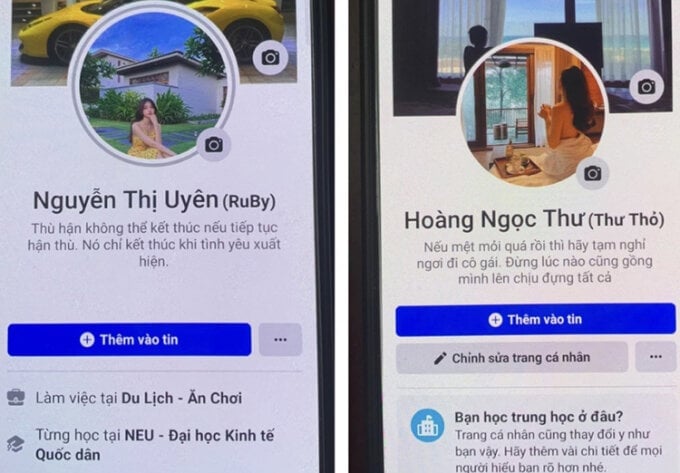
Several fake Facebook accounts were created by Hieu to deceive victims. (Photo: Provided by the police)
For example, Nguyen Van Hieu in Ha Tinh created multiple fake Facebook accounts, using pictures of beautiful women as profile pictures, and befriended and messaged many men. When approaching them, Hieu claimed his family was facing financial difficulties and he needed to borrow money to help. Believing his stories of hardship, two men transferred over 60 million VND and a phone worth over 4 million VND to Hieu. After receiving the money, Hieu cut off contact with the victims, failing to return the money and assets as promised. Hieu was arrested in July 2022 for his actions.
According to a technology expert, these signs indicate that the aforementioned accounts are all "fake," created for a specific purpose such as "bot farming" (automated accounts used to increase interaction, followers, and spam comments with links) or various forms of fraud (impersonating others, building trust to swindle money, or leading people into online scams...).
" Using fake accounts on social media is not a new practice, but with the help of increasingly sophisticated automated tools, they can proactively find and send friend requests to strangers to reach more 'targets,' expanding their reach and opportunities for attack ," the expert analyzed.
According to Mr. Vu Ngoc Son, Director of Technology at the National Cyber Security Corporation (NCS), using fake accounts to make friends is the first step in a series of actions that scammers will carry out. He explained: " Typically, the scammers will try to befriend their 'prey,' and after befriending them, they will lead the victims into fraudulent scenarios such as inviting them to cooperate, invest with huge interest rates, offer easy jobs with high salaries, or even deceive them emotionally ."
The head of security at NCS also agreed that the common method of this scam is for perpetrators to use fake accounts with avatars (profile pictures) depicting beautiful, attractive girls or successful, wealthy businesspeople... to easily gain the affection and trust of victims.
How to recognize scams
The easiest way to identify them is by looking for social media accounts with attractive, seductive profile pictures, no specific "check-in" locations, and no interacting friends. Accounts with few mutual friends should also be carefully investigated before adding them as friends and sharing your thoughts and feelings.
Users should also be wary of accounts from people they have never met or whose information is unclear, whose profile posts are generic and vague, whose activity history is recent, and who lack old posts...
" Besides fake usernames, scammers can also create fake accounts by using names similar to the official accounts of real individuals or organizations, and then reuse their official data such as avatars, images, posts, etc."
"After impersonating someone, the perpetrators will chat with their friends and relatives to ask them to do this or that, but in reality, the ultimate goal is to trick the victims into transferring money to the scammers' pre-prepared accounts ," said Mr. Vu Ngoc Son.
According to experts, to avoid online scams, users need to constantly increase their vigilance, not immediately trust messages or friend requests from others, and verify the information through independent channels such as phone calls or meeting in person if they know the information of the person whose name is on the social media account.
The ultimate goal of online scammers is to steal their victims' money. Therefore, under no circumstances should Facebook users easily transfer money to scammers without first meeting them and establishing a close relationship.
Users should not transfer money or send OTP codes to strangers and should regularly update themselves on online scams to identify and prevent them, as the tricks and schemes of fraudsters are constantly changing and becoming more sophisticated.
Khanh Linh
Source







































































































Comment (0)