

The global commodities market continued to experience mixed trading on May 26th. Selling pressure dominated the agricultural sector, while in the industrial raw materials sector, cocoa prices surged sharply due to concerns about global supply. At closing, the MXV-Index edged down 0.1% to 2,871 points.
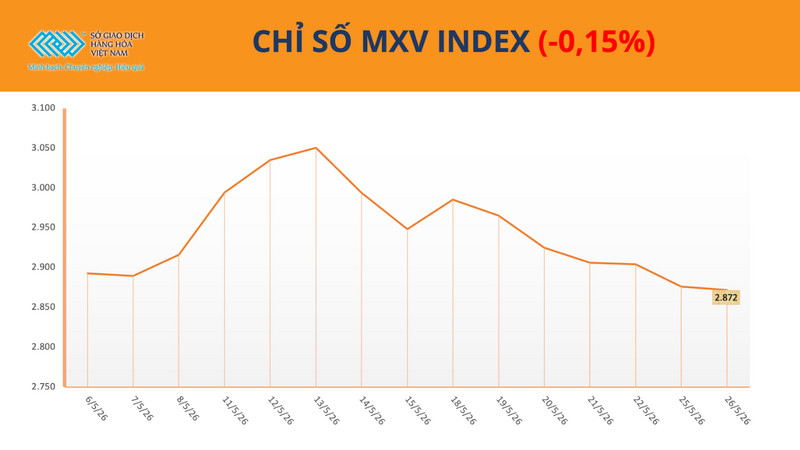
MXV-index
Selling pressure dominated the soybean market.
According to the Vietnam Commodity Exchange (MXV), the global soybean market turned red again yesterday as technical selling pressure and position liquidation by hedge funds intensified on the CBOT exchange.
At the close of trading on May 26, July soybean futures fell nearly 1%, to $435.8 per ton. This development reflects the cautious sentiment of investors amid the prospect of continued global supply surplus, given favorable crop progress in the US and very high supply levels in South America.
Technical pressure is currently a major factor weighing on the market. The decline in July contract prices over the past 6 out of 8 sessions has significantly weakened the short-term uptrend, triggering a strong wave of profit-taking from money managers. The latest Commitment of Traders (COT) report shows that hedge funds have net sold over 7,000 CBOT soybean contracts as of May 19th, bringing the total net long position down to approximately 208,000 contracts.
Furthermore, sluggish export activity continues to put pressure on prices. The USDA's Crop Progress Report forecasts superior planting rates and germination rates for U.S. soybeans under ideal weather conditions. This increases expectations of a bumper crop in the grain belt, leading importers to maintain a wait-and-see attitude and hesitate in making purchases.
Regarding supply, favorable crop prospects in the U.S. continue to bolster expectations of abundant supplies in the new crop year. Favorable weather in the grain belt is helping soybean planting and germination progress faster than the multi-year average, thus increasing expectations of a bumper crop.
The outlook for South American supply also remains very positive. Analysts continue to maintain their forecasts for Brazilian soybean production in the 2025-2026 season at a record 180 million tons, while Argentina's production is expected to remain around 49 million tons. The large supply from this region continues to narrow the upside potential for US soybean prices in the international market.
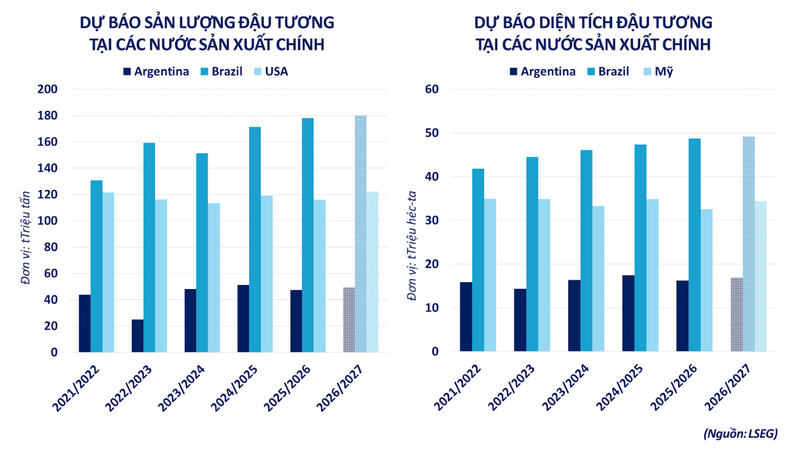
Forecast of soybean production/acreage in major producing countries. Source: MXV
Concerns about West African supply have fueled the cocoa market.
In contrast to the performance of the grain sector, the cocoa market recorded its strongest gain in weeks as weather and logistics risks in West Africa continued to escalate.
At the close of trading, July cocoa futures rose nearly 10%, to $4,169 per ton. The main driver was prolonged heavy rains in Ivory Coast, the world's largest cocoa producer.
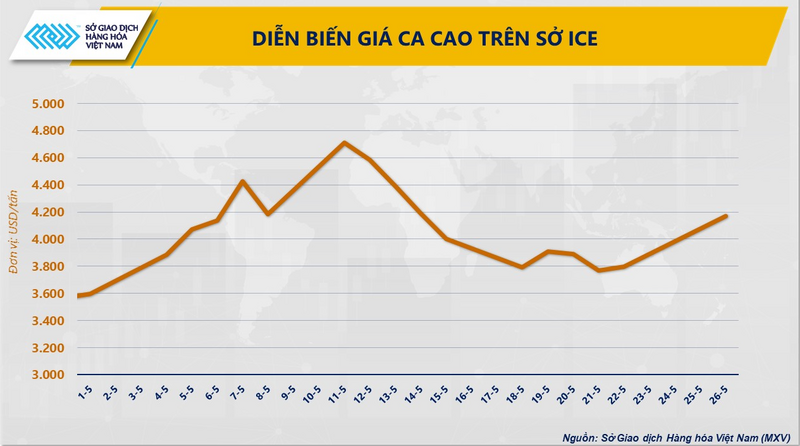
Cocoa price trends on the ICE exchange. Source: MXV
Heavy rains caused widespread flooding and disrupted transportation in many key cocoa-growing areas, raising concerns about future harvest and export prospects. This development prompted hedge funds to intensify short-covering activities following a period of earlier short selling.
In the long term, the cocoa market continues to receive support from increasing climate risks in West Africa. According to the US National Oceanic and Atmospheric Administration (NOAA), the probability of El Niño forming between May and July is as high as 82%, with about a 67% chance of developing into a "Super El Niño". This significantly increases the risk of prolonged drought and reduced yields in key cocoa-growing regions.
In addition to weather factors, geopolitical tensions in the Middle East are also increasing cost pressures on the global agricultural supply chain. Disruptions in transportation and escalating energy costs are causing fertilizer prices to rise sharply, directly impacting farming operations in Ivory Coast and Ghana.
On the demand side, the market continues to show relatively positive signs. Financial reports from major confectionery companies like Hershey and Mondelez have exceeded expectations, indicating that chocolate consumption remains stable despite high prices. However, data from Circana also shows that chocolate sales in North America over the past 13 weeks have slightly decreased by 1.3% year-on-year, reflecting consumer purchasing power beginning to feel pressure from inflation.
Source: https://congthuong.vn/gia-dau-tuong-the-gioi-quay-tro-lai-sac-do-458424.html

![[Photo] Delegation attending the 14th Congress of the Vietnam Trade Union visits the Mausoleum of President Ho Chi Minh.](https://vphoto.vietnam.vn/thumb/1200x675/vietnam/resource/IMAGE/2026/06/03/1780451842301_ndo_br_img-3824-jpg.webp)





































































































Comment (0)