

- The goal is to achieve a profit margin of over 30% in summer-autumn rice production.
- Solutions for protecting summer-autumn rice crops.
According to farmers, the damage to the summer-autumn rice crop this year is more severe than in previous years. Although farmers proactively cleaned their fields, used rat poison, and implemented other preventative measures before planting, their rice fields are still being damaged by rats to a considerable extent.
Mr. Tran Huu Thien, from Lung Ba hamlet, Khanh Binh commune, said: “Right after the first rains of the season, we farmers weeded and placed poison bait on the edges of the fields to kill rats. However, after planting, rats appeared and caused quite a lot of damage, especially in areas near the edges or gardens. We had to build shelters and place the poison bait inside to prevent it from being washed away by the rain, wasting our efforts.”
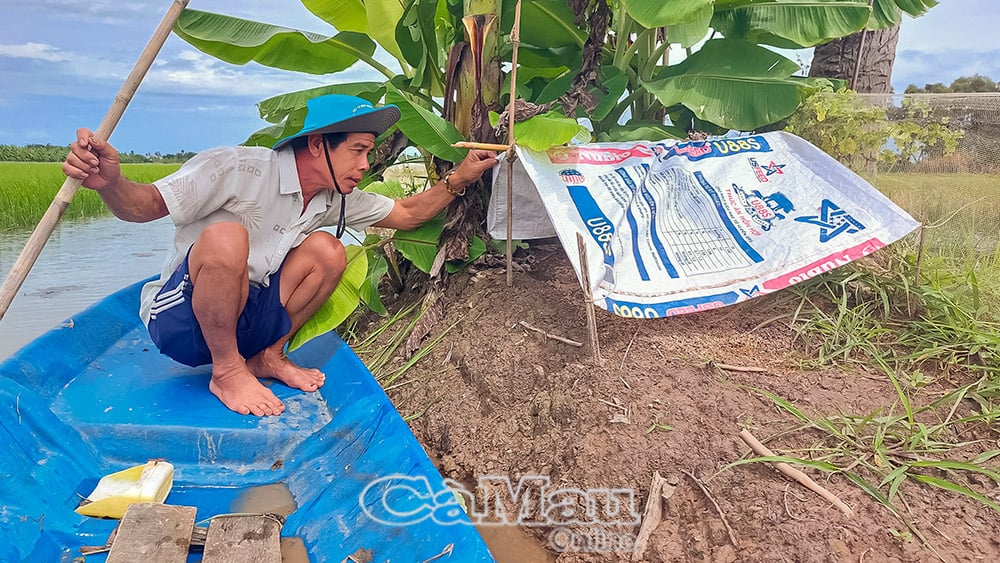
This situation was also observed in Tran Van Thoi commune. Mr. Nguyen Van Mau, from Rach Ruong C hamlet, Tran Van Thoi commune, complained: “This year, there are a lot of rats. When the rice plants are only about a handspan tall, they start being gnawed, causing about 30-40% damage. I have to constantly replant, but even now, when the rice is two months old and forming panicles, the rats continue to destroy and gnaw all over the field. With this situation, the yield will certainly decrease.”
Faced with the increasingly complex problem of rat damage, some households have purchased netting or rubber to fence around their fields. Although this measure is only partially effective, it has increased production costs and consumed a lot of time and effort from farmers in caring for and protecting their crops.
Mr. Nguyen Cao Chien, from Rach Ruong C hamlet, Tran Van Thoi commune, added: “Right from the beginning of this summer-autumn rice crop, I bought pesticides and applied them regularly, but the rats still damaged the crops. It's not just me; everyone here is experiencing the same thing. Some households, after planting, had their crops completely destroyed by rats and had to plow the land again to sow a second time. Now, we don't know how to effectively control the rats. Farmers only rely on two rice crops each year, and with this situation, we're sure to face difficulties.”
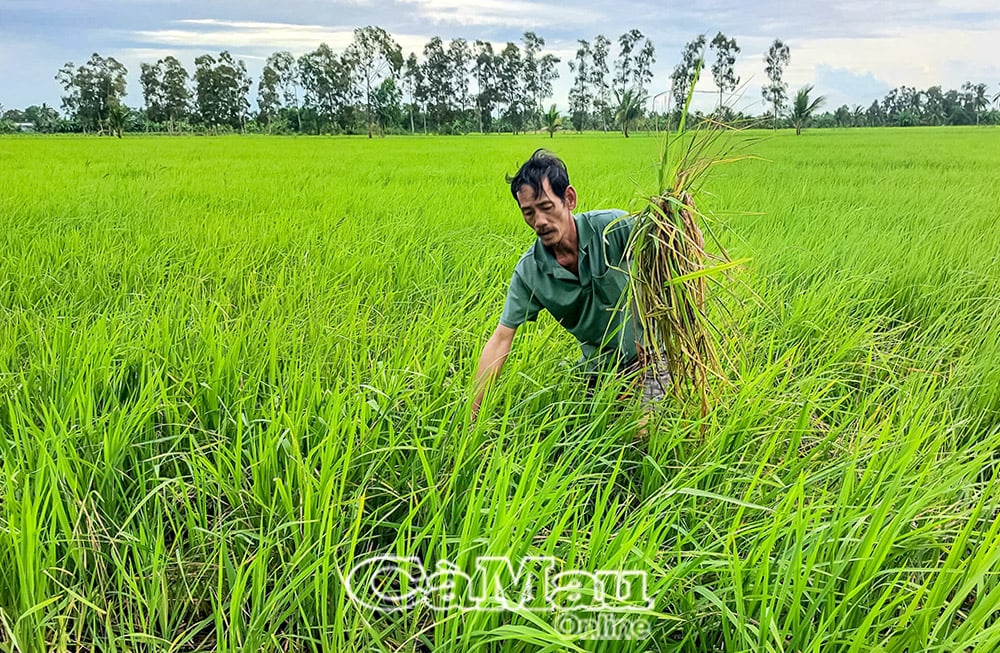
Currently, many of the farmers' summer-autumn rice crops are in the heading and flowering stage. If the damage caused by rats is not controlled, it will affect the yield and quality of the rice crop at harvest.
Therefore, people need to raise awareness of protecting rice crops, proactively clean their fields, implement comprehensive rodent control measures, and regularly inspect their fields to promptly detect and address problems. Above all, farmers need to cooperate with local authorities to implement effective rodent control measures to protect their rice crops from potential damage.
British
Source: https://baocamau.vn/gia-tang-tinh-trang-chuot-can-pha-lua-he-thu-a40025.html

![[Photo] Da Nang: Over 38,000 people "painted the streets red" during the Olympic Run for National Security.](https://vphoto.vietnam.vn/thumb/1200x675/vietnam/resource/IMAGE/2026/03/22/1774148860624_ndo_br_chay-15-jpg.webp)


























































































Comment (0)