

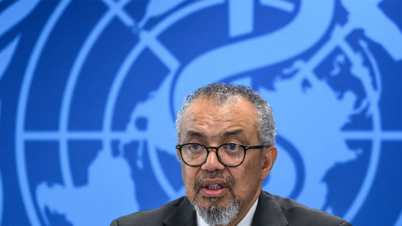
On May 19, the Director-General of the World Health Organization (WHO), Tedros Adhanom Ghebreyesus, expressed deep concern about the "scale and speed" of the Ebola outbreak in eastern Democratic Republic of Congo and Uganda. He warned that the disease risks spreading due to the increasing number of infections in urban areas, deaths among healthcare workers, and large-scale migration driven by conflict.
According to Tedros, more than 130 people have died from suspected illnesses and over 540 cases of Ebola have been recorded in these areas. The WHO head emphasized that this is the first time the agency has declared an international public health emergency immediately before convening the Emergency Committee.
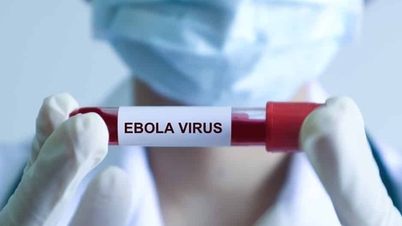
This Ebola outbreak, caused by the Bundibugyo strain, is unfolding in an extremely complex manner, with affected countries facing armed conflict, massive migration waves, and a severely weakened healthcare system.
According to health officials in the Democratic Republic of Congo, the officially reported figures do not fully reflect the reality, and the actual number of infections could be much higher. Notably, a predictive model from the MRC Centre for Global Infectious Disease Analysis at Imperial College London (UK) suggests that the total number of cases could potentially exceed 1,000.
According to Dr. Anne Ancia, WHO representative in the Democratic Republic of Congo, the outbreak originated in Ituri province and quickly spread to North Kivu and several urban areas such as Bunia and Goma, and even appeared in Kampala, Uganda.
Speaking from Bunia, Ms. Ancia said health authorities hope to bring the situation under control within the next few months, but did not rule out the possibility that the epidemic could be prolonged like the previous outbreak in the same region, which took two years to completely eradicate.
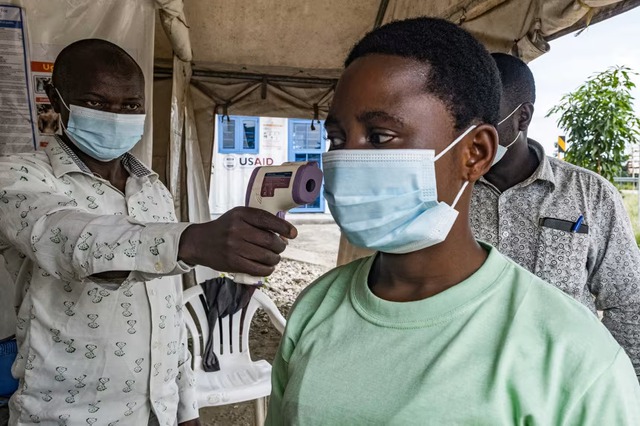
Medical personnel at the Busunga border crossing between Uganda and the Democratic Republic of Congo check the temperature of a traveler from Bundibugyo. Photo: Badru Katumba/Getty Images
One of the reasons the epidemic has become so serious is the delay in detection. Although the first death was recorded on April 24th, the exact cause of death, Ebola virus, was not identified until mid-May.
This delay stemmed from the fact that initial tests focused only on the more common Zaire strain, resulting in negative results. Additionally, the failure of many people to take protective measures when burying loved ones also contributed to the rapid spread of the disease.
The situation is becoming even more alarming as no vaccine or specific treatment for the Bundibugyo strain has yet been approved. The risk of a widespread outbreak is increasing due to the continuous appearance of infections among healthcare workers, combined with the movement of hundreds of thousands of refugees due to armed conflict.
Given this critical situation, the WHO has officially declared it an international public health emergency and urgently called for assistance in terms of protective equipment, testing kits, and personnel.
In response to the call, the US deployed a disaster response team to the region and transported an infected American citizen, Dr. Peter Stafford, to Germany for treatment.
In surrounding areas, many countries neighboring Uganda and the Democratic Republic of Congo have proactively tightened border controls. However, the Africa Centres for Disease Control and Prevention (CDC Africa) has spoken out against widespread travel restrictions, fearing that such measures could negatively impact transparency and international cooperation.
Right on the ground, organizations like Doctors Without Borders and UNICEF are working tirelessly to set up treatment centers and distribute disinfectants and clean water to the people.
However, they still face enormous challenges due to staffing shortages, poor infrastructure, and access to remote areas hampered by conflict.
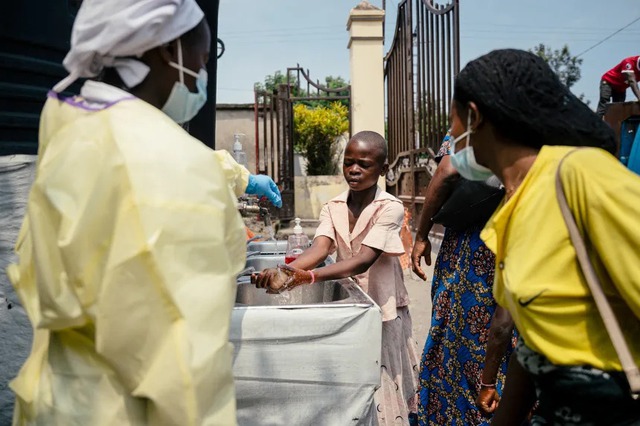
A young girl washes her hands at a hygiene and temperature check point at Kyeshero Hospital in Goma, Democratic Republic of Congo. Photo: Jospin Mwisha/Getty Images
Epidemiologists warn that this is truly a "race against time," as each passing day could increase the number of infections amidst epidemiological data being obscured by a "fog of war."
Currently, the WHO and its partners are accelerating research into vaccines and monoclonal antibody therapies, while also strengthening contact tracing and surveillance. However, experts are once again emphasizing that only drastic public health measures can effectively prevent further spread of the disease in a region already severely damaged by war and shortages.
Source: https://suckhoedoisong.vn/giam-director-who-lo-ngai-dich-ebola-co-the-lan-rong-169260520124311607.htm



![[Podcast] World News May 26: Details of US-Iran negotiations in Qatar revealed.](https://vphoto.vietnam.vn/thumb/402x226/vietnam/resource/IMAGE/2026/05/26/1779786517798_khung-thumbnail-tham-khao-tu-mau-cu-500-x-500-px-900-x-600-px-5.jpeg)







































































Comment (0)