

Floating on the river
At dawn, Mr. Nguyen Van Hanh (Bay Hanh, 64 years old, residing near Binh Thuy islet) started his motorboat and headed out onto the Hau River to cast his nets for anchovies. This season, the river water turns murky, signaling the approaching flood season. This is the time when anchovies are quite abundant, swimming freely on the surface, making it easy for fishermen to cast their nets and harvest a large quantity. Having years of experience in the fishing trade, Mr. Bay Hanh can tell at a glance when anchovies will appear, whether in large or small numbers. "This species mainly lives in the surface layer, feeding on plankton, so they're very easy to catch," Mr. Bay Hanh said.
According to folk wisdom, when the tide is about to recede, schools of fish swim on the surface of the water searching for food. Taking advantage of this time, many people in the riverside villages paddle their boats out to the river to cast their nets. Depending on the tide, which is not fixed at night or day, fishermen take advantage of the opportunity to catch fish in the river. Every morning, Mr. Bay Hanh harvests 30kg of anchovies. This species of fish is abundant for about 6 months of the year. When the floodwaters rise strongly, turning the water red with silt, Mr. Bay Hanh temporarily puts aside his oars and rests for a few months, then continues to go out to the river to cast his nets and harvest anchovies.

Fishermen prepare to go out into the river to cast their nets for anchovies.
Working tirelessly on the river, fishermen toil away, casting their nets with great difficulty, hoping to earn money to support their families. Time flies, the anchovy fishing season gradually passes, and people switch to other professions to make a living. Mr. Bay Hanh said that around the seventh lunar month, the floodwaters flow strongly, and fishermen stop casting their nets for anchovies. At this time, the fish swim downstream, and people temporarily stop fishing for a few months. Some people go to work as laborers to earn extra income. "I have about a month left before I stop casting my anchovy nets. In the ninth lunar month, there will be more anchovies," Mr. Bay Hanh said.
Sitting by the Hau River, reminiscing about the days when there was an abundance of fish, Mr. Bay Hanh sighed regretfully. In the past, people ate mostly large fish; the tiny anchovies were rarely eaten. When there was an oversupply, people fermented them into fish sauce, dried them, and ate them year-round. Mr. Bay Hanh used to be one of the "masters" specializing in catching large fish with nets on the Hau River section where it intersects with the Vam Nao River. He recounted that this stretch of river was teeming with fish and shrimp. Every day, he would cast his nets and catch large fish like snakehead, toadfish, catfish, and giant catfish... "Back then, there were countless large fish in this section of the river. Every night, I would catch dozens of kilograms of fish – it was normal. People wouldn't even bother eating the anchovies," Mr. Bay Hanh chuckled.
Anchovy specialty
We wandered around the sandbank village and saw people carrying basins of fish ashore, spreading anchovies out to dry on mesh mats. Looking at the white, glistening anchovies under the sun, we could sense the freshness and deliciousness of this dried fish. Turning each fish over, Mr. Vu (57 years old) said that currently, anchovies are in high demand from buyers. Fresh anchovies cost 20,000 VND per kilogram, while dried anchovies cost 150,000 VND per kilogram. Currently, dried anchovies are considered a specialty, and small traders buy and sell them in the eastern provinces, such as Binh Duong , Dong Nai, or Ho Chi Minh City.
Every day, in this sandbank village, more than 20 boats specialize in casting nets for anchovies, with each person catching an average of about 30kg. In the morning, traders come here to buy about 1 ton of anchovies, which they then dry and sell throughout the region. Currently, dried anchovies are processed into many attractive dishes, such as: braised, fried, and steamed. "Some mung bean porridge or pandan leaf porridge restaurants prepare braised dried anchovies, which are very delicious," Mr. Vu said. This type of dried anchovy is unique, easy to eat, and has a sweet aftertaste, as if infused with the alluvial soil of the Mekong Delta, a quality found nowhere else.
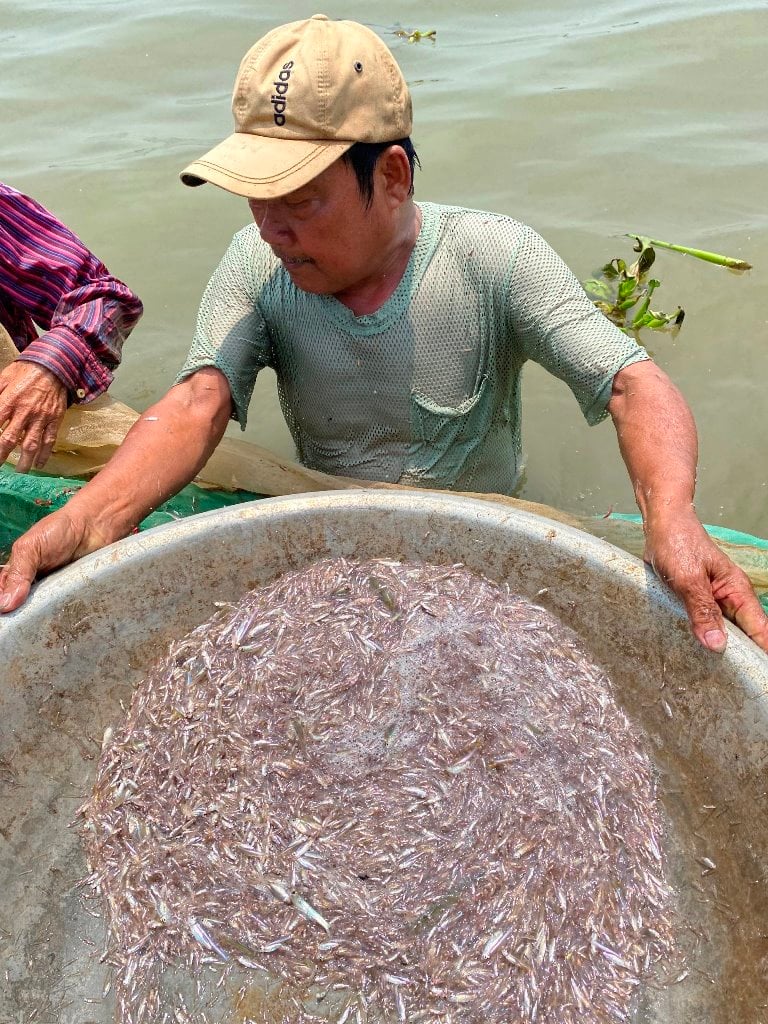
Anchovies and scad are caught by fishermen on the Hau River.
Thanks to the abundant anchovy resources, the households in Binh Thuy islet have a stable income from anchovy fishing. On average, each boat earns over 500,000 VND per day after deducting all expenses. Mr. Vu said that if you visit Binh Thuy islet early in the morning, you will see many boats casting nets to catch anchovies floating on the river. After a few hours, the fishermen bring their nets ashore to remove the fish, creating a lively scene. Anchovy fishing depends on the weather. On sunny days, there are many anchovies swimming in the surface layer of the water. After removing the anchovies from the nets, the fishermen dry them or sell them fresh to traders.
On the riverbanks, fishermen also use nylon nets to encircle an area to catch anchovies. This method of fishing is commonly known as anchovy net fishing, or simply anchovy net fishing. These fish are sold by traders at the market for between 40,000 and 50,000 VND per kilogram. Anchovies are mainly used in braising or deep-frying, both of which are delicious. According to experienced fishermen, areas with anchovies or anchovies indicate clean water. In the Hau River, anchovy resources are still abundant, providing income for rural residents. "Thanks to anchovy net fishing, I have money to cover my daily living expenses. Each riverbank is a refuge for anchovies," said Mr. Tam Phat, who specializes in anchovy net fishing on the Hau River.
Anchovy fishing is considered a lowly occupation. As the years pass, they live by the river, silently catching fish to make a living, following the rhythm of time.
Source: https://baoangiang.com.vn/giang-luoi-ca-com-tren-dong-song-hau-a422492.html

![[Image] Central Party Office summarizes work in 2025](/_next/image?url=https%3A%2F%2Fvphoto.vietnam.vn%2Fthumb%2F1200x675%2Fvietnam%2Fresource%2FIMAGE%2F2025%2F12%2F18%2F1766065572073_vptw-hoi-nghi-tong-ket-89-1204-jpg.webp&w=3840&q=75)

































































Comment (0)