

When rewards become lessons
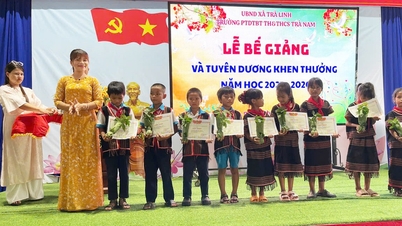
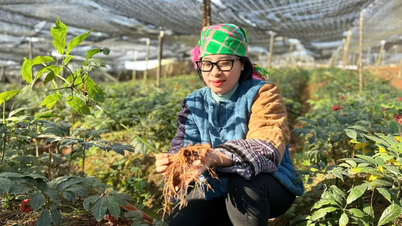
The closing ceremony of the school year at a highland school in Tra Linh commune, Da Nang city, left many emotions. Instead of familiar gifts like notebooks, pens, or cash, many students with good academic performance were given Ngoc Linh ginseng seedlings by the school.
At first glance, it seems like just a unique gift, but looking deeper, the story raises a thought-provoking question: "Should education begin with livelihoods?"
The image of dark-skinned, bright-eyed children from the highlands, shy yet proud, clutching small mounds of soil containing delicate seedlings, evokes a special feeling. It's not just a gift honoring their efforts; more importantly, the teachers are giving their students a tiny, compact "startup" project right on their graduation day.
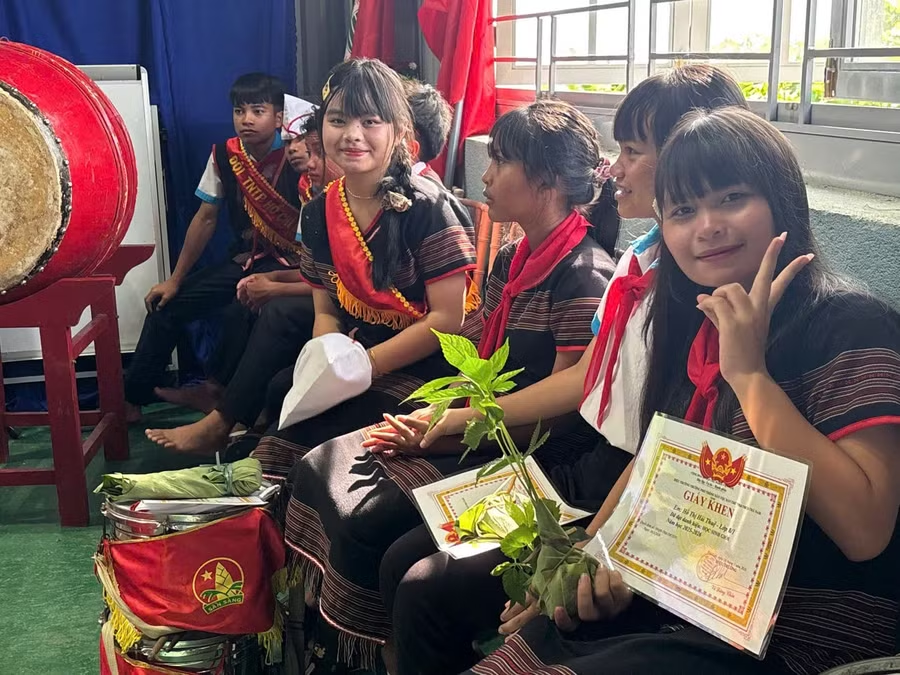
For many years, when discussing education, we have often emphasized knowledge, skills, qualities, and abilities. These are all core values; however, a less frequently mentioned reality is that for many students and parents in disadvantaged areas, the first question is "Why study?" and "Will studying improve the family's life?".
Many students in remote, disadvantaged areas still face economic pressure from a very young age. They witness their parents working in the fields year-round, with unstable incomes and lives heavily dependent on the weather and the market.
In that context, maintaining long-term motivation for learning is not easy. Advice about a bright future sometimes seems far-fetched if learners don't see a concrete connection between going to school today and their lives tomorrow.
Therefore, giving Ngoc Linh ginseng seedlings to students is not only a reward, but also carries another message: learning can be linked to their own economic future.
A well-cared-for ginseng plant can grow over the years. The value of ginseng lies not in the moment it is received, but in the process of accumulation. From a small gift, students can learn about hard work, responsibility, perseverance, and the value of investing in the future. This is a lesson that textbooks often struggle to convey so visually.
Connecting knowledge with local livelihoods.
This story perhaps prompts us to take a broader view of the relationship between education and livelihoods.
For decades, education has often been seen as the path out of poverty. While this is entirely true, in many places, education and livelihoods are being pursued as two separate areas.
Schools teach knowledge, while the task of earning a living is left to the family and society.
This separation sometimes creates a gap between what students learn and what they experience in real life.
A student in a mountainous region may excel at learning about forest resources, but they rarely receive systematic guidance on developing sustainable livelihoods from those local resources.
A student from a coastal area may be able to memorize geographical knowledge but has never had access to modern models of the maritime economy.
A rural student may learn about science and technology, but has few opportunities to see that technology applied directly in their hometown's fields.
When education is not connected to real life, learners easily find the knowledge alien. Conversely, when learning is linked to specific local issues, knowledge becomes more relatable and meaningful.
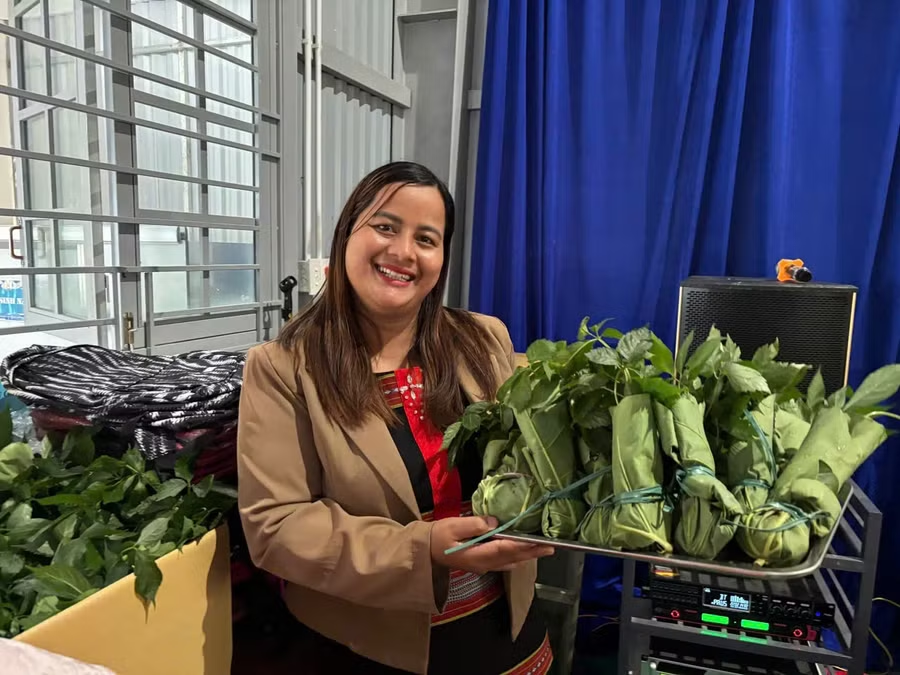
From the perspective of the 2018 General Education Program, the teachers' act of giving ginseng seedlings to students is essentially a highly educational approach that aligns with current reform directions.
The new program not only aims at imparting knowledge but also emphasizes the development of qualities and competencies, enhances practical experience, and provides career guidance for students.
Therefore, giving away a ginseng root is not simply an end-of-year reward, but becomes a "life lesson" that helps the children understand the value of labor, recognize the potential of their own homeland, and begin to form career-oriented thinking and envision their future career development path.
However, education should not shy away from the issue of livelihoods.
A modern education needs to help learners understand that knowledge can create value for the community, for their homeland, and for their own lives. When students realize that knowledge can solve real-world problems, their motivation to learn will become much more sustainable than mere slogans.
In fact, many developed countries have built educational models that are closely linked to the local ecosystem. Students participate in practical projects, learn about the characteristic industries of their region, engage in entrepreneurship, innovation, or the conservation of indigenous resources. The goal is to help them understand that knowledge always has the potential to create value in the real world.
A seed for the future
Giving a ginseng root to a student is not like giving a book to read and then close; it requires a series of highly practical, follow-up actions.
The recipients of the award have now inadvertently become the "managers" of a valuable sapling. They can't just put it aside like a stack of notebooks; they must learn: Does this plant prefer sun or shade? How much water is enough? Is the soil on their hillside suitable? How can they protect the ginseng from root rot when the rainy season arrives?
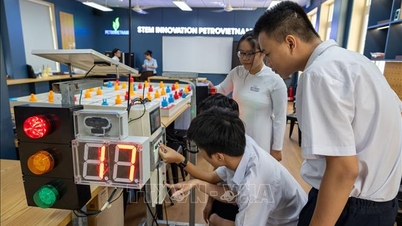
The process of answering those questions is a vibrant and original form of STEM (Science, Technology, Engineering, and Mathematics) education.
We often advocate for educational reform, introducing STEM into schools with expensive robot models or air-conditioned labs in urban areas, but for children in mountainous regions, STEM is sometimes simply applying knowledge of biology, climatology, and soil science to help a local plant survive and thrive in their homeland.
In Vietnam, each locality possesses its own unique resources. These could include high-tech agriculture, community tourism, marine economy, processing industry, digital economy, or local specialty products.
If schools know how to integrate these resources into educational activities, students will have more opportunities to explore the potential of their homeland and gain a clearer understanding of their own development paths.
What is admirable about the story in Tra Linh is how a school in a remote area found a way to turn the act of rewarding students into a lesson about the future.
Instead of giving a gift to be used for a few days, teachers give an opportunity to nurture for many years.
Instead of simply acknowledging past achievements, the teachers expressed their belief in the potential for future successes.
And instead of telling students, "Study to change your life," the teachers at Tra Nam Ethnic Boarding Primary and Secondary School (Tra Linh commune, Da Nang city) chose a more concrete way of expressing it: study, take care of this ginseng plant, watch it grow day by day to understand that all values require time to cultivate.
Ultimately, the highest goal of education is not only to help people gain more knowledge, but also to enable learners to build a better life for themselves, their families, and their communities.
And sometimes, that journey can begin with a small ginseng plant in the high mountains. The event of donating Ngoc Linh ginseng plants to students during the closing ceremony in Tra Linh commune is a beautiful brushstroke that paints a truly vibrant and creative picture of education.
Source: https://giaoducthoidai.vn/giao-duc-gan-lien-voi-sinh-ke-dia-phuong-post780256.html
![[Photo] General Secretary and President To Lam presides over a meeting with the Central Organizing Committee.](https://vphoto.vietnam.vn/thumb/1200x675/vietnam/resource/IMAGE/2026/06/03/1780482764658_a1-bnd-4741-3342-jpg.webp)
![[Photo] First session of the 14th Congress of the Vietnam Trade Union](https://vphoto.vietnam.vn/thumb/1200x675/vietnam/resource/IMAGE/2026/06/03/1780465947883_ndo_br_img-3852-jpg.webp)
![[Photo] Secretary of the National Assembly Party Committee, Chairman of the National Assembly presides over the meeting of the Standing Committee and Executive Committee of the National Assembly Party Committee.](https://vphoto.vietnam.vn/thumb/1200x675/vietnam/resource/IMAGE/2026/06/03/1780480353201_ndo_br_bnd-2585-jpg.webp)



































![[Video] Sunset at Lap An Lagoon – Where the sun sets over the fishing nets](https://vphoto.vietnam.vn/thumb/1200x675/vietnam/resource/IMAGE/2026/05/31/1780192137701_beach-landscape-sea-water-nature-grass-745871-pxhere-com.jpeg)























Comment (0)