

In January 2025, among the 50 winning projects in the provincial science and technology research competition for junior and senior high school students in the 2024-2025 school year, there was one project that won the only third prize in the field of animals, titled: "Research and understanding of the biodiversity value of Ha Long Bay through some animal species belonging to the class Gastropoda and the class Bivalvia of the phylum Mollusca " supervised by teacher Nguyen Tuan Nghia. Despite serving as the Vice Principal of Ha Long Specialized High School, during his limited teaching hours, Mr. Nghia allows his students to admire the vast world of Ha Long Bay's rich endemic flora and fauna through his own photographs and research data: “There are many species of shellfish found in the market, but there are also many species not found there. Although they may not have high economic value, they are of special value to scientists. They are a link in the food chain of the ecosystem,” Mr. Nghia confided. And so, after months of research, photography, touching the creatures, studying relevant documents from around the world and Vietnam, comparing and classifying, Mr. Nghia and his colleagues have added 12 species to the list of benthic animals in Ha Long Bay.

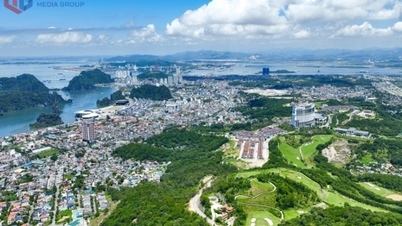
With its vast core area, Ha Long Bay is currently home to more than 2,900 species of terrestrial and aquatic plants and animals. Among them are dozens of extremely rare endemic species – meaning they only exist on the limestone islands here and cannot be found anywhere else in the world . Typical examples include: Ha Long gecko, Ha Long cave crab, cave fish, snipe shrimp, Ha Long Acanthopanax, Ha Long palm, and Ha Long fig… Participating in one of the four field trips exploring Ha Long Bay organized by Mr. Tuan Nghia, Nguyen Ngoc Anh Duong, a 10th-grade history student, was amazed: "I saw many benthic animals as well as many rare white-bellied sandpiper species on the cliffs of Ha Long Bay. For me, this was a wonderful, one-of-a-kind experience."
Beneath the rocky mountains, the turquoise waters of Ha Long Bay's coral reefs and mangrove forests serve as natural "nursery gardens," providing habitats and breeding grounds for hundreds of economically valuable marine species. This rich biodiversity not only enhances the scientific value of the heritage but also directly supports the sustainable livelihoods of local fishing communities.

However, the explosive growth of the tourism industry, rapid urbanization, and aquaculture and fishing activities have been putting the bay's ecosystem to the test, putting Ha Long Bay's carrying capacity to the extreme.
Recognizing the vital importance of protecting the heritage environment, the Ha Long Bay - Yen Tu World Heritage Management Board, together with the Quang Ninh provincial government, is working tirelessly to preserve the green landscape of the heritage site and conserve the existing biodiversity values of this wondrous bay. This is a long-term journey requiring perseverance and unity, as well as the active participation of tourism businesses and local fishing communities. Shifting from a "exploitation-driven" mindset to "responsible tourism" and "sustainable fishing" is key to biodiversity conservation and development.
According to the plan, Quang Ninh province has 7 nature reserves. Currently, the system of nature reserves continues to be improved, upgraded, and expanded; in which 4 nature reserves and natural heritage sites, namely Yen Tu National Forest, Dong Son - Ky Thuong, Bai Tu Long, and Ha Long Bay, have been established and continue to be effectively conserved.
The province has also identified three ecological corridors: mountainous, coastal, and marine. From there, further research will be conducted on biodiversity corridors to enhance connectivity, stabilize climate change-adaptive habitats, and conserve and sustainably develop biodiversity resources.
Source: https://baoquangninh.vn/vi-mau-xanh-di-san-3408199.html



![[Image] Close-up view of the interchange connecting the two expressways and Long Thanh Airport.](https://vphoto.vietnam.vn/thumb/1200x675/vietnam/resource/IMAGE/2026/05/25/1779703378210_ndo_br_z7863716673926-224453a31600126cce10622af6290afd-4549-jpg.webp)
![[Image] Hanoi's urban life under the challenge of a "scorching hot" environment](https://vphoto.vietnam.vn/thumb/1200x675/vietnam/resource/IMAGE/2026/05/25/1779706979265_nang-nong-t5-2026-minh-duy-7-4636-jpg.webp)












































































Comment (0)