

 |
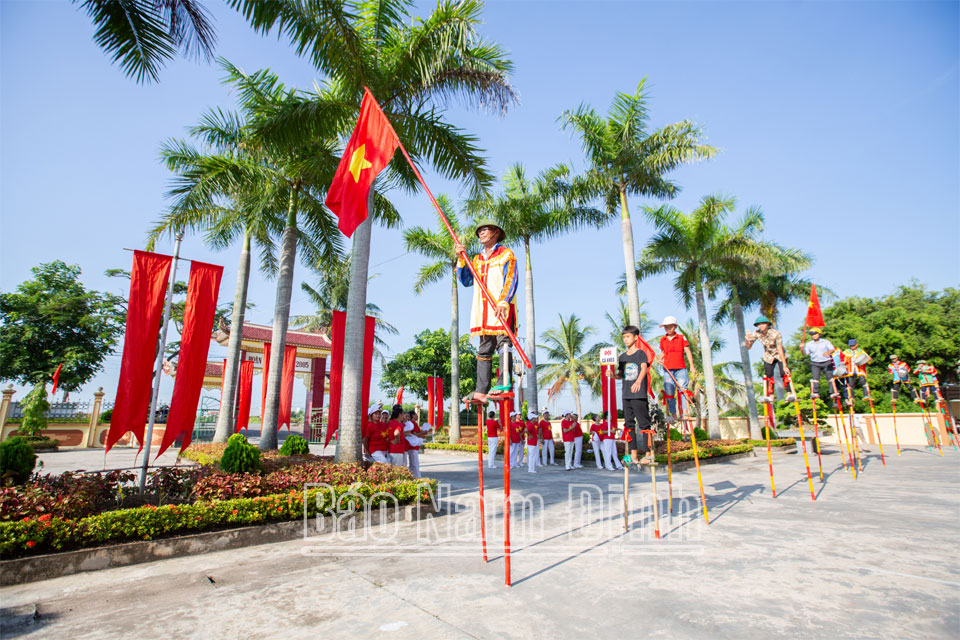
| Stilt walking performance at the Traditional Culture and Sports Festival of Hai Hau District. |
According to veteran fishermen, in the days before modern fishing equipment was available, stilts were an essential tool, helping fishermen venture further out into the vast tidal flats. On their elevated legs, made of bamboo or wood, fishermen could easily wade through deep water to pull in their nets, cast their traps, and catch fish. Each step demonstrated skill and intense concentration to maintain balance. As life changed, stilts became less common in the fishing industry but were preserved as a unique form of folk culture. From social gatherings and recreational activities after work, people began combining stilt walking with performances such as lion dances, drumming, wrestling, and stick dancing. The art of stilt walking was born and quickly became a distinctive highlight in coastal festivals.
Stilt walking has long been an integral part of the major cultural activities of Quat Lam town (Giao Thuy district). According to local residents, the art of stilt walking performance originated in the 1960s. After a period of interruption, in 2006, a group of passionate artisans revived the movement and established a stilt walking club. In 2016, the People's Committee of the town officially established the Lam Tho residential area stilt walking club. With favorable conditions for operation, the club has developed steadily and become increasingly professional. The club currently has 15 members aged 30 to 50, many of whom have been involved since its inception. Members regularly practice and actively create new performances to serve at various events inside and outside the district. Typical performances include fan dance, stick dance, lion dance, martial arts dance, drumming, etc. The skill and creativity in the performances have helped Quat Lam stilt walking become a prominent cultural "brand" of the Giao Thuy coastal region.
In Phuc Thang commune (Nghia Hung district), the local stilt-walking team has nearly 30 members and stands out with its rich and captivating performance style. Stilt walking here is a part of the childhood memories of many generations. Children from the age of seven or eight begin learning to walk on stilts under the guidance of their fathers and uncles. Movements from basic to advanced, such as leg curling, hopping, wrestling, and lion dance, are all taught systematically. Thanks to continuous preservation and innovation, the Phuc Thang stilt-walking team has developed many unique performances such as stick fighting, wrestling, net casting, and fishing with nets. The team has been invited to perform at many major events nationwide, contributing to the promotion of traditional art in Nam Dinh province.
 |
| A training session of the stilt walking team of Con town (Hai Hau). |
One of the major challenges facing stilt walking today is the shortage of a new generation of performers. Recognizing this, clubs and performance groups have proactively opened free training classes for local youth. In Con town (Hai Hau district), elderly artisans take advantage of the summer break to teach children aged 13 to 15 how to walk on stilts. These classes teach performance skills and guide the children in making their own stilts to suit their physical abilities. Through each story and each teaching movement, the children gain a deeper understanding and appreciation of the labor of their ancestors. Along with male students, many female students have also begun participating in training, bringing diversity to this traditional art form. In Hai Xuan commune (Hai Hau district), the stilt walking movement is gaining attention and expanding to schools. Schools and local authorities are coordinating extracurricular activities focused on learning about and practicing stilt walking, initially attracting the interest of students and parents, thereby forming a solid pool of successors for the art of stilt walking in the future.
Over the years, stilt walking has become a prominent feature in the festival life of the local people. In events such as local cultural and sports festivals and festivals at historical sites, stilt walking teams participate with spectacular performances. Each graceful step on high stilts, each dragon dance, martial arts performance, and drumming in harmony with local melodies creates a lively and vibrant atmosphere for the festivities. Beyond cultural performances, stilt walking is gradually becoming a distinctive tourism product. Tourists visiting the coastal region of Nam Dinh, especially during festivals and village celebrations, can experience and admire stilt walking performances, gaining a clear sense of the local people's cultural identity. Some community tourism tours have integrated stilt walking performances into their itineraries, providing local people with additional income while contributing to the preservation of this intangible cultural heritage. Images of barefoot artists walking on towering stilts, performing on beaches or in village courtyards, have inspired many artistic creations. Photography clubs and numerous literary and artistic groups have chosen stilts as a theme to depict the beauty of the people and the coastal land. In fact, the gradual integration of stilt art into tourism activities has opened up a sustainable development path for local cultural heritage, creating motivation for successive generations to continue preserving, creating, and spreading the precious spiritual values that their ancestors have built over generations.
From a simple means of livelihood, stilt walking has evolved into an art form deeply rooted in the folk culture of coastal regions. With the support of the community, the government, and generations of artisans, it is believed that stilt walking art will continue to thrive, be preserved, and spread strongly in contemporary life.
Text and photos: Viet Du
Source: https://baonamdinh.vn/van-hoa-nghe-thuat/202503/gin-giu-nghe-thuat-ca-kheo-aa21cff/


















































































Comment (0)