

 |
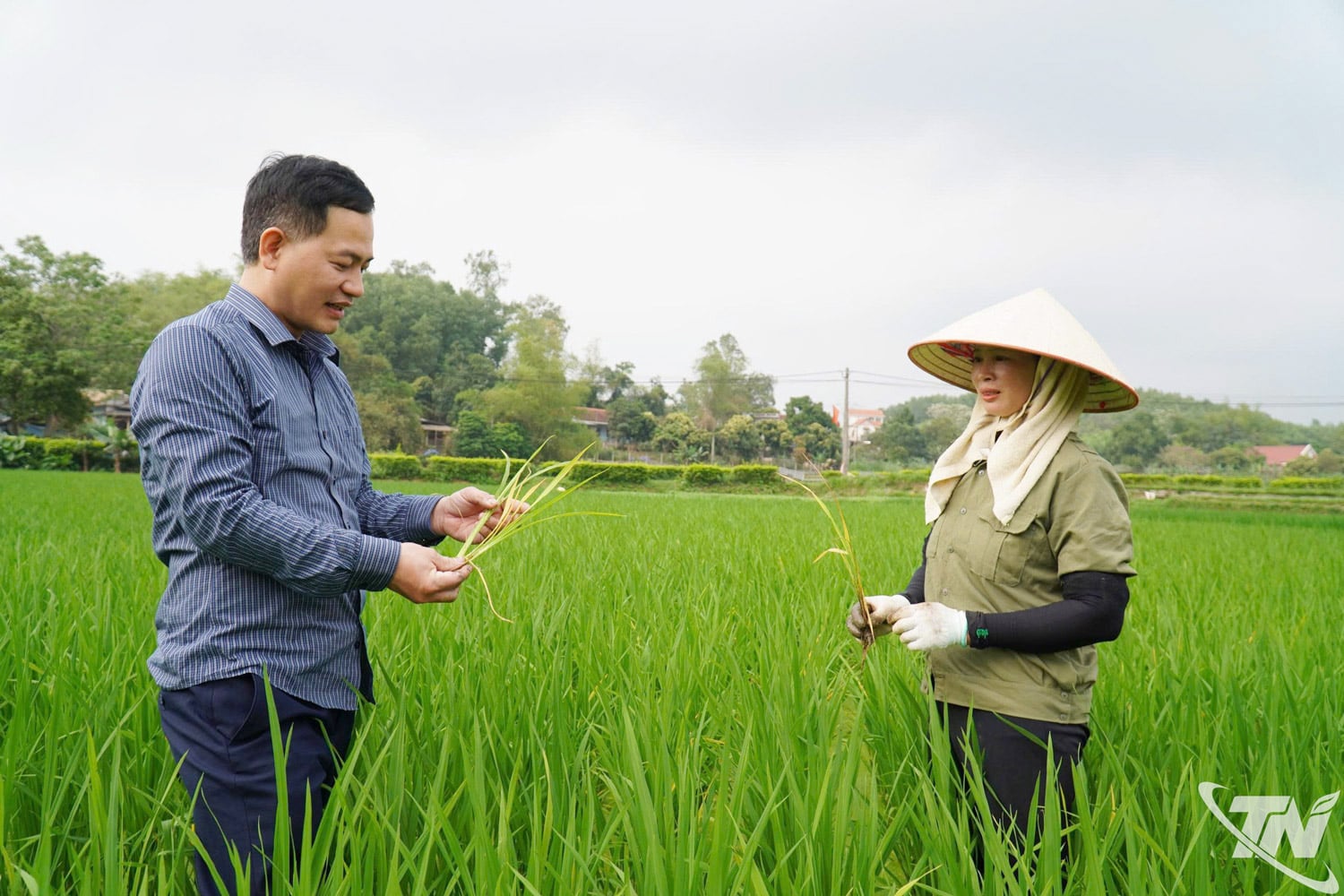
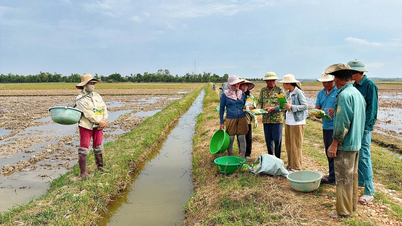
| Agricultural extension officers in Tan Khanh commune are guiding farmers on how to identify pests and diseases that damage spring rice crops during the flowering stage. |
Despite the impact of urbanization and industrialization, rice remains the staple crop, playing a crucial role in the province's agricultural production structure.
By 2025, the total area of grain crops in the province will reach over 117,000 hectares, of which rice will account for nearly 89,000 hectares and corn over 28,000 hectares. Total food production will reach over 587,000 tons, with an average per capita food supply of approximately 326 kg/year, firmly meeting consumption needs.
Mr. Duong Son Ha, Deputy Director of the Department of Agriculture and Environment, informed: The provincial planning for the period 2026-2030 identifies the total rice cultivation area in the province at 88,000 hectares to ensure food security. Based on this, the province has developed a production plan, assigning specific targets to each locality, linked to the goal of increasing value per unit area.
At the grassroots level, the policy of preserving rice land is implemented flexibly, in accordance with the conditions of each locality. Tan Khanh commune is one of the key rice-producing areas, currently maintaining an area of nearly 2,000 hectares; the annual production is over 10,000 tons, with an average yield of more than 55 quintals/hectare.
Local authorities have determined that rice remains the main food crop and its planted area will be kept stable. A small portion of the land will be converted to growing other crops such as peanuts and corn in higher areas where water sources are difficult to control. Maintaining the planted area while increasing productivity helps ensure output and increase income per unit of cultivated land.
For the local households, rice cultivation remains closely linked to their lives. The family of Ms. Vu Thi Chien, in Na Ri hamlet, Tan Khanh commune, maintains 4 sao (approximately 0.4 hectares) of rice per year, ensuring both food security and livestock support.
According to Ms. Vu Thi Chien, this area is sufficient to provide rice for consumption year-round, while also utilizing by-products as feed for livestock and poultry. From these small rice paddies, it is clear that rice cultivation plays a crucial role in stabilizing the livelihoods of each family.
In Nam Hoa commune, the area of rice cultivation has remained stable over the years, contributing to ensuring local food security. Mr. Hoang Van Long, head of Chi Son hamlet, said: "The livelihood of the people mainly depends on rice cultivation."
Thanks to support in terms of seeds and supplies, many high-yield, high-quality rice varieties such as J02, BTE, etc., have been introduced into production, improving economic efficiency. Spring crop production was implemented synchronously, with the entire commune completing planting on 440 hectares, mainly with high-quality rice varieties, creating a foundation for increasing productivity and production value.
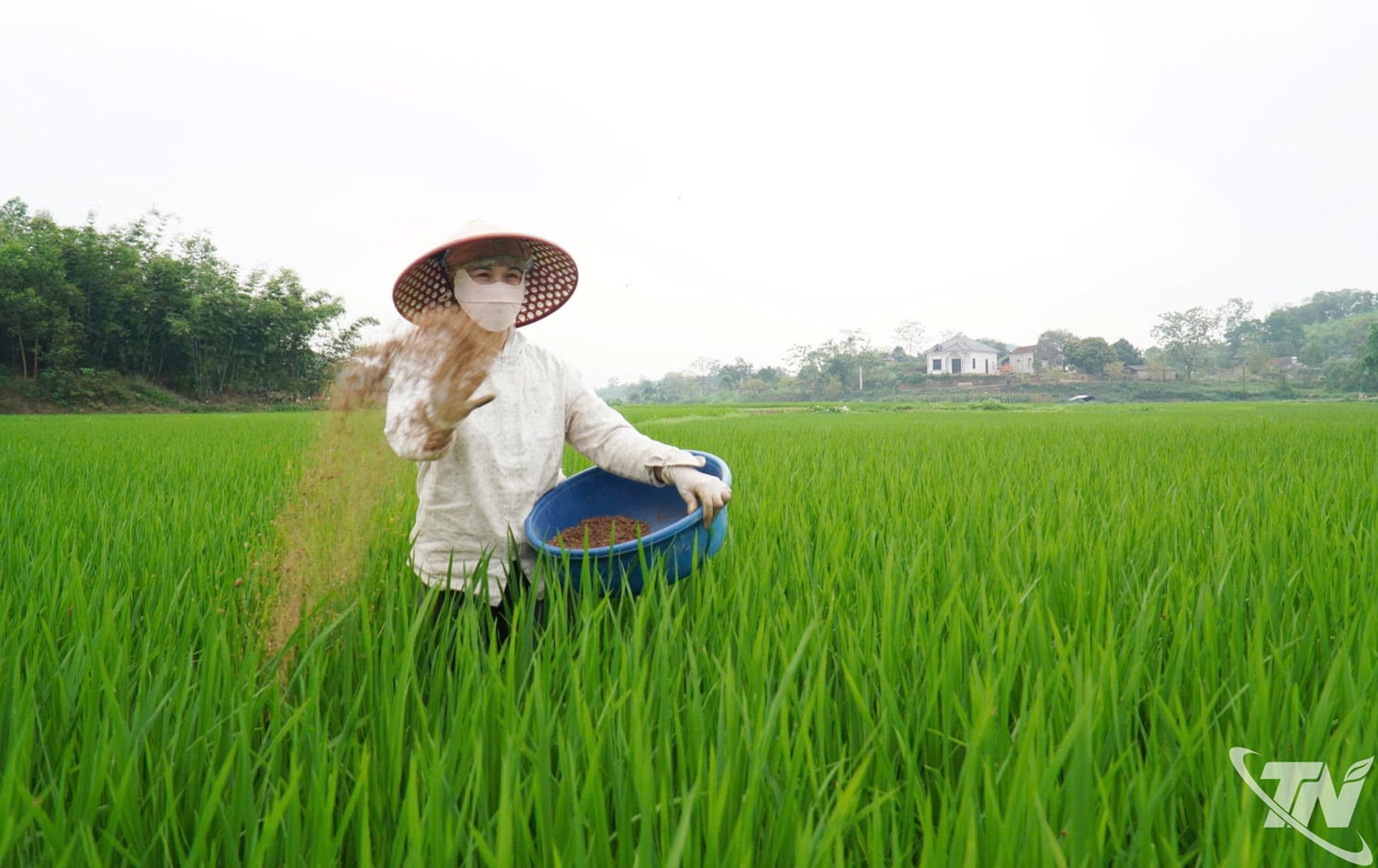 |
| The people are taking care of the rice plants. |
By 2026, Thai Nguyen aims to maintain a stable area of food crops at approximately 117,000 hectares, with a production of 590-600 thousand tons, raising the average per capita food production to over 330 kg/year.
The agricultural sector is focusing on promoting the application of science and technology, innovating crop varieties, improving productivity and product quality, while strictly controlling the conversion of rice land for other purposes.
Preserving rice land has long-term significance, linked to the requirement of ensuring food security and stabilizing people's lives. This is an important foundation for maintaining sustainable local development, meeting the needs of nearly 1.8 million people.
From vast rice paddies across various localities, the orientation towards modern and efficient agricultural development is gradually being affirmed. Rice and rice grains continue to play a fundamental role, contributing to ensuring food security and social stability in the development process.
Source: https://baothainguyen.vn/kinh-te/202604/giu-dat-lua-de-bao-dam-an-ninh-luong-thuc-65441a3/

![[Image] Nearly 125,000 Hanoi students completed the Literature exam for the 10th grade entrance exam.](https://vphoto.vietnam.vn/thumb/1200x675/vietnam/resource/IMAGE/2026/05/30/1780117233041_ndo_br_thiet-ke-chua-co-ten-2-png.webp)


















































































Comment (0)