

Ancient villages bordering the capital city, guilds of craftspeople from various regions, and clans bringing with them their professions, beliefs, and customs have created an urban space that still bears the imprint of village culture.
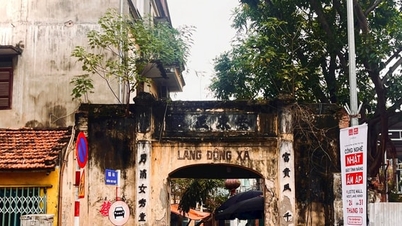
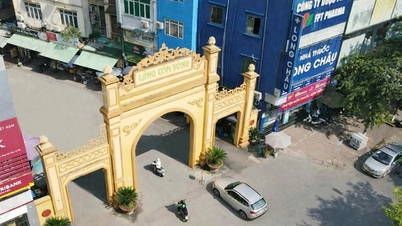
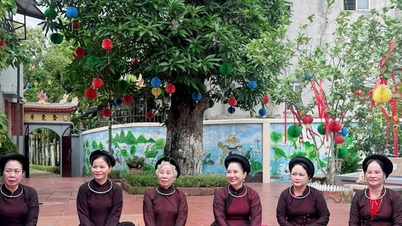
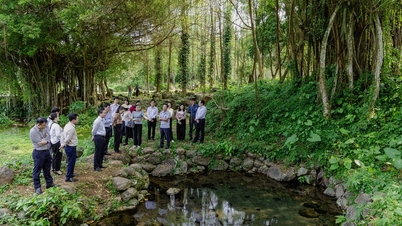
Therefore, "village within the city, city within the village" is not just a nostalgic image, but also a unique socio-cultural structure of Hanoi. Here, village gates, communal houses, wells, and banyan trees coexist with high-rise buildings and modern streets. Traditional festivals still resonate amidst the urban rhythm.
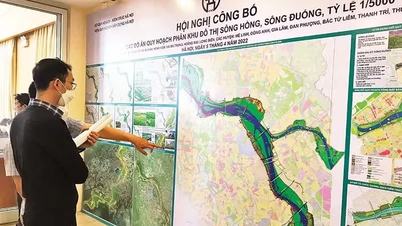
Significantly, this model is not a random product of history, but has been elevated to a development philosophy. The master plan for Hanoi Capital City with a 100-year vision identifies culture as the central element and driving force for sustainable development; in which "villages within cities, cities within villages" is the core element for preserving identity in a modern urban environment.
From an architectural perspective, village spaces provide the city with ecological buffer zones and soft structures that balance the relationship between humans and nature. From a cultural perspective, they nurture community spirit and maintain traditional norms of behavior and morality that contribute to the refined and civilized character of Hanoians. Therefore, without villages, Hanoi would lose its profound soul; without streets, Hanoi would struggle to achieve modern development. The combination of these two elements is the unique identity and competitive advantage of the capital city in the context of globalization.
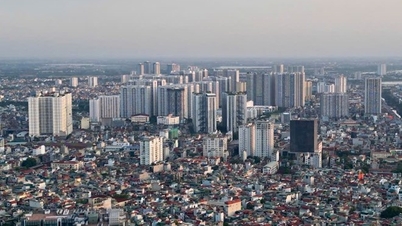
However, recent development shows that the "village within the city" model is facing many major challenges. Rapid, even sometimes "overheated," urbanization has shrunk village spaces, disrupted traditional structures, and risked the erosion of cultural values. Villages like Nhật Tân and Ngọc Hà, known for their flower gardens, and Yên Thái, known for their traditional dó paper-making, now exist only in memory. More worryingly, the physical space is being transformed, and the cultural space in these villages is also being broken. As apartment buildings replace traditional village structures, community bonds – the very "soul" of the village – are gradually weakening. These shortcomings raise a major question: Without timely and fundamental solutions, will Hanoi lose its unique advantages?
To make the concept of "villages within cities, cities within villages" a true driving force for development, the most important thing is to shift from a passive preservation mindset to one that integrates preservation with development. In this context, the city needs to clearly define the role of villages within the modern urban structure. Villages should not be viewed as mere remnants of the past, but rather as cultural nuclei within the overall planning. Classifying villages according to their historical value, occupation, landscape, etc., is essential for developing appropriate preservation solutions. Furthermore, sustainable livelihoods for villagers need to be created. Lessons from successful models like Bat Trang and Van Phuc show that when traditional crafts are linked to tourism and the market, heritage is not only preserved but also generates economic benefits.
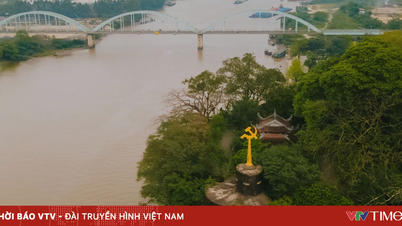
Another important solution is to develop open cultural spaces associated with suburban villages, especially along the Red River, To Lich River, Nhue River, and Day River, in order to create tourist destinations and enhance the economic and cultural value of the capital. At the same time, emphasis should be placed on restoring communal houses, temples, and pagodas – the core soul of the villages.
"Village within the city, city within the village" is not just a spatial model, but a development philosophy – where tradition and modernity coexist and complement each other. In the context of Hanoi striving to become a global city, preserving and promoting this value is not about clinging to the past, but rather about building a sustainable future. Because a city can develop rapidly through technology, but it can only endure through culture. And for Hanoi, the "soul of the village" is the foundation upon which the capital can move forward without losing its identity.
Source: https://hanoimoi.vn/giu-hon-cot-thang-long-ha-noi-744458.html



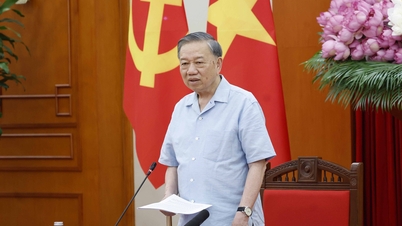
![[Photo] General Secretary and President To Lam presides over a meeting on preparations for the review of one year of operation of the three-tiered government system.](https://vphoto.vietnam.vn/thumb/1200x675/vietnam/resource/IMAGE/2026/06/02/1780391821195_a1-bnd-4595-9717-jpg.webp)



























































Comment (0)