

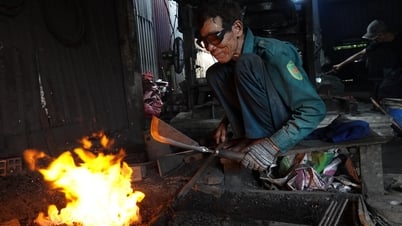
Despite facing numerous difficulties and ups and downs in his craft, the blacksmith's forge of Mr. Cứ Văn Lộng in Lọng Háy village, Mường Phăng commune, has remained burning brightly for decades. Every morning, Mr. Lộng and his son, Cứ A Nếnh, light the fire, pour in the charcoal, and swing their hammers… to start the new day before going about their other family chores.
It's called a blacksmith's forge, but it's quite simple. Just a small pit surrounded by stones to make the furnace, a large, smooth block of iron to use as an anvil, and an electric fan. Yet, from this rudimentary forge, thousands of knives, farming tools, and other items have been produced and sold to people in the commune, the province, and even tourists from near and far.
Mr. Cứ A Nếnh, the son of Mr. Cứ Văn Lộng, only learned the craft from his father about two years ago. However, it seems he inherited the skill, as his forging techniques are as proficient and skillful as those of a seasoned craftsman. In his hands, heated and forged steel bars are transformed into knives and agricultural tools.
“Making a product isn't too difficult. The important thing is to be careful and meticulous. One day, I forged two knives, including the handles and wooden sheaths. Nowadays, forging isn't entirely done by hand; we can use fans to blow air into the furnace and machines for cutting and grinding to shape the knives. However, the most important steps, such as heating the iron, shaping the hammer, making the handles, hammering, and tempering the knives, still have to be done manually,” Nenh shared.

According to Mr. Cứ A Nếnh, the average selling price of a knife is currently around 50,000 to 300,000 VND, depending on size and thickness. “There was a time when forging knives could support an entire family. But now, sales are very slow; we mostly supply only people in the village and commune, and haven't yet started selling our products in tourist areas. To preserve this craft, we need to find a stable market…,” Mr. Nếnh lamented.
The story of Mr. Cứ A Nếnh reflects the shared concerns of the Mong people in Mường Phăng commune, who are struggling to preserve their traditional blacksmithing craft. It is known that, besides Lọng Háy village, the Mong people in Lọng Luông 1, Lọng Luông 2, and Lọng Nghịu villages in Mường Phăng commune are still persistently keeping their blacksmiths' forges burning.
In order to preserve the traditional blacksmithing craft, in 2023, the Department of Culture and Information of Dien Bien Phu City, in coordination with the People's Committee of Muong Phang commune, organized a training course to teach the traditional Mong ethnic blacksmithing craft in Long Hay village to 15 trainees.

Among the 15 trainees was Village Chief Lọng Háy Cứ A Thềnh. Born in 1991, he belongs to a younger generation but has always wanted to learn traditional crafts to contribute to the preservation and development of his ethnic culture.

Nowadays, blacksmithing is not entirely done by hand; fans can be used to blow air into the furnace, and cutting and grinding machines can be used for shaping. However, the most important steps, such as heating the iron, shaping the hammer, making the handle, riveting, and tempering the knife, still have to be done manually.
Mr. Cứ A Nếnh , Lọng Háy village, Mường Phăng commune
Mr. Thenh shared: “Blacksmithing is a distinctive cultural product of the Mong people, but in the context of cultural integration and market economy , the Mong blacksmithing craft also faces many difficulties. Therefore, we are making great efforts to preserve the craft and create many traditional products, bringing a stable income to serve our daily lives…”
For a long time, products from the traditional blacksmithing craft of the Hmong people have been in high demand. The current challenge is how to build a brand for these traditional Hmong blacksmithing products in Muong Phang, so that they can reach the market and enable blacksmiths to make a living from their craft. This requires local authorities and relevant agencies to provide guidance and coordinate with travel companies and businesses to organize tours, experiences, and shopping opportunities for handcrafted blacksmithing products. Only then can the traditional blacksmithing craft of the Hmong people in Muong Phang be preserved and contribute significantly to the socio-economic development of the locality.
Dien Bien Phu City: Presenting "Houses of Compassion" to impoverished households.






































































Comment (0)