

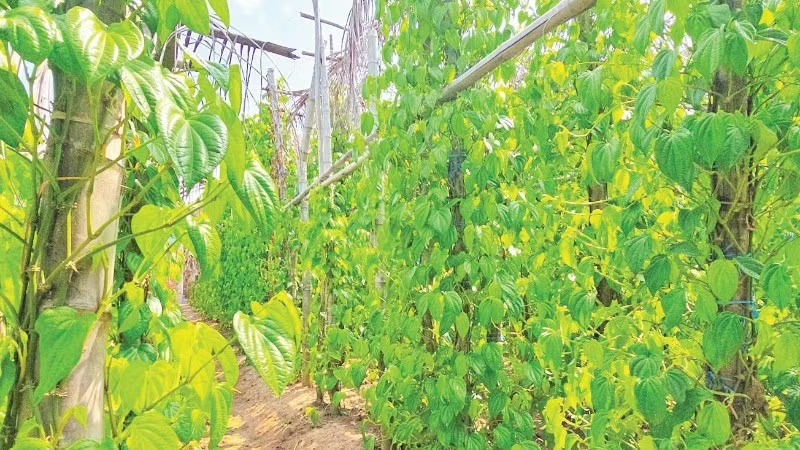
Betel leaves help farmers earn a stable income.
The Tân Châu and Phú Tân islets in the former An Giang province were once famous throughout the Mekong Delta for their Lãnh Mỹ A silk and the lush green Long Sơn betel nut plantations. During its heyday, the betel nut villages stretched for over 3 kilometers along Provincial Road 954, covered in a vibrant green carpet. After several administrative boundary changes, the former betel nut village has merged to form Phú Lâm commune in An Giang province.
As a third-generation descendant of the family, Mr. Vuong Van Bien (62 years old, residing in Long Hoa 1 hamlet) said that this type of climbing plant has taken root in the area for nearly 100 years. Back then, the elders bought betel vine seedlings from Ba Diem (Hoc Mon) to cultivate, then utilized the abundant silkworm fertilizer from Tan Chau silk region to fertilize. Thanks to this, the betel leaves here have a superior glossy sheen and vibrant green color compared to other regions. Recalling his memories, Mr. Bien feels like he's back in his childhood, helping his grandparents with the harvest. According to him, this plant is very "picky" about soil; it must be planted on high ground that isn't flooded, but it also loves water. The advantage of being located next to the Tien River has allowed the gardeners to have a reliable water source for irrigation since the beginning of their business.
In the past, betel leaves were present in every aspect of spiritual and daily life: from ancestral offerings and New Year's celebrations to betel nuts and leaves on joyous occasions. Exchanging betel leaves was once a secret declaration of love between couples, and the custom of chewing betel was a deeply ingrained habit for women.
However, over time, as the Lanh My A silk village gradually faded away, the betel nut growing area shared the same fate. From vast betel nut fields, the cultivated area has shrunk to a mere 40 hectares. Many households have dismantled their trellises and leveled the land to build houses or switch to other crops. The younger generation is no longer interested in growing betel nuts. Now, only the elderly remain, clinging to this ancestral crop. Mr. Bien confided that betel nut cultivation, like life itself, always has its ups and downs, driven by the fluctuating prices.
The "money-making" season for betel leaf growers usually begins in the twelfth lunar month and lasts until the end of the following February. This is when market demand is high to serve weddings and religious ceremonies during the Lunar New Year. Closer to Tet, selected leaves can fetch prices as high as 10-12 million VND per ten thousand leaves (one ten thousand leaves is equivalent to 1,000 leaves). During the festival honoring the Goddess of Sam Mountain, people from all over flock to buy betel leaves shaped like phoenix wings for worship, driving prices up to 4-6 million VND per ten thousand leaves. In the remaining months of the year, prices decrease, remaining between 1.05-2.5 million VND per ten thousand leaves.
According to Mr. Bien's experience, betel plants begin to yield their first harvest after about four months of planting. After each harvest, leaves grow back evenly after about 20 days, and the farmers continue harvesting; this cycle repeats continuously. Thanks to this, farmers have a stable income. On average, one hectare of land yields about 30,000 leaves per harvest. Growers mainly use organic manure, thus minimizing agricultural input costs. The leaves have a naturally pungent taste, so they are less susceptible to pests. However, they are very sensitive to cold winds. Around October and November in the lunar calendar, when cold winds arrive, if preventive pesticides are not sprayed in time, the entire betel garden can become diseased and die off en masse.
Mr. Bien, a retired teacher, shared: "Throughout my years teaching, I chose to cultivate this plant because it's relatively easy compared to rice farming or other agricultural work. All I need to do is water it, fertilize it with manure, and betel plants tolerate heat well, so heavy rain or intense heat isn't a problem." He proudly stated that it was thanks to his 1,000 m² garden with 600 betel plants that he was able to make ends meet, raise two children to university, and build a spacious house.
During peak harvest season, the small village bustles with the laughter and chatter of the workers. Some pick leaves, others arrange betel leaves, and still others process them into betel quid... Each task brings local laborers an income of several hundred thousand dong per day, helping them make ends meet. Although the culture of betel chewing has gradually faded, the market for spiritual practices, worship, and traditional rituals still considers it an indispensable item. Therefore, the Long Son craft village still finds its place. Notably, in recent years, the local fish farming industry has boomed, and whenever the seasons change, fish farm owners buy betel leaves to put in the water to treat diseases in aquatic animals. This unexpected "solution" has helped regulate the betel leaf market naturally.
Also owning around 600 betel plants, Ms. Le Kim Tuyen (residing in Long Hoa 1 hamlet) said that Khmer women still practice the custom of chewing betel, so the market for the product remains stable. Previously, traders mainly collected them for export to the Cambodian market; the quantity has decreased but is still maintained. Ms. Tuyen shared that she is also the third generation continuing the family tradition. Through years of ups and downs, joys and sorrows, the green leaves have intertwined her life with betel vines.
The once-famous betel-growing village, though no longer bustling, still fills those who cling to the craft with pride whenever they talk about this once-famous village on the island. For decades, the lush green leaves have sustained countless families and nurtured the dreams of education for generations to come. They are happy to realize that, despite changing times, this pungent leaf still holds a special place in festivals, ancestral worship ceremonies, and weddings, as an enduring cultural and spiritual tradition of the community.
According to Nhandan.vn
Source: https://baoangiang.com.vn/giu-mau-xanh-vuon-trau-a487022.html

![[Photo] Standing Committee member of the Party Central Committee Tran Cam Tu working with the Central Inspection Committee](https://vphoto.vietnam.vn/thumb/1200x675/vietnam/resource/IMAGE/2026/05/28/1779969579668_ndo_br_bnd-2495-jpg.webp)































































































Comment (0)