


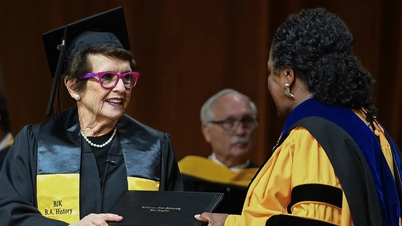
Opening a new path is a daunting but incredibly worthwhile challenge, especially when that path can inspire others. Eileen Collins, 68, the first female pilot and commander of NASA's space shuttle, is a testament to overcoming countless obstacles to achieve great success.
Eileen Collins' journey began in Elmira, New York, where she grew up in a poor family. From a young age, Collins harbored a dream of flying, seeing it as a way to escape her challenging family life.
She worked quietly and persistently for many years, saving every penny to pursue her dream of flying, taking on all kinds of part-time jobs from cleaning school hallways to assisting customers at a home appliance store.
For Collins, no job was too small, and no effort too great. At age 19, after years of hard work, she finally saved enough money to begin her first flight lessons, a pivotal moment that launched her onto a path of greatness.
When the U.S. Air Force opened the door to female pilots, Collins was one of the first to seize an opportunity previously unattainable for generations of women. Selected by NASA in January 1990, she officially became an astronaut in July 1991.
Despite facing discrimination and harassment, both overt and covert, in a predominantly male environment, Collins did not falter. Instead, she redoubled her efforts and relentlessly moved forward.
Collins's space career reached new heights when NASA selected her as the first female pilot on the Space Shuttle Discovery in February 1995. Piloting a space shuttle was a feat that only a select few could dream of, let alone successfully accomplish.
I advise everyone to embrace challenges, even if you think they're too difficult, even if you think you might fail. When you're old and look back on your life, you might regret not trying. Set yourself interesting challenges and be willing to help others. There's no greater feeling than helping others.”
Eileen Collins
But Collins didn't stop there. After her first two missions, in July 1999, she became the first female commander of a space shuttle mission, launching the Columbia into Earth orbit to deploy the Chandra X-ray Observatory. This was a monumental achievement, inspiring countless women and girls to pursue careers in Science , Technology, Engineering, and Mathematics (STEM).
Her fourth mission took place after the Columbia disaster, when what seemed like a normal flight became completely different. The "Return to Flight" mission in 2005, testing new safety modifications and resupplying the International Space Station (ISS), was Collins' final mission. She retired from the U.S. Air Force in 2005 and from NASA in 2006.
Last November, the documentary "Spacewoman" brought Eileen Collins' story to the big screen. Directed by Hannah Berryman and produced by Natasha Dack Ojumu and Keith Haviland, the film offers an authentic and intimate look, revealing Collins' sacrifices and relentless efforts to become a pioneering woman in space.
"Spacewoman" doesn't shy away from exploring the emotional and physical sacrifices Collins faced on her journey to becoming the "first." Through interviews with colleagues like Dr. Cady Coleman and Dr. Charlie Camarda, as well as members of Collins' family, the film vividly portrays the price of pioneering while celebrating the obstacles Collins overcame.
Twenty-five years ago, Eileen Collins's leadership broke the boundaries of human spaceflight. As former First Lady Hillary Clinton predicted, her selection opened the door to opportunities for many other female astronauts.
More and more women are being entrusted with commanding space missions, such as Expedition 65 commander Shannon Walker, and Expedition 68 commander Samantha Cristoforetti.
More importantly, Collins has become a role model for younger generations who love space and STEM. Her career has proven that there are no limits if you work hard and dare to pursue your passion.
The Britannica Encyclopedia once selected Collins as one of the 300 most influential women in human history.
Source: Forbes, NASA
Source: https://phunuvietnam.vn/nu-phi-cong-dau-tien-cua-nasa-giup-do-nguoi-khac-la-cam-giac-tuyet-voi-20241220160937388.htm























































































Comment (0)