

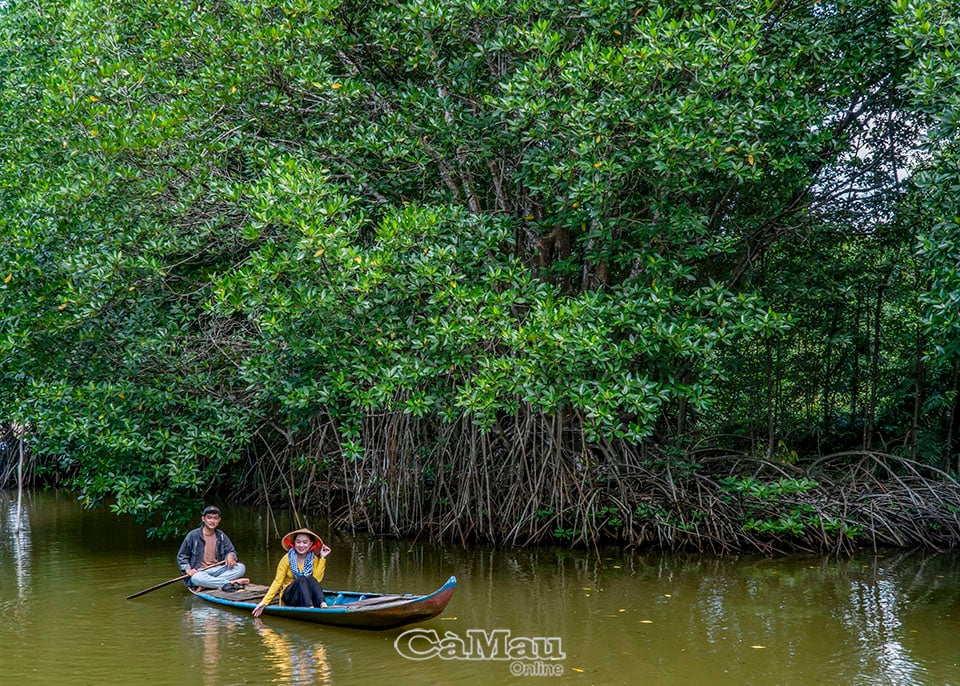
Tourists enjoy sitting in boats and taking in the scenery of the mangrove forest next to the mangrove trees.
Mr. Le Minh Ty (Tu Ty), the owner of the tourist spot, recounted: “When my father-in-law came here around before 1980, he started reclaiming the wasteland, and the State allocated him forest land, which he has kept until now. At that time, when harvesting the forest, this tree couldn't be cut because its canopy was too wide and its root system was very large, making it difficult to move. The villagers advised us to keep it as a seed source, so that when it bore fruit, it would fall to the ground, making it convenient for reforestation later.” And so, that mangrove tree has remained there with Mr. Tu Ty's family, becoming a part of the tour route to exploit the tourism potential of his hometown.
Currently, the mangrove forest ecosystem here grows and develops from the fruit of those mangrove trees. Of the 9 hectares of forest, about 7 hectares are preserved by Mr. Tu Ty, not exploited, and have now become a primary forest, ensuring the preservation of the original mangrove ecosystem.
“I unintentionally preserved the tree, never imagining it would become a tourist attraction. When I came here to work in tourism, around 2018, I noticed this special mangrove tree and gradually developed an affection for it. When I started developing tourism, I kept it in its original state, mainly building small bridges so that tourists could walk around the tree, take photos, and rest… The mangrove's canopy is wide, so tourists can sit or climb on its trunk, and everyone is very excited. Before the pandemic, many performing arts groups came here to film scenes next to the mangrove tree, introducing our hometown of Ca Mau …”, Mr. Tu Ty said proudly.
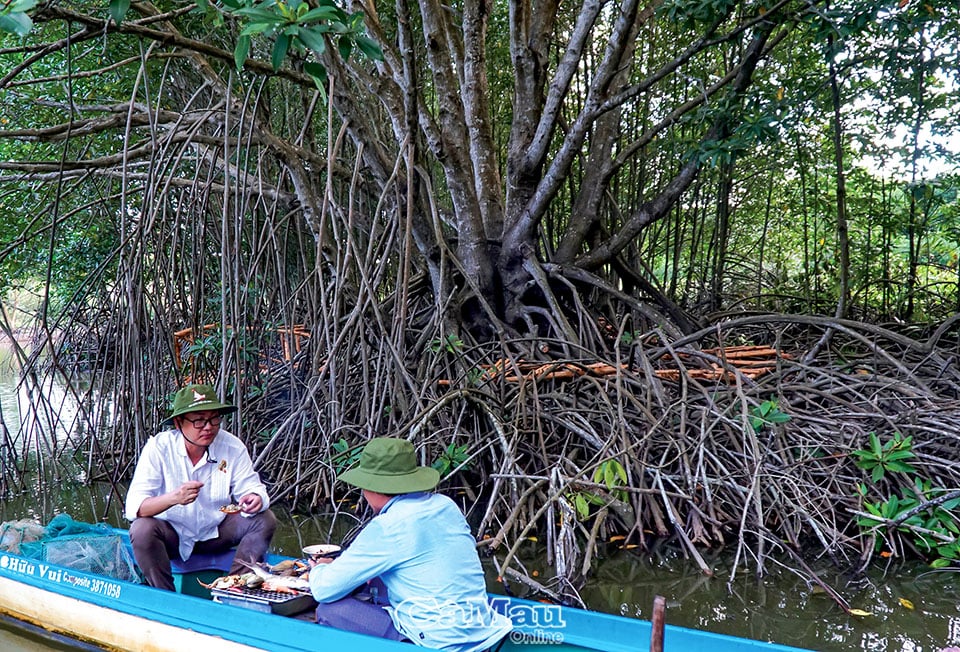 |
| Under the cool shade of mangrove trees, visitors can enjoy rustic dishes and specialties of Ca Mau Peninsula. |
According to Mr. Tu Ty, this mangrove species is a bushy mangrove with a large trunk and canopy, making it very suitable for planting in mangrove areas. The base of this particular mangrove tree is special; its trunk branches into 11 individual mangrove trees (all over 10 meters tall). Typically, when a mangrove tree reaches 16 years old, it no longer grows taller, but only the trunk (circumference) continues to thicken, forming a wide canopy. The mangrove trees surrounding the large tree are about 20 years old, having reproduced from the larger tree. The family prunes the branches every 2-3 years to encourage the tree's growth.
Following in his father's footsteps, Le Trung Nguyen (son of Mr. Tu Ty) is always concerned about how to protect and continue planting and preserving mangrove trees. “Mangrove trees are about 7 years old before they bear abundant fruit. It takes about 6 months for the fruit to mature from flowering until it falls off. Therefore, creating a mangrove forest ecosystem is a long process. Many tourists who come here, even without being introduced, already know about the mangrove tree and ask me to organize tours. Gradually, the mangrove tree has become more widely known, and every visitor finds it strange and interesting,” Nguyen shared.
The mangrove ecosystem is also very favorable for shrimp farming. Mangrove trees provide shelter and breeding grounds for shrimp, crabs, and fish. The wide canopy also serves as nesting places for birds and some reptiles. In particular, the area around the base of large mangrove trees, with its spreading root system, is home to many marine species, and is also a place where tourists can experience casting nets, searching for crabs, and removing crab traps.
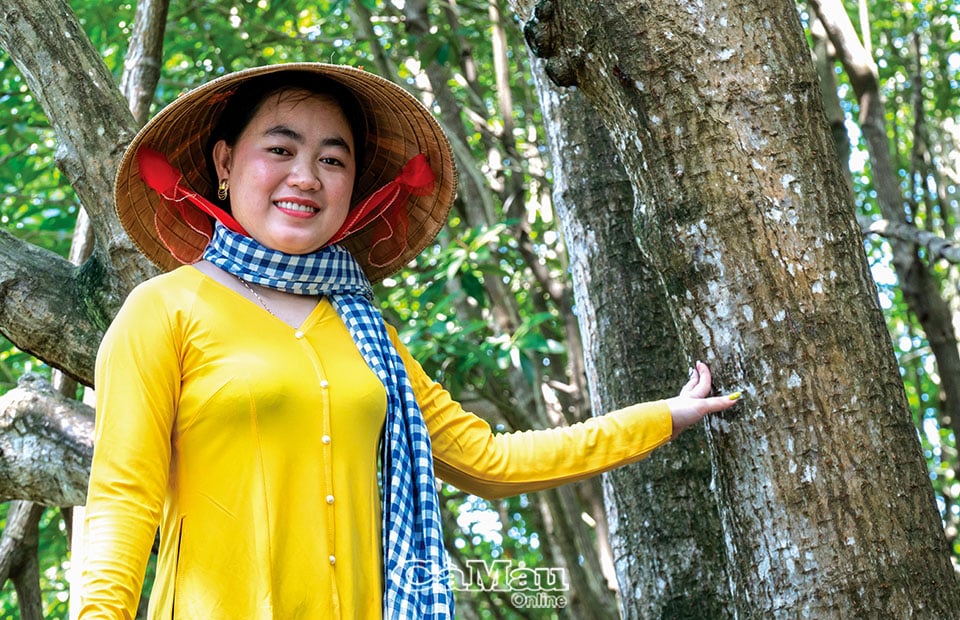 |
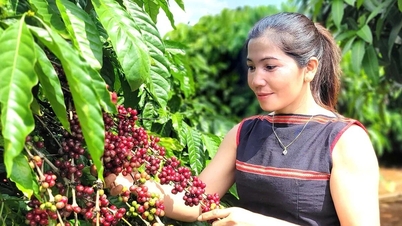
| Ms. Le Thi Tra My, from Vien An Dong commune, often comes to admire the mangrove tree in her hometown. |
Ms. Le Thi Lan, a tourist from Ho Chi Minh City, shared her thoughts: “Traveling from the mangrove forests to the wetlands, I truly appreciated the natural beauty and the people of Ca Mau. Reaching Tu Ty was like touching the southernmost point of Vietnam. Here, we not only enjoyed fishing for mudskippers and setting crab traps, but also admired the beauty of such large mangrove trees – it was the first time I’d ever seen one like this. I will definitely return to explore this place again soon.”
The mangrove tree is familiar and close to the people of Ca Mau Peninsula. As a son of the homeland, Mr. Tu Ty is very proud of it. From wartime to peacetime, the mangrove tree has stood tall and proud. “Preserving the mangrove forest ecosystem is also protecting our common home. Regarding this particular mangrove tree, I plan to build a bridge to it; make some small boats so tourists can cast their own nets and grill seafood to enjoy next to the tree… I want to give tourists the most authentic experience possible,” Mr. Tu Ty plans.
Nhat Minh
Source: https://baocamau.vn/goc-duoc-hon-60-nam-tuoi-a1949.html


![[Image] Close-up view of the interchange connecting the two expressways and Long Thanh Airport.](https://vphoto.vietnam.vn/thumb/1200x675/vietnam/resource/IMAGE/2026/05/25/1779703378210_ndo_br_z7863716673926-224453a31600126cce10622af6290afd-4549-jpg.webp)
![[Image] Hanoi's urban life under the challenge of a "scorching hot" environment](https://vphoto.vietnam.vn/thumb/1200x675/vietnam/resource/IMAGE/2026/05/25/1779706979265_nang-nong-t5-2026-minh-duy-7-4636-jpg.webp)

























































Comment (0)