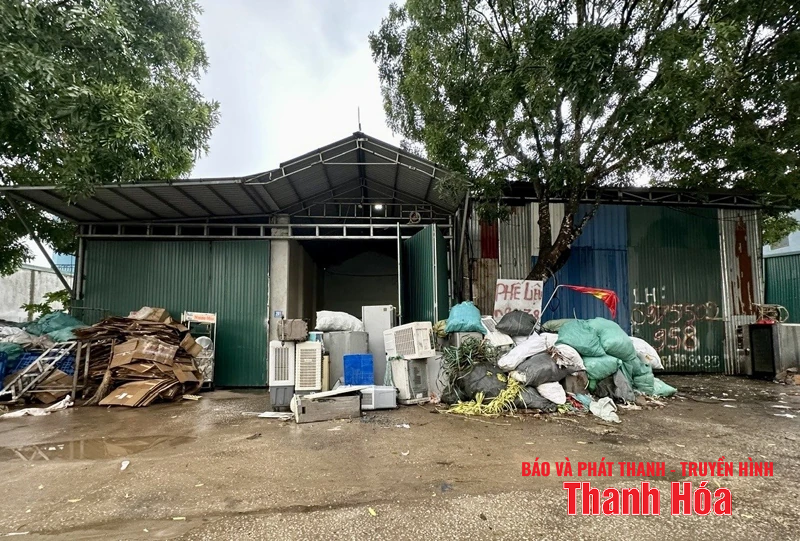
A scrap metal collection facility in Nong Cong commune.
Living with garbage
On Nguyen Cong Tru Street, Hac Thanh Ward, a scrap collection and sorting facility located right in the middle of a residential area has become a nightmare for the surrounding residents. From the outside, it's just an old two-story house, but the sidewalk is completely occupied by piles of sacks. There's no sign, no fence, and scrap materials of all kinds are scattered everywhere. Under a makeshift corrugated iron roof, sorting and dismantling activities are bustling. Collectors use their bare hands to pull sacks, sort metal, and break up old equipment right on the dusty ground. No safety measures or waste collection methods are in place. On hot days, the pungent smell of burning plastic and decaying fabric, combined with dust, creates a heavy atmosphere that permeates the entire area.
"We're practically living next to a garbage dump. Children suffer from allergies and constant coughing due to the dust and smoke from burning trash. My family had to install two layers of doors to block out the smell, but even that only helps to some extent," shared Ms. Nguyen Thi Lan, a resident living nearby, expressing her frustration.
Most dangerous of all is the ever-present risk of fire and explosion. Flammable materials such as paper, foam, and plastic are piled up in large heaps, right next to power lines. In hot weather, even a small spark could lead to disaster. However, this facility has no fire prevention and extinguishing system or emergency response plan.
A similar situation is unfolding right here in Nong Cong commune. A scrap collection point, located right next to the main road, has a large pile of garbage surrounding the base of an old tree in front of the entrance. Inside, old refrigeration equipment, charred copper wires, and partially burned plastic casings lie scattered everywhere. Workers are working without protective gear, cutting metal and burning plastic wires with bare hands... smoke spreads directly into the nearby residential area.
"Every day is the same, the smoke is thick and hazy. We have to seal all the doors and windows, but the smell still lingers. Now my whole family is suffering from allergic rhinitis," a resident living nearby shared.
The presence of scrap collection points interspersed within residential areas has become a serious problem in many localities across the province. For example, in Dong Tien ward, residents have to endure the smell of burning plastic every afternoon as people burn materials to extract metal cores. In Quang Phu and Ham Rong wards, many households utilize their front yards as scrap collection points without proper covering or processing, causing unsightly conditions and posing a high risk of fire and explosion.
The Silent Threat
It is evident that the emergence of scrap collection points in residential areas is not a temporary phenomenon but a consequence of uncoordinated development. This situation has persisted for many years, yet there is still no official statistic on the number of existing collection points.
It has been found that one of the reasons for this situation is the lack of specific planning for the scrap collection and processing industry. Local authorities have not designated designated areas, leading to people using their homes and yards as collection points. Without appropriate technical infrastructure, these facilities operate spontaneously, lacking waste treatment systems, fire safety, and environmental protection measures. Furthermore, environmental management at the local level is weak. Many localities lack dedicated environmental officers or only conduct inspections after receiving complaints from residents. Enforcement measures often only involve warnings, leading to widespread repeat offenses. On the other hand, the practice of small-scale or unregistered businesses, exploiting legal loopholes, makes it difficult for authorities to impose strict penalties.
Given this situation, relevant authorities need a more comprehensive, long-term, and robust strategy to address this issue. First, a thorough review and inventory of all scrap collection points, including small, informal ones, is necessary. Based on this, a relocation and reorganization plan should be developed, prioritizing locations far from residential areas. Simultaneously, the responsibility of local authorities at the commune level needs to be enhanced, with clear assignments of environmental management authority, increased surprise inspections, and strict penalties for repeat offenders. For existing businesses, solutions should be implemented to support them in transitioning to more suitable occupations. To build a civilized city with a safe environment, these "hidden corners" cannot be allowed to continue to exist.
Text and photos: Truong Giang
Source: https://baothanhhoa.vn/goc-khuat-cua-do-thi-hoa-256875.htm





![[Video] Sunset at Lap An Lagoon – Where the sun sets over the fishing nets](https://vphoto.vietnam.vn/thumb/1200x675/vietnam/resource/IMAGE/2026/05/31/1780192137701_beach-landscape-sea-water-nature-grass-745871-pxhere-com.jpeg)
















![[Video] Sunset at Lap An Lagoon – Where the sun sets over the fishing nets](https://vphoto.vietnam.vn/thumb/800x450/vietnam/resource/IMAGE/2026/05/31/1780192137701_beach-landscape-sea-water-nature-grass-745871-pxhere-com.jpeg)



















































![[Video] Sunset at Lap An Lagoon – Where the sun sets over the fishing nets](https://vphoto.vietnam.vn/thumb/402x226/vietnam/resource/IMAGE/2026/05/31/1780192137701_beach-landscape-sea-water-nature-grass-745871-pxhere-com.jpeg)
































Comment (0)