|
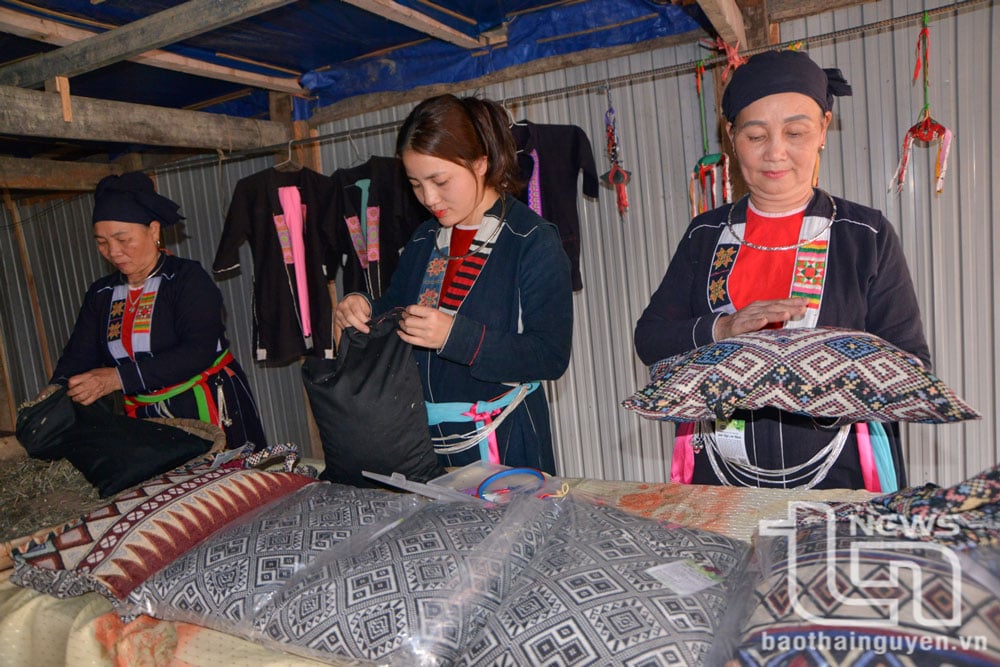
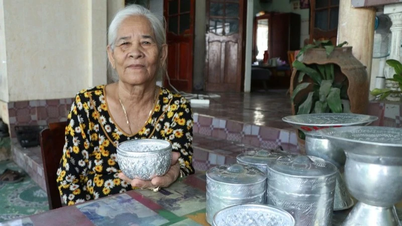
Members of the Dong Tien Community Agriculture and Tourism Cooperative produce herbal pillows. |
Welcoming us into her spacious and airy stilt house, Ms. Hoang Thi Hang, Director of the Cooperative, shared: "In 2023, during a trip to Thailand, I went to a pharmacy and saw them putting various dried herbs into a bag and selling them to customers. I smelled it and found it fragrant and pleasant. Upon inquiring, I learned that these were medicinal herbs that help relieve colds, reduce stress and fatigue, and improve blood circulation."
I think, since local medicinal plants are readily available, why don't we take advantage of them, harvest them, and process them into herbal pillow products like in other countries? - Ms. Hoang Thi Hang
After that experience, Ms. Hang returned to her village and shared with the villagers the method of making herbal pillows used in Thailand. Everyone agreed that it was a very good method. If the villagers knew how to utilize the advantages of local medicinal plants, they could spread the benefits of this good product from the ethnic minority people to more people.
Based on that idea, in July 2024, the Dong Tien Community Agriculture and Tourism Cooperative was established with 8 members. From being accustomed only to growing rice and corn and raising poultry for daily life, the members of the cooperative have now created unique local products.
|
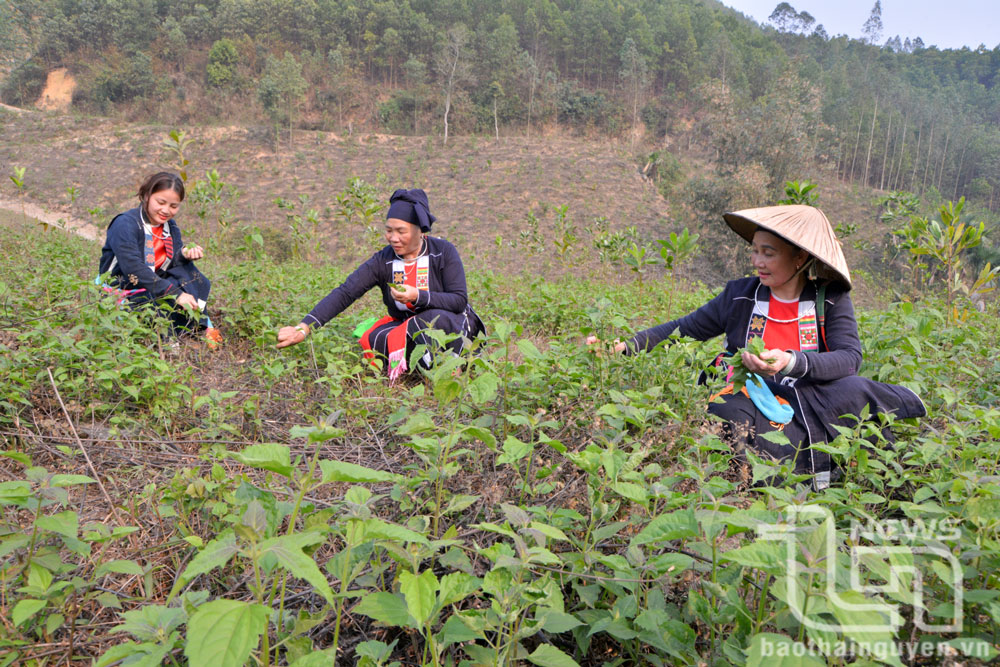
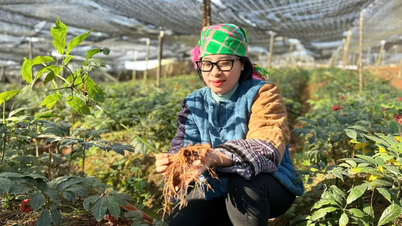
Members of the Dong Tien Community Agriculture and Tourism Cooperative are harvesting medicinal plants. |
Ms. Hang further informed us that the biggest advantage in producing herbal pillows, besides the support and assistance from specialized agencies of the district, is that the members of the cooperative basically all have some knowledge of medicinal plants because they followed their parents and grandparents to the forest to learn about medicinal plants from a young age; they know how to prepare some remedies to treat diseases such as stomach, bone and joint, kidney problems, etc. Therefore, combining various medicinal plants to create herbal pillows is not difficult for the cooperative members.
Ms. Dang Thi Phuong, a Dao ethnic minority member of the cooperative , said: "Previously, I knew a little about some medicinal plants and often went to the forest to pick them to brew into tea. That's why, when I joined the cooperative, my passion for these plants was rekindled."
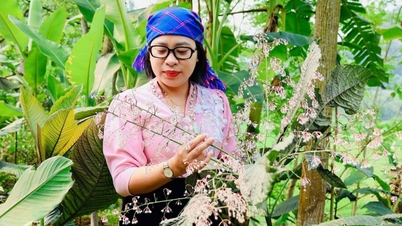
Immediately after its establishment, the members jointly developed a medicinal herb cultivation area covering nearly 1 hectare. The main plants grown include mugwort, lemongrass, *Dendrobium nobile*, basil, and perilla. In addition, the villagers also go into the forest to gather other plants such as *Passiflora incarnata* and fragrant leaves to create products with a full range of ingredients.
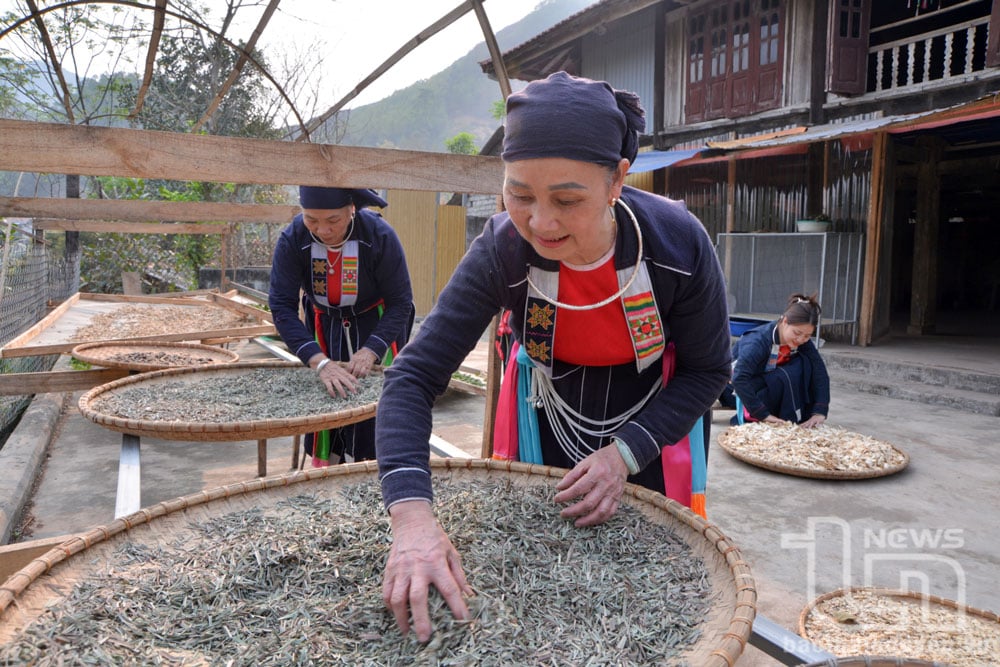
The ingredients are not difficult to find, but making herbal pillows requires many steps. These include roasting, drying, and flavoring the product. Due to a lack of investment in modern equipment, after harvesting and drying the medicinal plants, the cooperative members have to take them to a member's house for roasting and drying.
|
Members of the Dong Tien Community Agriculture and Tourism Cooperative dry medicinal herbs after harvesting. |
After the incense is extracted, the ingredients are placed into a pillowcase (made of brocade fabric sourced from Hoa Binh province) and carefully sewn shut. Labels and QR codes are attached for customers to easily look up product information.
Our impression upon holding the herbal pillow, handcrafted by the ethnic people of Dong Tien, was that the hand-woven brocade fabric, decorated with various eye-catching patterns, was impressive. The pillow was enclosed in a carrying bag also made from brocade fabric. The medicinal herbs emitted a subtle, pleasant fragrance.
Ms. Hoang Thi Trinh, a Tay ethnic woman and member of Dong Tien Cooperative, said: "After carefully packaging the herbal pillows, we bring them to the cooperative's display and product introduction point on the Thai Nguyen - Cho Moi highway. Here, whenever customers stop to rest, they buy the pillows for personal use or as gifts for relatives. Some customers, after using them once and seeing the effectiveness, return to buy them a second and third time."
Currently, the Dong Tien Community Agriculture and Tourism Cooperative produces and sells an average of 200 herbal pillows per month, priced at 180,000 VND per pillow. To further expand the product's reach to customers, Ms. Hang shared: "In the future, besides selling pillows, we will research and develop a community tourism model, allowing tourists to stay, rest, and experience harvesting and identifying medicinal plants with the local ethnic minority people."
Source: https://baothainguyen.vn/kinh-te/202503/goi-thao-moc-san-pham-doc-dao-cua-nguoi-dong-tien-fb220d6/


![[Photo] Secretary of the National Assembly Party Committee, Chairman of the National Assembly presides over the meeting of the Standing Committee and Executive Committee of the National Assembly Party Committee.](https://vphoto.vietnam.vn/thumb/1200x675/vietnam/resource/IMAGE/2026/06/03/1780480353201_ndo_br_bnd-2585-jpg.webp)
![[Photo] General Secretary and President To Lam presides over a meeting with the Central Organizing Committee.](https://vphoto.vietnam.vn/thumb/1200x675/vietnam/resource/IMAGE/2026/06/03/1780482764658_a1-bnd-4741-3342-jpg.webp)
![[Photo] First session of the 14th Congress of the Vietnam Trade Union](https://vphoto.vietnam.vn/thumb/1200x675/vietnam/resource/IMAGE/2026/06/03/1780465947883_ndo_br_img-3852-jpg.webp)


































![[Video] Sunset at Lap An Lagoon – Where the sun sets over the fishing nets](https://vphoto.vietnam.vn/thumb/1200x675/vietnam/resource/IMAGE/2026/05/31/1780192137701_beach-landscape-sea-water-nature-grass-745871-pxhere-com.jpeg)




























Comment (0)