

From changing mindsets to taking action to save the land.
"Clean soil" is no longer just a slogan but has become a principle in the rigorous farming process over the years at An Phu Thuan Organic Agricultural Cooperative, Phu Huu commune, Dong Thap province. Instead of relying on fertilizers and chemical pesticides as in the old ways, many farmers here have begun a journey of "diagnosing" the soil by measuring pH levels, checking micronutrients, and supplementing with microorganisms to restore the gradually depleted soil resources.
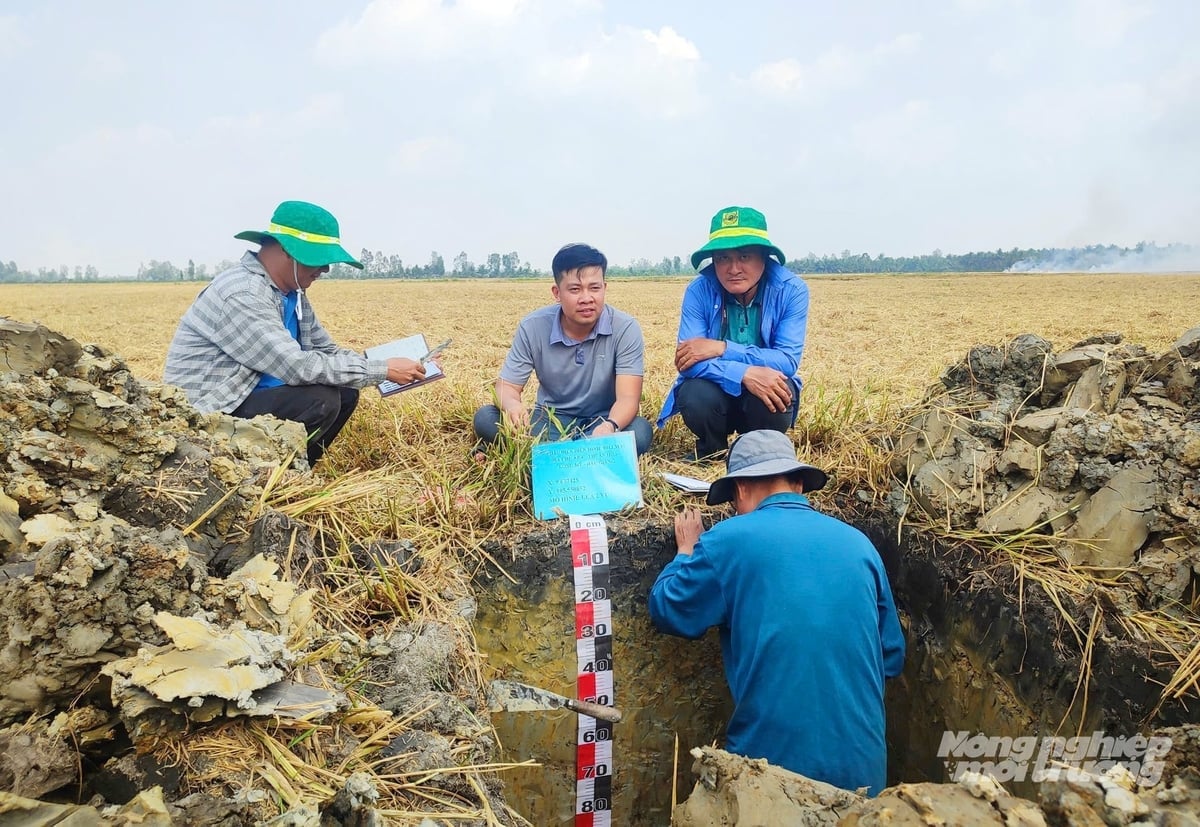
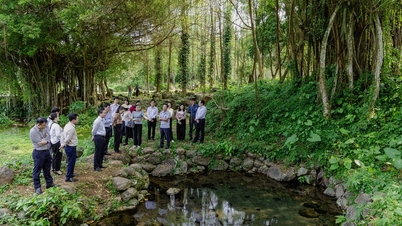
Scientists and farmers are collaborating to survey and assess the current state of agricultural land in order to find solutions to restore fertility and biological balance to cultivated land in the Mekong Delta. Photo: Le Hoang Vu.
A new production mindset is emerging among farmers at the An Phu Thuan Organic Agricultural Cooperative as they are no longer solely focused on maximizing yields but have begun prioritizing soil health. They understand that healthy soil is essential for healthy plants, safe agricultural products, and sustainable livelihoods.
Having cultivated 2 hectares of longan trees using traditional methods for many years, Mr. Bui Xuan Tai in Phu Huu commune once fell into a vicious cycle due to the overuse of chemical fertilizers to increase productivity. Investment costs increased each year, while the soil became increasingly compacted, significantly reducing its water retention and nutrient absorption capacity.
The turning point came when he boldly tested the soil pH and discovered that the soil was severely acidic. From then on, he decided to completely change his farming methods, starting to apply lime to reduce acidity, and increasing the use of organic fertilizers and biological preparations instead of chemicals.
According to Mr. Tai, switching to using organic fertilizers and biological products has significantly improved the soil, making it more porous, resulting in healthier plants and increased economic efficiency.

Farmers in Dong Thap are increasing their use of organic fertilizers and agricultural by-products to improve soil quality, gradually reducing their reliance on chemical fertilizers. Photo: Le Hoang Vu.
It's not just Mr. Tài; more and more members of the An Phú Thuận Cooperative are proactively seeking solutions to save their land after years of intensive farming practices. Farmers are beginning to focus on replenishing the soil with organic matter using self-composted fertilizers, utilizing agricultural by-products, and minimizing the use of chemical fertilizers and pesticides.
Mr. Luong Tien Thanh, a farmer cultivating 1.7 hectares of green pomelo in Phu Huu commune, said that the most important thing is to "feed the soil" instead of just taking nutrients from it. In recent years, he has focused on using 70% organic fertilizer and 30% chemical fertilizer. This method aims to supplement nutrients so that the soil is healthy, the plants are healthy, and in the long run, it does not deplete the soil's energy. This is the result of a change in mindset, no longer chasing productivity at all costs.
Healthy soil is essential for sustainable agriculture.
According to Mr. Nguyen Van Ba, Director of An Phu Thuan Organic Agricultural Cooperative, soil restoration is currently considered a fundamental task by the cooperative. Techniques such as pH measurement, micronutrient testing, compaction assessment, and drainage capacity evaluation are regularly performed to help farmers adjust their farming methods accordingly.
"Water that doesn't drain away is partly due to soil compaction. The soil's inability to absorb nutrients is also due to an unsuitable pH level. Soil is the foundation of production, so farmers are gradually changing their perceptions and trying to cultivate in greater harmony with nature," Mr. Ba shared.
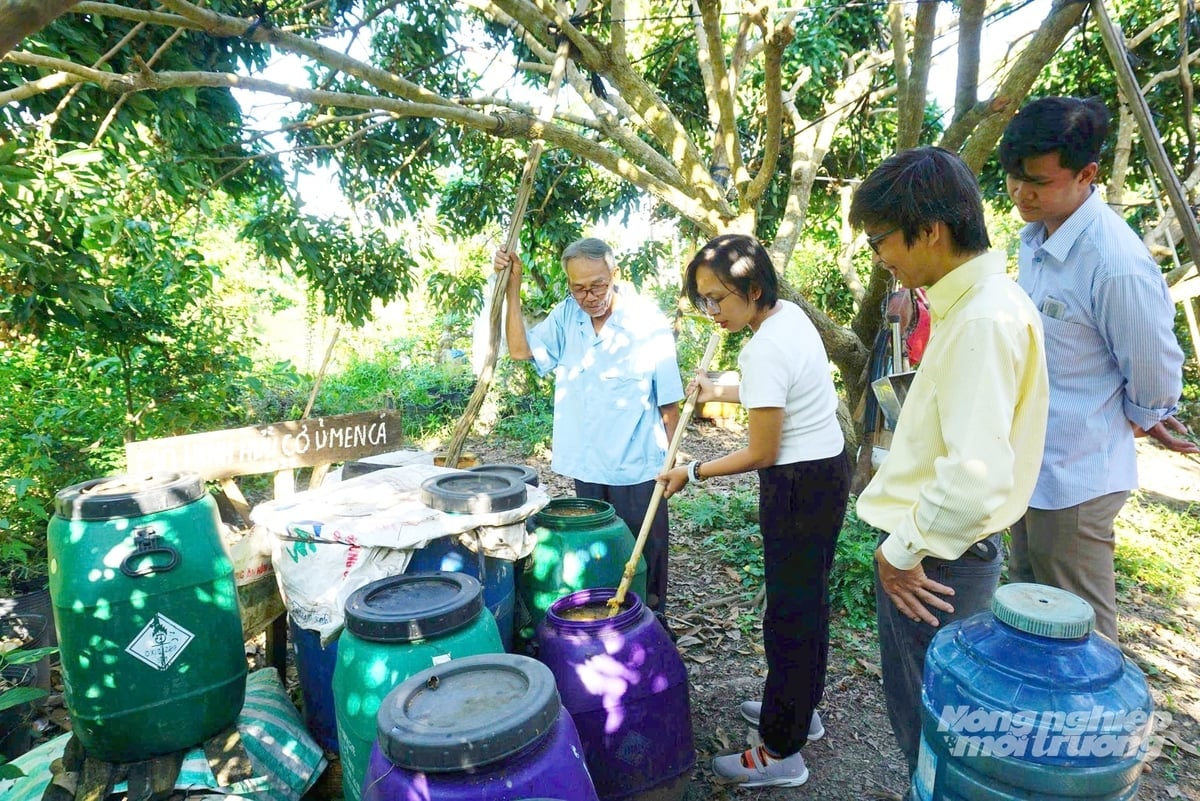
The model of composting organic fertilizer and microbial preparations from local raw materials helps regenerate beneficial microorganisms and improve the health of agricultural soil. Photo: Le Hoang Vu.
The issue of land restoration in the Mekong Delta is no longer just a matter for individual farmers, but has become an urgent requirement in the context of increasingly severe climate change. Salinity intrusion, prolonged droughts, and the overuse of chemical fertilizers and pesticides are causing serious degradation of agricultural land in many areas.
According to Associate Professor Dr. Nguyen Khoi Nghia, Deputy Head of the Department of Soil Science - School of Agriculture, Can Tho University, healthy soil is not simply a place to keep plants standing, but also performs a series of vital functions for the agricultural ecosystem.
Healthy soil creates a stable physical environment that allows roots to develop deeply, anchor firmly, and increase their ability to absorb water and nutrients. Conversely, if the soil is compacted and has poor structure, the roots cannot develop, making the plant susceptible to falling over and weakening in adverse weather conditions.
Furthermore, soil is also home to a rich ecosystem of microorganisms, fungi, and many other beneficial organisms. This ecosystem participates in the decomposition of organic matter, releasing natural nutrients for plants and helping to maintain ecological balance in the soil.
Another important role of healthy soil is its ability to regulate water. Organic-rich soil has more pores, which helps retain water effectively and provide a stable water supply to plants throughout the growing season.
Especially in increasingly severe drought conditions, soils with high organic matter content retain water better, helping plants overcome periods of water scarcity.
Associate Professor Dr. Nguyen Khoi Nghia analyzed that soil degradation leads to a series of consequences such as poor plant growth, increased pest and disease outbreaks, nutrient imbalance, and especially the accumulation of toxins in the soil. This not only affects productivity but also threatens the quality of agricultural products and consumer health.
Climate change is currently exacerbating the damage to agricultural land. Salinity intrusion introduces sodium ions from seawater into the soil, disrupting soil structure and reducing water permeability and gas exchange.

Switching to organic farming has helped many gardeners in Dong Thap improve soil aeration, resulting in healthier plant growth and enhanced sustainable economic efficiency. Photo: Le Hoang Vu.
When soil loses its structure, plant roots cannot "breathe," unable to transport water, nutrients, and oxygen to deeper layers. Simultaneously, pests and diseases proliferate, forcing farmers to increase their use of chemicals, inadvertently accelerating soil degradation.
The urgent task now is to restore soil health, which should become the focus of agricultural production in the Mekong Delta in the coming period. Organic farming, circular agriculture, and emission reduction are no longer optional trends but inevitable paths to soil revitalization.
"Increased use of organic fertilizers, utilization of agricultural by-products, gradual reduction of chemical fertilizers and pesticides, combined with rational land and water management, will help improve soil structure, increase organic matter content, and restore natural ecological balance."
Although many farmers in the Mekong Delta have begun to switch to environmentally friendly farming models, the scale remains small and lacks uniformity. In the long term, the restoration of agricultural land requires stronger collaboration from scientists, management agencies, and appropriate support policies for farmers,” said Associate Professor Dr. Nguyen Khoi Nghia.
Source: https://nongnghiepmoitruong.vn/hanh-dong-de-phuc-hoi-suc-khoe-dat-nong-nghiep-dbscl-d813318.html
![[Photo] General Secretary and President To Lam presides over a meeting on preparations for the review of one year of operation of the three-tiered government system.](https://vphoto.vietnam.vn/thumb/1200x675/vietnam/resource/IMAGE/2026/06/02/1780391821195_a1-bnd-4595-9717-jpg.webp)







![Water security in the Mekong Delta: [Part 3] Turning rivers into 'super reservoirs'](https://vphoto.vietnam.vn/thumb/402x226/vietnam/resource/IMAGE/2026/06/01/1780271198729_0712-t10nr-150406_121.jpeg)



![Transforming from Resolution 57: [Part 2] Businesses Lead the Way](https://vphoto.vietnam.vn/thumb/402x226/vietnam/resource/IMAGE/2026/06/02/1780399668663_5332-dsc09931-2-235637_295-235639.jpeg)


























































Comment (0)