

The journey to find teammates in a foreign land.
From the forests along the Cambodian border to the area along the Sekong River in southern Laos, many search teams continue to follow witness accounts to find comrades who sacrificed their lives decades ago.
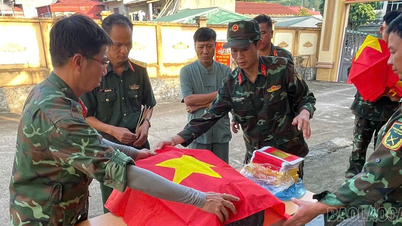
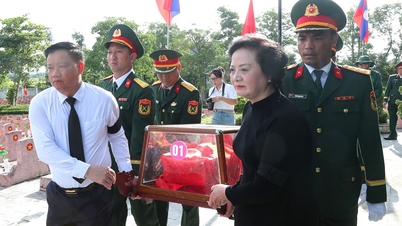
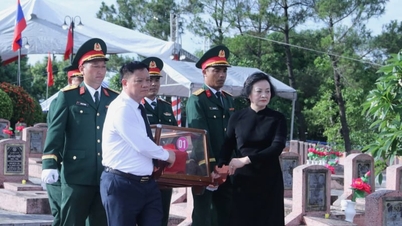
According to VNA, on May 12th, at the Binh Hiep International Border Gate in Tay Ninh province, a ceremony was held to welcome back 158 remains of Vietnamese volunteer soldiers and experts who died in Cambodia during the second phase of the 25th repatriation effort (dry season 2025-2026). These remains were searched for and collected in Cambodia by Teams K71 and K73. This is one of the largest repatriation efforts of the 2025-2026 dry season.
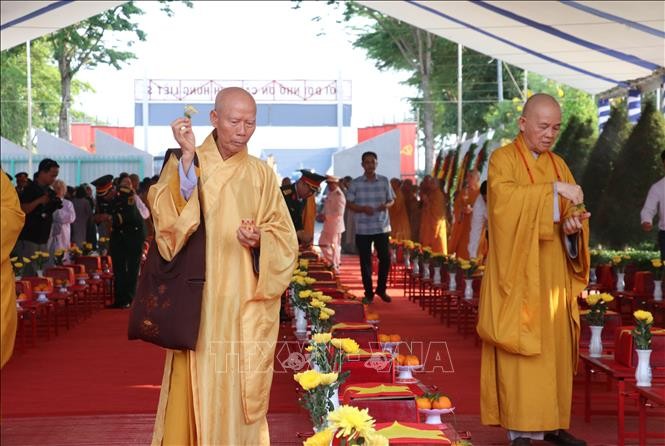 |
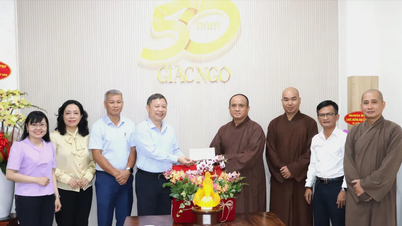
| Buddhist dignitaries of the Vietnam Buddhist Association in Tay Ninh province perform a memorial service for the heroic martyrs who sacrificed their lives in Cambodia throughout history. (Photo: News and Nation Newspaper) |
Tay Ninh is currently one of the localities that has strongly implemented the campaign and maintained search and repatriation activities in Cambodia for many consecutive years. According to Nhan Dan newspaper, the province's repatriation teams regularly travel deep into mountainous areas, former battlegrounds, to verify information about the burial places of fallen soldiers.
In northeastern Cambodia, Team K52 of the Gia Lai Provincial Military Command continues to expand its search in the provinces of Ratanakiri, Stung Treng, and Preah Vihear.
In early May 2026, Team K52 recovered two more remains of fallen soldiers in Ratanakiri province. Notably, the initial information was provided by local Cambodian residents. Along with the remains, the recovery team found many artifacts such as canteens, medical scissors, pens, medicine bottles, Vietnamese coins, and other items used by Vietnamese soldiers during the war. Biological samples were also taken for DNA testing.
According to the Gia Lai Provincial Military Command, since the beginning of the 2025-2026 dry season, Team K52 has collected 18 remains of Vietnamese volunteer soldiers and experts who died in Cambodia.
The search for fallen comrades continues in Laos. In recent days, recovery efforts have continued to uncover many remains of fallen soldiers in the southern provinces of Laos, including the area along the Sekong River – a site of many fierce battles. Many search areas have rugged terrain, and verifying burial locations relies primarily on witness memories and information provided by local residents.
As part of the campaign, authorities recovered the remains of 28 fallen soldiers in two provinces of Laos.
Accelerating DNA identification
Along with intensified search and repatriation efforts both domestically and internationally, many localities are accelerating the collection of biological samples, digitizing data, and conducting DNA testing to identify fallen soldiers whose identities are still unknown.
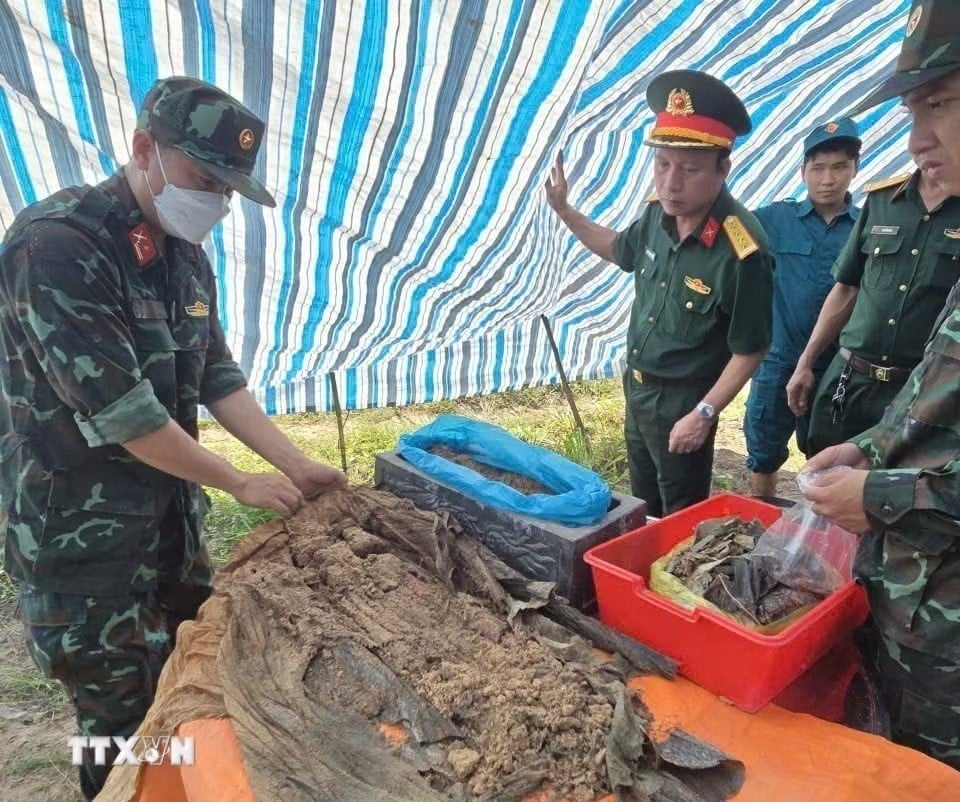 |
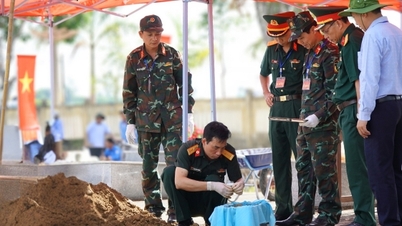
| Exhuming the remains of fallen soldiers in Phu Binh hamlet, Thanh An commune, Ho Chi Minh City. (Photo: VNA) |
According to VNA, during the campaign, Quang Tri province aims to search for and collect between 360 and 590 remains of fallen soldiers. Besides the search and collection efforts, Quang Tri aims to complete the sampling of remains from unidentified graves at 100% of the martyrs' cemeteries in the province, as well as all remains collected during the campaign. Simultaneously, it aims to build and operate a database of genetic information of relatives of unidentified fallen soldiers, creating a scientific basis for future identification efforts.
Hung Yen currently has nearly 35,000 martyrs' graves in 230 cemeteries, of which more than 4,200 graves have not yet been identified. The province aims to complete the collection of biological samples before March 2027.
Hai Phong currently has nearly 56,000 martyrs' graves in 383 cemeteries, of which 2,730 graves lack information and require DNA testing. The city was selected by the Steering Committee 515 (National Steering Committee on the search, collection, and identification of martyrs' remains) of Military Region 3 as the pilot location for collecting, handing over, and digitizing information on martyrs' remains, with the aim of gaining experience for wider implementation throughout the region. Hai Phong aims to complete this task before January 31, 2027.
Lao Cai province is also actively implementing a plan to collect samples of the remains of fallen soldiers for DNA testing to identify those whose identities are still unknown at cemeteries throughout the province. According to the plan, from now until July 27, 2027, the province aims to complete the collection of samples from 1,241 unidentified graves at 16 martyrs' cemeteries, as well as the remains of fallen soldiers that have been searched for and collected, for DNA testing.
In implementing the campaign, Thanh Hoa province set a target of searching for and collecting 40 to 45 remains of martyrs, including 33 remains of martyrs in Laos.
Behind those figures lies the persistent cooperation between Vietnamese authorities and the governments, armies, and people of Laos and Cambodia. Many burial sites of fallen soldiers were identified from the memories of elderly witnesses, those who directly participated in the burials or witnessed battles decades ago.
In this journey, technology is also opening up hope for thousands of families of fallen soldiers. One of the campaign's tasks is to enhance DNA testing and connect the gene bank of relatives with data on the remains of fallen soldiers.
Taking place from March 15, 2026 to July 27, 2027, the campaign aims to locate and collect approximately 7,000 remains of fallen soldiers; complete the sampling of remains from unidentified graves in martyrs' cemeteries nationwide; and conduct DNA testing on approximately 18,000 remains of fallen soldiers.
The campaign also aims to build and put into operation a database of genes of relatives of martyrs whose information has not yet been identified, serving the work of cross-referencing and identifying the remains of martyrs; to strengthen the work of clearing bombs, mines, and explosive ordnance to search for and collect the remains of martyrs, especially in key areas and core regions in Tuyen Quang, Lao Cai, and Lang Son provinces…
Source: https://thoidai.com.vn/hanh-trinh-dua-cac-liet-si-tro-ve-tu-dat-ban-221705.html

![[Photo] General Secretary and President To Lam presides over the meeting to approve the draft report on the results of the second inspection by the Politburo of the Standing Committee of the Hanoi City Party Committee.](https://vphoto.vietnam.vn/thumb/1200x675/vietnam/resource/IMAGE/2026/05/26/1779789811432_a2-bnd-4430-9620-jpg.webp)






























































Comment (0)