

Chinese researchers have discovered a new species of dinosaur, weighing about a ton, that lived during the Jurassic period, along with dozens of unhatched eggs in its nest.
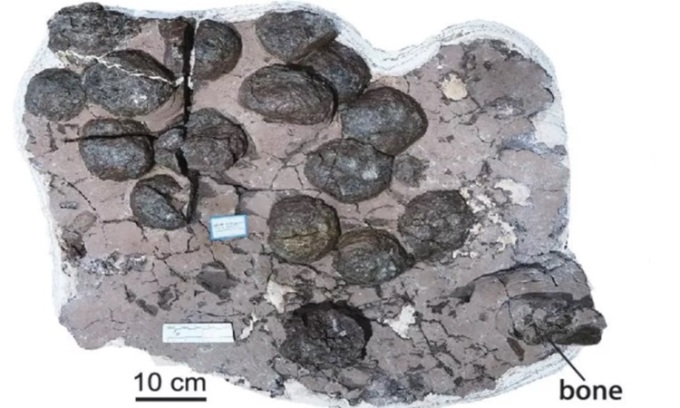
A nest of Q. shouhu eggs. Photo: Han Fenglu
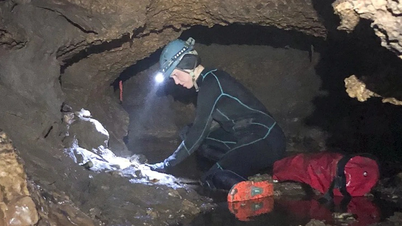
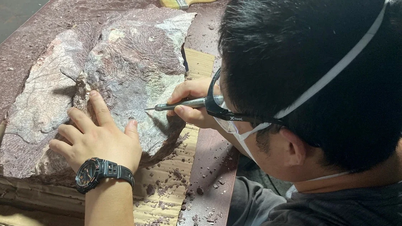
A research team from the Institute of Vertebrate Paleontology and Paleoanthropology (IVPP) of the Chinese Academy of Sciences (CAS) unearthed fossils representing at least three adult individuals of a newly discovered species in Guizhou province in southwestern China, according to a study published in the journal National Science Review, Newsweek reported on November 17.
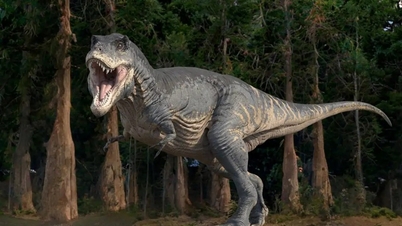
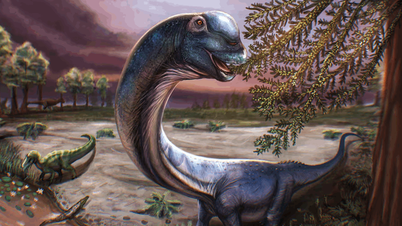
The newly discovered species, scientifically named Qianlong shouhu , belongs to the sauropod branch of dinosaurs, which includes the largest land animals that ever lived on Earth. These dinosaurs could reach enormous sizes, walk on four legs, and had extremely long necks, long tails, small heads, and broad thighs.
Q. shouhu was a medium-sized dinosaur, approximately 6 meters long and weighing around one ton. Along with the adult specimen, Chinese researchers also found 50 fossilized eggs of the same species, scattered across five different nests, containing the skeletons of embryos inside. Both the adult and the eggs date back 190 million years to the Jurassic period (145-200 million years ago).
The new discovery may be the earliest known fossil evidence of an adult dinosaur alongside an egg clutch. Analysis of the egg clutch revealed that the eggs were oval-shaped and relatively small. The analysis also revealed that the eggshells had a leather-like texture. Based on the findings, the research team named the new species Q. shouhu, meaning "dragon protecting embryos in Guizhou".
Human understanding of pre-Cretaceous dinosaur reproduction is limited due to the scarcity of fossils. However, this discovery helps fill some gaps. The research team's analysis revealed that the eggshells were semi-hard, challenging current understanding of the nature of early dinosaur eggs. According to the study's lead author, Han Fenglu, a professor at the School of Earth Sciences at the China University of Geosciences in Wuhan, dinosaur eggs from a similar period have also been found in South Africa and Argentina, but the eggs of Q. shouhu retain the most complete shell structure.
Furthermore, the research team found that all the embryonic skeletons inside the eggs in the nest of Q. shouhu were at the same stage of development, indicating that the dinosaurs hatched simultaneously, similar to modern sea turtles. This was a tactic to reduce the risk of being preyed upon by predators when the individual emerged from the eggshell.
An Khang (According to Newsweek )
Source link
![[Photo] Delegation attending the 14th Congress of the Vietnam Trade Union visits the Mausoleum of President Ho Chi Minh.](https://vphoto.vietnam.vn/thumb/1200x675/vietnam/resource/IMAGE/2026/06/03/1780451842301_ndo_br_img-3824-jpg.webp)


































































Comment (0)