

At Computex 2026 (Taiwan), Intel dedicated most of its key announcements to outlining its role in the next wave of AI. Instead of focusing solely on PC hardware, Intel demonstrated its ambition to bring its processors to multiple infrastructure layers, from end devices and robots to data centers.
This strategy is evident throughout the company's announcements, from the Core Ultra Series 3 platform for personal computers to the Xeon 6 line for data centers. Instead of just talking about hardware performance, Intel focuses on how its processors participate in the operation of AI systems.
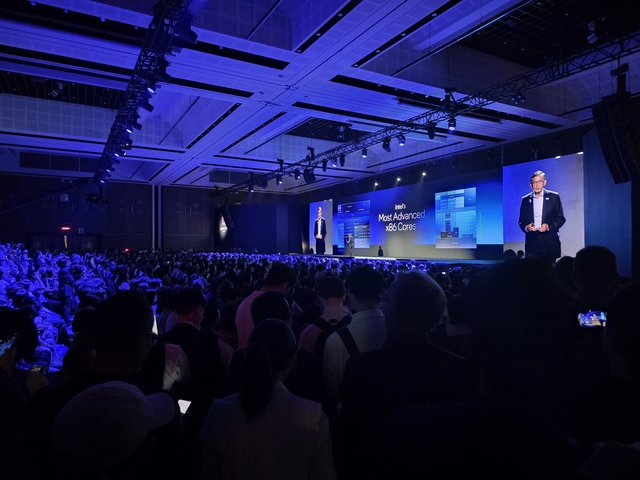
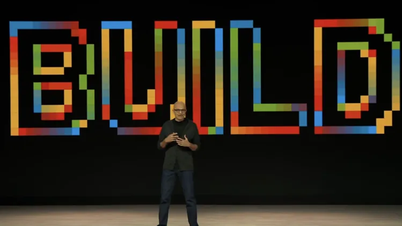
CEO Lip-Bu Tan presents at Intel's new product launch event at Computex 2026.
PHOTO: KHAI MINH
One of the standout presentations at the event came from Perplexity AI. The company demonstrated a hybrid processing model on devices using Core Ultra, where sensitive data is processed directly on the device, while less security-sensitive tasks are migrated to the cloud. This approach reflects the trend of bringing AI to end-user devices to reduce latency and reliance on remote infrastructure.
Beyond personal computers, Intel is expanding the application range of Core Ultra Series 3 to many other fields. Intel introduced the Arc G3 Series graphics platform for handheld gaming devices, and continues to integrate this platform into edge AI and robotics systems. According to Intel, there are currently over 130 edge AI design projects using the company's technology. One example is Sensory AI's Ella barista robot, which uses Core Ultra Series 3 to handle simultaneous AI tasks and real-time control. Intel also announced OpenVINO Physical AI, an open-source toolkit for deploying AI models to robots.
At the data center side, Intel argues that the technology industry is shifting from the Large Language Model (LLM) to agent-based AI systems (Agentic AI), where multiple AI agents work simultaneously to complete tasks. According to the company's argument, such systems require not only GPU processing power but also CPUs to act as coordinators and resource managers.
That's also why Intel continues to focus on Xeon 6 and Xeon 6+, while introducing Rackscale Blueprints and AI infrastructure collaborations with Foxconn. As NVIDIA and AMD expand their influence in the AI field, Intel is seeking to maintain its position by emphasizing the role of CPUs in the entire AI operational chain, rather than just competing in the race to accelerate computing speed.
Source: https://thanhnien.vn/intel-mo-rong-core-ultra-series-3-sang-robot-va-ai-bien-tai-computex-2026-185260602170614684.htm



![[Photo] First session of the 14th Congress of the Vietnam Trade Union](https://vphoto.vietnam.vn/thumb/1200x675/vietnam/resource/IMAGE/2026/06/03/1780465947883_ndo_br_img-3852-jpg.webp)






























































































Comment (0)