

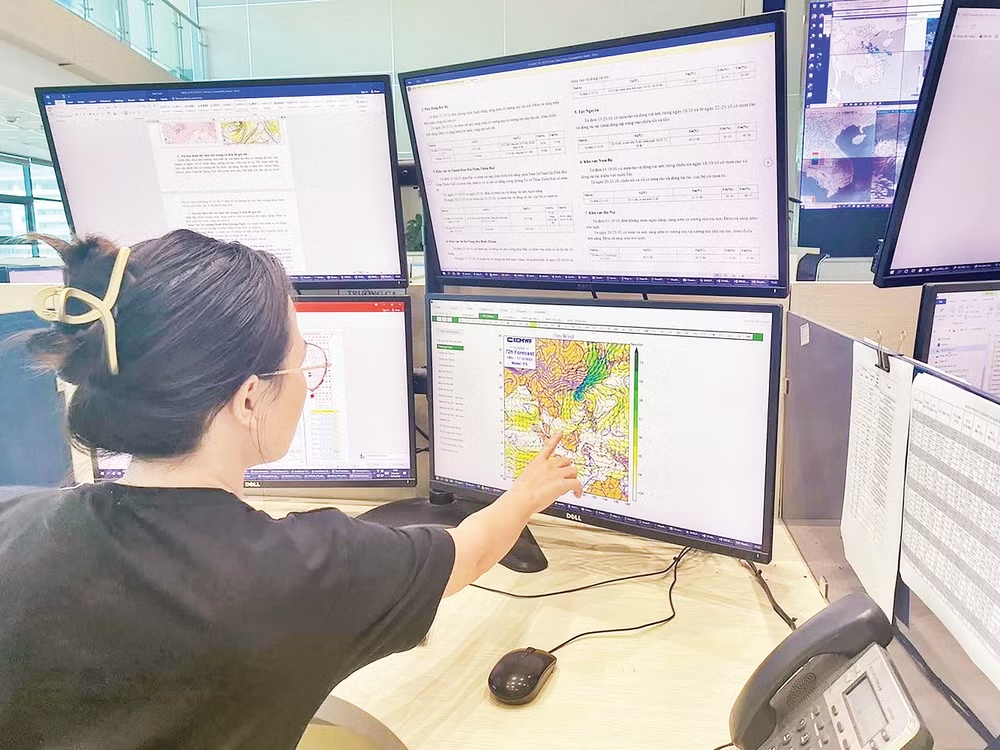
This year, the forecast predicts many extreme natural disasters.
Despite it being only the beginning of summer, the National Center for Meteorological and Hydrological Forecasting reported that on April 6th, 25 monitoring stations in 13 provinces and cities (Lai Chau, Dien Bien, Son La, and provinces and cities from Thanh Hoa to Dak Lak ) recorded temperatures ranging from 38 to under 40 degrees Celsius. Three stations recorded temperatures exceeding 40 degrees Celsius: Tay Hieu (Nghe An) at 40.3 degrees Celsius, Huong Son (Ha Tinh) at 40.1 degrees Celsius, and Dong Hoi (Quang Tri) at 40.2 degrees Celsius. The Southern region experienced hot weather with maximum temperatures generally ranging from 35-36 degrees Celsius, and in some places exceeding 36 degrees Celsius.
The Department of Hydrometeorology ( Ministry of Agriculture and Environment ) predicts that 2026 will see a strong shift in ENSO phases from La Niña to neutral, with a high probability of transitioning to El Niño by mid-year, significantly increasing the volatility, extremity, and unpredictability of natural disasters. Specifically, heatwaves will appear earlier, last longer, and be more intense than in 2025, concentrated from April to August. The risk of drought, water shortage, and saltwater intrusion will increase, especially in Central Vietnam, the Central Highlands, and Southern Vietnam.
Heavy rainfall is concentrated mainly in Northern Vietnam, North Central Vietnam, the Central Highlands, and Southern Vietnam from June to September. In Central Vietnam, it is concentrated from October to December. The total rainfall and number of widespread rain events this year are forecast to be approximately equal to or lower than the multi-year average, but the intensity of localized heavy rainfall is likely to increase, easily causing urban flooding, flash floods, and landslides, especially during transitional periods (April-May and September-October).
Regarding the typhoon season, Mr. Mai Van Khiem, Director of the National Center for Meteorological and Hydrological Forecasting, stated: According to forecasts, the activity of typhoons and tropical depressions in the East Sea in 2026 is likely to be no more than the multi-year average. From April to July 2026, the number of typhoons and tropical depressions operating in the East Sea and affecting Vietnam is predicted to be approximately the multi-year average. From August to December 2026, the number of typhoons may be lower than the multi-year average (the multi-year average in the East Sea is about 9.6 storms, of which about 3.8 storms directly affect the mainland). However, under current climate conditions, the trajectory and timing of typhoons are increasingly difficult to predict accurately, and unusual occurrences may happen.
Close coordination in disaster response.
According to the Ministry of Agriculture and Environment, natural disasters in 2025 occurred frequently, severely, and on a wide scale, exhibiting many unusual characteristics and exceeding historical levels. Statistics show that natural disasters resulted in 484 deaths and missing persons, 811 injuries, 4,259 houses destroyed, collapsed, or swept away, over 350,000 houses damaged or roof-blown, and approximately 547,000 hectares of rice and other crops and 322,000 hectares of other crops flooded and damaged. The total estimated economic damage exceeded 104,000 billion VND.
In light of this year's weather forecast and natural disasters, the Ministry of Agriculture and Environment emphasizes the need for central and local ministries and agencies to improve the institutional and legal framework for disaster prevention and control in a synchronized and unified manner, clearly defining the functions of ministries and agencies to avoid overlapping responsibilities. Promoting decentralization and delegation of authority, coupled with the responsibility of local authorities under a two-tiered government model, is necessary to enhance operational efficiency and ensure close coordination in disaster response.
One of the key lessons in disaster prevention and control is the crucial role of forecasting and warning systems. Forecast and warning information must be provided early, from afar, promptly, and accurately. In the context of climate change leading to increasingly extreme weather events, authorities and the public are advised to regularly update meteorological and hydrological forecasts, especially those covering 1-3 days. Based on this, relevant agencies and the public can proactively adjust production plans, response strategies, reservoir operations, and ensure the safety of structures, downstream areas, and people's livelihoods.
From a community perspective, Mr. Cao Duc Phat, Chairman of the Community Fund for Disaster Prevention, suggested that the meteorological and hydrological sector needs more effective solutions to deliver forecast and warning information closer and faster to communities. In particular, it is necessary to promote the application of technical advancements, digital technology, and AI in disaster forecasting and warning to make them increasingly effective.
Launch of an app to warn of thunderstorms, lightning, and flash floods.
On the morning of April 7th, the Department of Meteorology and Hydrology, Ministry of Agriculture and Environment have launched the "Vietnam Weather KTTV" app, providing real-time weather data. It integrates disaster warning systems. The application utilizes data from over 2,600 monitoring stations nationwide. It combines eight weather radar stations and numerical forecasting models. Rainfall, temperature, humidity, and wind data are updated every 10 minutes, allowing users to monitor the situation. The app closely monitors weather developments at your specific location. It can provide forecasts for up to 10 days, displayed every 3 hours.
According to Nhan Dan Online
Source: https://baohaiquanvietnam.vn/tin-uc/hoan-thien-the-che-phap-luat-phong-chong-thien-tai


![[Image] Hanoi's urban life under the challenge of a "scorching hot" environment](https://vphoto.vietnam.vn/thumb/1200x675/vietnam/resource/IMAGE/2026/05/25/1779706979265_nang-nong-t5-2026-minh-duy-7-4636-jpg.webp)


![[Image] Close-up view of the interchange connecting the two expressways and Long Thanh Airport.](https://vphoto.vietnam.vn/thumb/1200x675/vietnam/resource/IMAGE/2026/05/25/1779703378210_ndo_br_z7863716673926-224453a31600126cce10622af6290afd-4549-jpg.webp)























































































Comment (0)