Hundreds of protests involving thousands of people took to the streets across England in the first two weeks of August to protest against immigration and Islam, highlighting the alarming problems that persist in British society and politics .
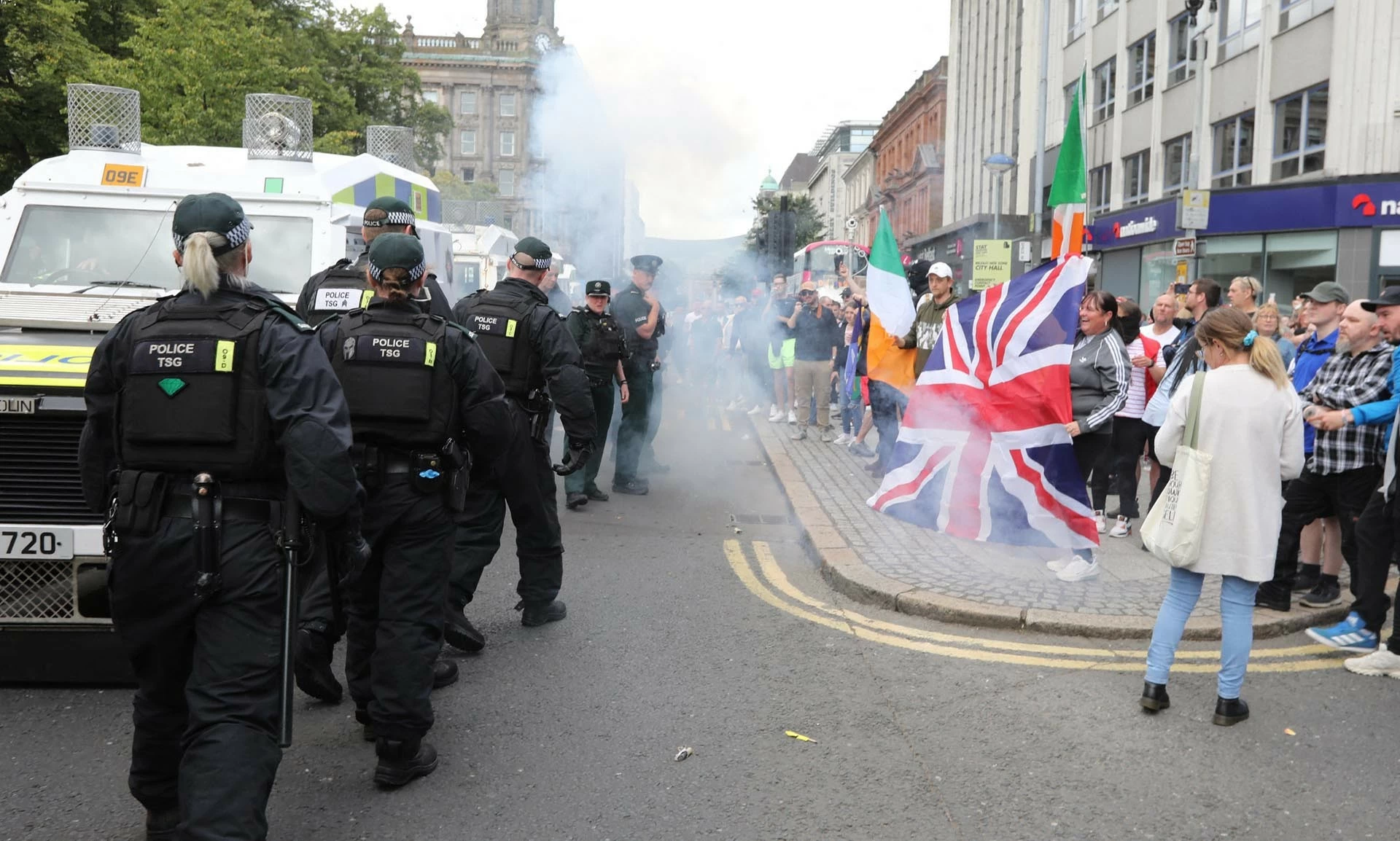 |
| Police and protesters on the streets of Belfast on August 3. (Source: AFP) |
The violent protests stemmed from the case of Axel Rudakubana, a 17-year-old British-born man of Rwandan parents who went to a dance class in the town of Southport and attacked three girls with a knife, killing three and injuring several others.
Fake news and division
However, the worst riots in Britain in 13 years only truly erupted when social media spread misinformation claiming that the suspect in the attack was a "radical Muslim immigrant" who had arrived in Britain by boat as a refugee and was on MI6's watchlist.
Prominent figures at the forefront of the far right, such as Tommy Robinson (founder of the far-right EDL movement, who was once banned from Twitter) and Laurence Fox (formerly a presenter for the right-wing GB News TV channel), have used social media to criticize and discriminate against immigrants, condemn the high rate of illegal immigration into the UK, and argue for the complete eradication of Islam from Britain.
Many assessments suggest that the spread of toxic rhetoric surrounding migration, easily inciting people from protests to riots, stems from existing frustration and dissatisfaction with the government and social conditions within the UK. Statistics from Oxford University show that the percentage of foreign-born workers in the UK has steadily increased over the past two decades, from 9% in the first quarter of 2004 to 21% in the first quarter of 2024. A segment of the population is beginning to worry about social inequality and the unfair distribution of resources.



However, another notable study by sociologist Noah Carl suggests that the figures from the recent election do not indicate strong opposition among the British people to mass immigration. Thus, the dissatisfaction is not solely focused on immigration; rather, the British people feel the government is failing to address fundamental social issues such as the cost of living and public services, leading them to seek a target for blame: immigrants and Muslims.
A warning bell
The Guardian argues that the riots in Britain have exposed a worrying “double standard” in how society perceives and responds to far-right violence and Islamic extremism. Research by the Defence and Security Research Institute (Rusi) in 2015 and 2016 showed that the public often associates far-right-motivated violence with “thuggish” or criminal behavior, while similar acts of Islamic extremism are seen as terrorism and jihad. This inconsistency diminishes awareness of the dangers of far-right extremism and the political will to effectively counter extremist violence.
What is happening in the UK is not an isolated incident, but part of a broader "phenomenon" of far-right extremism spreading across Europe. Similar far-right riots occurred in Dublin (in 2023) and Chemnitz, Germany (in 2018), both in response to stabbings that sparked anti-immigrant sentiment.
In 2024 alone, far-right extremists were suspected of attacking several Socialist and Green Party candidates and campaigners in Germany, as well as an anti-fascist event organized by left-wing and Green parties in Sweden. According to ACLED (an organization that collects and analyzes data on armed conflict), in 2020, far-right extremists were behind 85% of targeted attacks in 12 EU countries.
The violence in Britain serves as another wake-up call for Europe to reassess the state of far-right-motivated violence and find ways to address it with the same determination and precision as it deals with extremist violence.
The test for the new Prime Minister



British Prime Minister Keir Starmer, who had promised to cut immigration, is facing his first major test since taking office in early July. Previous Conservative governments have made similar commitments but have failed to bring annual legal immigration below 100,000. Since Brexit, legal immigration has even tripled, only slightly down from its 2022 peak.
Prime Minister Starmer's experience as a prosecutor in 2011 may help him quickly control the unrest in Britain and de-escalate the situation. However, addressing immigration issues remains a difficult problem. Britain still relies heavily on foreign workers to fill jobs in healthcare and several other sectors, and immigration is a driver of economic growth. It will be a challenge for the occupant of 10 Downing Street to reduce immigration without harming healthcare and hindering the goal of economic recovery to address the cost of living crisis.
The violent protests in Britain may be resolved soon. However, the riots have also exposed the challenges facing Britain, namely long-standing discontent stemming from economic and social inequality, racial and cultural tensions, and poorly controlled media. This compels the new British government to quickly find solutions to address the root causes that have existed within Britain for so long.
Source: https://baoquocte.vn/bieu-tinh-o-anh-hoi-chuong-ve-bao-luc-cuc-huu-282672.html
![[Image] A look back at the capital's preparations for the century-long master plan.](https://vphoto.vietnam.vn/thumb/1200x675/vietnam/resource/IMAGE/2026/06/29/1782750453122_quy-hoach-100-nam-minh-duy-1-2118-jpg.webp)
![[Photo] National Assembly Chairman Tran Thanh Man attends the Conference to announce the Master Plan for Hanoi Capital City with a 100-year vision.](https://vphoto.vietnam.vn/thumb/1200x675/vietnam/resource/IMAGE/2026/06/29/1782709639728_ndo_br_1-jpg.webp)

![[Photo] General Secretary and President To Lam works with the Party Committee of the Government on the work of preventing and combating storms, floods, extreme natural disasters and climate change.](https://vphoto.vietnam.vn/thumb/1200x675/vietnam/resource/IMAGE/2026/06/29/1782729441945_a1-bnd-0385-9454-jpg.webp)




































































![[Image] Building an elevated road through the Ma Da forest.](https://vphoto.vietnam.vn/thumb/402x226/vietnam/resource/IMAGE/2026/06/29/1782724737750_anh-man-hinh-2026-06-29-luc-16-18-43.png)