

Eighty years ago, the conference between the leaders of the three world powers—the United States, the Soviet Union, and Great Britain—held from November 28 to December 1, 1943, in Tehran, issued a joint declaration agreeing on unified action to end World War II and maintain lasting post-war peace.
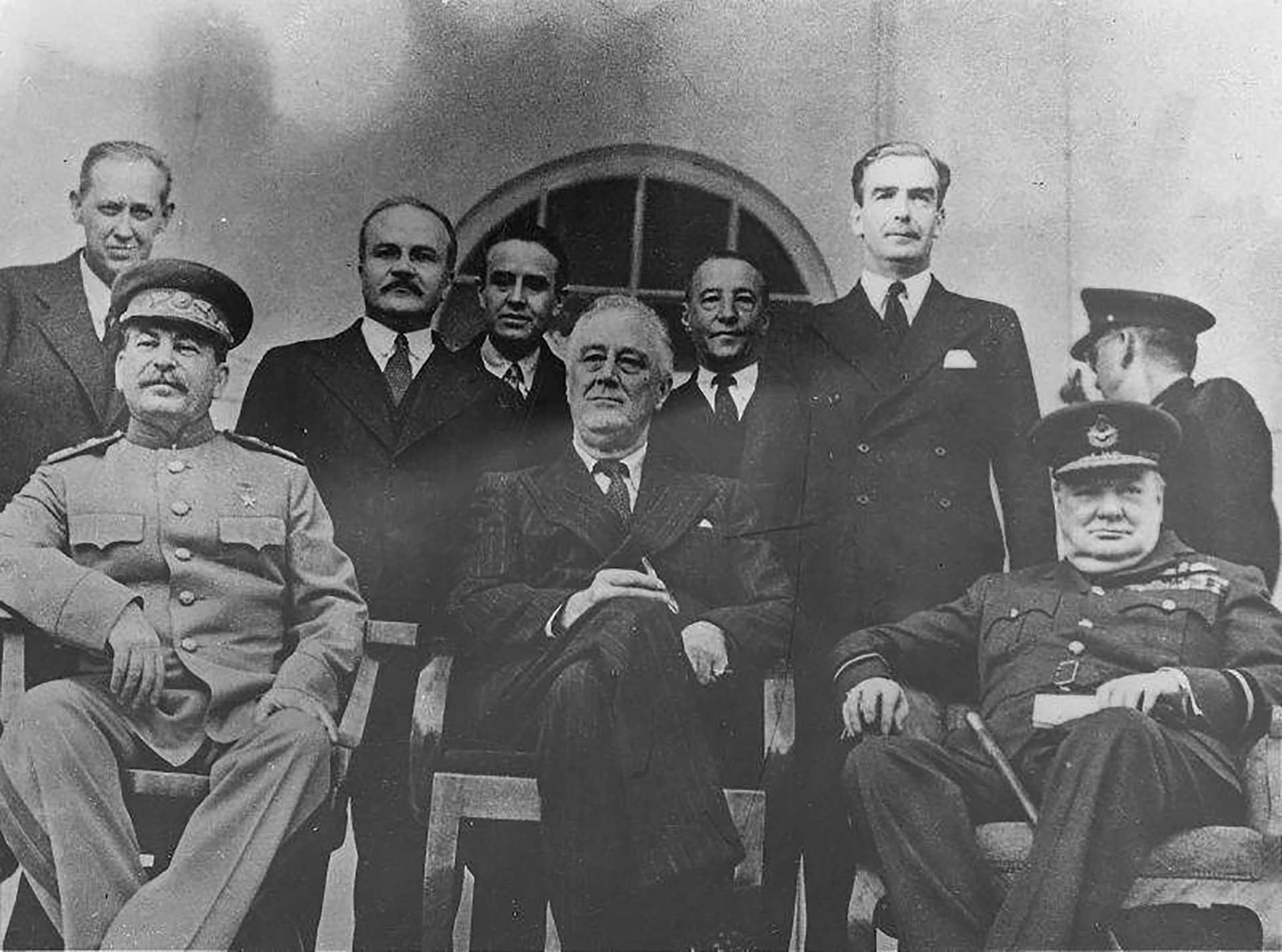 |
| Marshal Joseph Stalin, Chairman of the State Defense Committee of the Soviet Union, US President Franklin Roosevelt, and British Prime Minister Winston Churchill at the Tehran Conference in 1943. (Source: Topwar.ru) |
Marshal Joseph Stalin, Chairman of the State Defense Committee of the Soviet Union, US President Franklin Roosevelt, and British Prime Minister Winston Churchill set aside differing opinions to reach crucial decisions, accelerating the collapse of fascism and minimizing casualties among the military and civilians.
This event and the lesson about the responsible actions of the world's leading powers remain relevant today, as conflicts between Russia and Ukraine, and Hamas and Israel are raging fiercely.
Decision on location
In Western Europe, there was no suitable place, or if there was, it was too dangerous, to hold a meeting of the three world power leaders. The Americans and the British did not want to hold the conference on Soviet territory. In August 1943, Moscow was informed that neither Arkhangelsk nor Astrakhan were suitable for such a conference.
President Roosevelt and Prime Minister Churchill proposed a meeting in Fairbanks, Alaska. Marshal Stalin refused to leave Moscow for such a long journey during such intense warfare. The Soviet leader suggested holding the meeting in a country with representatives from all three nations, such as Iran. Besides Tehran, Cairo (as suggested by Churchill), Istanbul and Baghdad were also considered. Ultimately, the countries agreed to hold the meeting in Tehran, as the city was then controlled by Soviet and British forces, and also housed a US garrison.
The Iran Campaign (Operation Concord) was launched by British and Soviet forces in late August 1941. The Allied forces were stationed in Iran due to economic and military strategic considerations. Several Soviet units were stationed in northern Iran. British forces controlled the southwestern provinces. American troops, ostensibly to protect goods destined for the Soviet Union, entered Iran in late 1942. A crucial transport route then ran through Iranian territory, through which strategic American goods were transported to the Soviet Union. Overall, the situation in Iran, while complex, was manageable.
Ensuring security at the Conference
Stalin arrived at the conference on a train that passed through Stalingrad and Baku. Prime Minister Churchill traveled from London to Cairo, where he awaited President Roosevelt to coordinate the American and British positions on key issues in negotiations with the Soviet leader. The American president crossed the Atlantic aboard the battleship Iowa. After nine days at sea, the American fleet arrived at the Algerian port of Oran. Roosevelt then traveled to Cairo. On November 28th, the delegations of the three great powers were present in Tehran.
Due to the threat from German agents, enhanced security measures were implemented. The Soviet delegation stayed at the Soviet Embassy. The British stayed on the territory of the British Embassy. The British and Soviet diplomatic missions were located opposite each other on the same street in Tehran, no more than 50 meters wide. The American Embassy was located on the outskirts of the capital, where security was not guaranteed, so the American President accepted the Soviet leader's invitation to stay in the Soviet Embassy building.
The meeting took place at the Soviet Embassy. The British Prime Minister walked along a specially constructed covered corridor connecting the two embassies. Around the Soviet-British diplomatic complex, Soviet and British intelligence agencies had established three layers of security, supported by armored vehicles. All press in Tehran was shut down, and telephones, telegraphs, and radio communications were cut off.
Nazi Germany, relying on its extensive secret service system, attempted to orchestrate the assassination of the leader of hostile forces (Operation Leap Forward). Soviet intelligence, along with their British counterparts from MI6, directed and deciphered all messages from German telegrams about the landing of an assault group. The German telegraph operators were arrested, and subsequently the entire German intelligence network (over 400 people) was apprehended. The assassination attempts on Soviet, American, and British leaders were thwarted.
Issues for discussion
The Allied opening of a "Second Front" was the most difficult problem. After the strategic turning point in World War II at Stalingrad and Kursk, the situation on the Eastern Front (on the Soviet side) progressed favorably for the Soviets. The German army suffered irreparable losses and was no longer able to recover. The German political and military leadership lost the initiative, and Nazi Germany shifted to strategic defense. Soviet forces successively liberated Donbass and other areas of Ukraine, crossed the Dnieper River, and recaptured Kyiv. The Soviets drove the German army out of the North Caucasus and landed in Crimea.
But victory was still a long way off; Germany remained a formidable opponent with its powerful armed forces and industrial base. The longer the war dragged on, the greater the human and material losses for the Soviet Union and other European countries. The only way to accelerate the defeat of this fascist empire and its allies was through the joint efforts of the three great powers.
The Allies promised to open a second front in 1942, but a year later there was still no sign of it. The front was not opened for several reasons, including geopolitical considerations. Militarily, the Allies were ready for the campaign by the summer of 1943. A force of 500,000 soldiers had been deployed in Britain, always ready for combat, and provided with everything necessary, including naval, land, and air forces. The generals were eager to go into battle.
The British and Americans devised a strategic plan to attack from the south, through Italy and the Balkans. With the help of Türkiye, the Allied forces would launch an offensive on the Balkan Peninsula. Regarding the Soviet proposal to open a front from France, the British and Americans convinced the Soviet delegation that a landing in northern France would be complicated due to a lack of transport and logistical difficulties. Involving Türkiye in the war and advancing through the Balkans was a more advantageous scenario. This would allow the Allied forces to link up on Romanian territory and attack Germany from the south.
After much debate, the issue of opening a Second Front reached a deadlock. At that time, leader Stalin expressed his willingness to leave the conference, saying that there were too many things to do domestically and he did not want to waste time there.
Prime Minister Churchill realized that further demands were impossible and compromised. The British and American leaders promised the Soviet leaders that a second front in France would be opened no later than May 1944. The final timeline for the campaign was set for the first half of 1944 (the Second Front – Operation Overlord – finally began on June 6, 1944). In this campaign, the Soviet Union committed to launching a strong offensive in the East to prevent the movement of German troops from East to West.
The issue of the Soviet Union's involvement in the war against Japan was agreed upon at the Unification Conference. The Soviet delegation, taking into account the Japanese Empire's repeated violations of the 1941 Soviet-Japanese treaty on neutrality and its support for Germany, and also in response to the wishes of the Allies, declared that the Soviet Union would join the war against Japan after defeating Nazi Germany.
The future of Poland was also discussed at the conference. Preliminary, the parties agreed that Poland's eastern border would run along a line called the "Curzon Line." This line essentially corresponds to the ethnographic principle: to the west are territories with a predominantly Polish population, and to the east are territories with a predominantly Western Russian and Lithuanian population. Regarding Iran, the Tripartite group adopted the Iran Declaration. The document emphasized the desire of Moscow, Washington, and London to protect Iran's sovereignty and territorial integrity. The countries planned to withdraw their troops stationed there after the war ended.
The future of Germany was a hot topic at the Conference. During discussions on the post-war structure of Western Europe, the American and British leaders proposed dividing post-war Germany into several autonomous states and establishing international control over Germany's most important industrial regions, such as the Ruhr and Saarland. The Soviet leader disagreed with this idea and suggested referring the German issue to the European Consultative Committee. Subsequently, the Soviet leader maintained his position of preserving German unity. Nevertheless, Germany remained divided into East and West Germany at later Tripartite conferences.
Regarding the establishment of an international organization to ensure lasting peace after World War II, US President Roosevelt proposed the creation of an organization called the United Nations (this matter had previously been discussed with Moscow). The core of this international organization would be a committee comprising the Soviet Union, the United States, Great Britain, and China, tasked with preventing the initiation of a new war and aggression from Germany and Japan. Stalin and Churchill generally supported this idea.
It can be said that the special significance of the Tehran Conference has been forever etched in the history of diplomacy.
Source
























































































Comment (0)