

 |
| Mr. Dong Thanh Phong's indigo-dyed textile products are printed using advanced technology, attracting many customers to his workshop to purchase them. |
The call of the original blue color
In recent years, the art world, both domestically and internationally, has witnessed a quiet but powerful "return." Many artists have abandoned industrial paints, diligently searching for shades emanating from the earth and flowers – yellow from turmeric, or reddish-brown from boiled forest roots. For artist Dong Thanh Phong, former lecturer at the Ha Giang College of Education (now the Ha Giang branch of Thai Nguyen University), this return began with a deep blue: indigo blue.
The opportunity arose in 2010 when he was appointed Head of the Art Workshop of the Fine Arts Branch of Ha Giang Province (formerly). Field trips took him to highland villages, where the indigo color was present like the breath on the clothes and skirts of the local people.
However, behind that rustic beauty lies a reality that deeply saddened him. Recalling his days wandering through highland markets, artist Dong Thanh Phong mused: "I felt heartbroken seeing many bundles of fabric and shirts disguised as indigo dyes being bought and worn by the locals, but in reality, they were dyed with chemicals or naturally dyed but not according to standards. Their colors were dull, lacking depth, and faded and patchy after only a few washes."
Determined to find the perfect dyeing formula, artist Dong Thanh Phong traveled throughout the villages, inquiring about the indigo dyeing processes of the locals. Through his observations, he realized that this process was as intricate as any art form.
Without hesitation, the artist packed his bags and traveled to the villages in Hoang Su Phi commune, asking to stay with the local people for three days to learn from them. He excitedly said, "Living with them, I finally understood the secret. The Nung U people here don't just use one type of plant. They skillfully combine the indigo plant (herbaceous, with large leaves) with the woody indigo plant with small leaves to create indigo paste. Through extremely elaborate soaking, fermentation, and lime-making processes, the thick green foam is filtered into a viscous mixture called indigo paste." Buying the indigo paste was like finding a treasure for artist Phong. Unlike single-use dyes, indigo paste can be stored for several years, maintaining its quality, which is extremely convenient for long-term creative work. However, finding the right indigo raw material was only the beginning.
Innovations from "screen printing"
Having obtained a source of high-quality indigo dye, artist Dong Thanh Phong faced another major obstacle regarding its practical application. The traditional beeswax painting technique (Batik) of the ethnic minorities is extremely sophisticated, but its weakness is that it is too time-consuming.
From that concern, a bold idea emerged: to apply the silk-screen printing technology of industrial art to handcrafted indigo-dyed fabric. The principle of screen printing is to create a pre-printed silk screen with a pattern. However, the key difference here is that instead of applying chemical ink to the fabric as usual, the artist uses a "resist paste" to coat the mesh surface. This layer of paste will imprint itself onto the fabric, protecting the pattern from absorbing the dye when it is placed in the dye bath.
He began a grueling series of experiments, using all sorts of substitutes for beeswax, such as beef fat, cassava starch, and arrowroot starch, to stretch through the mesh frame. Even when trying cooking oil as a color-blocking agent, a "disaster" occurred. "Indigo is like a living organism; it's very sensitive to dirt and chemical impurities, oil, and grease. The chemical reaction from the cooking oil ruined and spoiled an entire large vat of dye. That time, I failed miserably, had to pay compensation, hire dyers to redo the dye, and throw away tens of millions of dong. It was a painful loss, but what remained was a valuable lesson about respecting the natural properties of indigo," artist Phong confided.
Undeterred, he packed his bags and headed back to Lung Tam, Quan Ba. After two to three years of research, he finally discovered a color-blocking agent extracted from natural ingredients such as cassava starch, beeswax, arrowroot starch, kaolin clay, etc., mixed with a unique secret recipe.
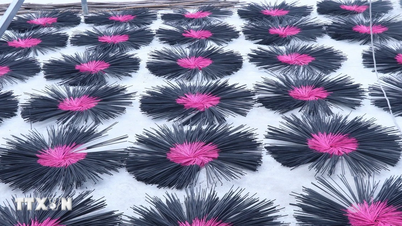
In 2022, he successfully experimented with screen printing technology on indigo-dyed fabric. The process unfolds like magic: a natural color-blocking agent is stretched flat across the screen, printing sharp patterns onto the surface of the raw fabric. After this agent dries, the fabric is dipped into a vat of indigo dye. After multiple dipping and drying cycles to allow the indigo dye to penetrate deeply, the fabric is boiled and rinsed. At this point, the color-blocking agent dissolves, revealing pristine white patterns that are perfectly uniform and stand out against the deep indigo background. This groundbreaking technique has been the subject of a school-level scientific research project: "Application of Technology in the Production of Indigo-Dyed Brocade" at Ha Giang College of Education. Artist Dong Thanh Phong shared: "The purpose of applying modern technology is to increase quantity, lower costs, and still ensure the aesthetic value of hand-painted designs. Through this, the products not only serve the tourism market but also contribute to the supply of materials for the Vietnamese fashion design industry."
In 2023, in the very first month of launching the product, revenue reached 40 million VND. His indigo-dyed fabric quickly moved beyond traditional stilt houses, transforming into curtains, bedsheets, decorative paintings, etc., and was continuously ordered by tourism establishments in Hanoi, Bac Ninh, Bac Giang, and Kien Giang. Using his products, Mr. Giang A Phon, owner of Nui Hoa homestay in Tung Vai commune, enthusiastically said: "Tourists, especially international visitors, are extremely impressed. They love the feeling of touching the fabric, which has a pungent mountain scent but also features modern, sophisticated patterns."
Not content with his initial successes, artist Dong Thanh Phong is planning to lease land and plant seedlings to establish a sustainable indigo dyeing raw material area. His greatest aspiration is to continue forging a new path, where "the soul of the nation is not only found in museums, but is present and breathes with the rhythm of contemporary life."
Giang Lam
Source: https://baotuyenquang.com.vn/van-hoa/tin-tuc/202605/hon-cham-trong-nhip-song-duong-dai-3002811/

![[Image] Hanoi's urban life under the challenge of a "scorching hot" environment](https://vphoto.vietnam.vn/thumb/1200x675/vietnam/resource/IMAGE/2026/05/25/1779706979265_nang-nong-t5-2026-minh-duy-7-4636-jpg.webp)





























































Comment (0)