


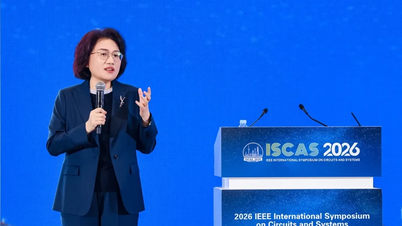
Ms. Ha Dinh Ba, President of Huawei's Semiconductor division, speaks at the International Circuit and Systems Conference (ISCAS) in Shanghai on May 25 - Photo: Huawei
According to AFP on May 25, the statement was made at the International Conference on Circuits and Systems (ISCAS) held in Shanghai.
Ms. Ha Dinh Ba, chairwoman of Huawei's semiconductor division, stated that the company aims to produce 1.4-nanometer (nm) chips by 2031. Meanwhile, TSMC, the world's leading chip manufacturer, expects to reach this milestone around 2028.
For many years, Huawei has been at the center of technological tensions between the US and China. Washington accuses Huawei's equipment of potentially being used for espionage, an accusation the Chinese company has repeatedly denied.
Since 2019, the US and several allies have imposed restrictions aimed at preventing Huawei from accessing advanced technology and components, including EUV lithography machines – equipment considered crucial for producing chips under 5nm.
According to Huawei, the new method could help the company produce advanced chips without relying on EUV machines.
Ms. Ha Dinh Ba stated that instead of continuing to shrink the space on the chip in the traditional way of Moore's Law, Huawei is shifting towards optimizing the communication time between the components inside the chip.
Huawei calls this new approach "Tau Scaling".
Moore's Law, proposed by Intel co-founder Gordon Moore, suggests that the number of transistors on a chip should double every two years, thereby making the chip more powerful or smaller. However, experts believe this method is gradually reaching its physical limits.
According to Huawei, the new approach aims to solve a problem that Intel once described as "being able to shrink indefinitely until it can't shrink anymore."
Ms. Ha Dinh Ba said that US sanctions have brought technological challenges to Huawei sooner, but at the same time forced the company to find a different path.
"Our solution is feasible and cost-effective. The performance of the new chip can fully compete with other approaches," she announced the solution.
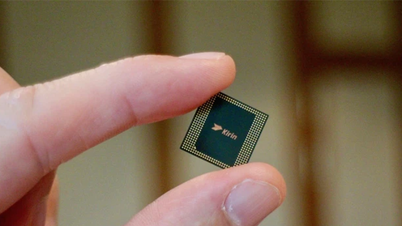
Huawei also stated that the next generation of Kirin chips, expected to launch this fall, will be the first product to fully adopt the new LogicFolding architecture.
Some experts believe that although Huawei has not yet announced specific commercial products, the company's new direction could further increase concerns from the US in the semiconductor technology competition.
Source: https://tuoitre.vn/huawei-phat-develop-new-chip-technology-to-overcome-us-ban-20260525154428906.htm
![[Image] Hanoi's urban life under the challenge of a "scorching hot" environment](https://vphoto.vietnam.vn/thumb/1200x675/vietnam/resource/IMAGE/2026/05/25/1779706979265_nang-nong-t5-2026-minh-duy-7-4636-jpg.webp)




























































































Comment (0)