

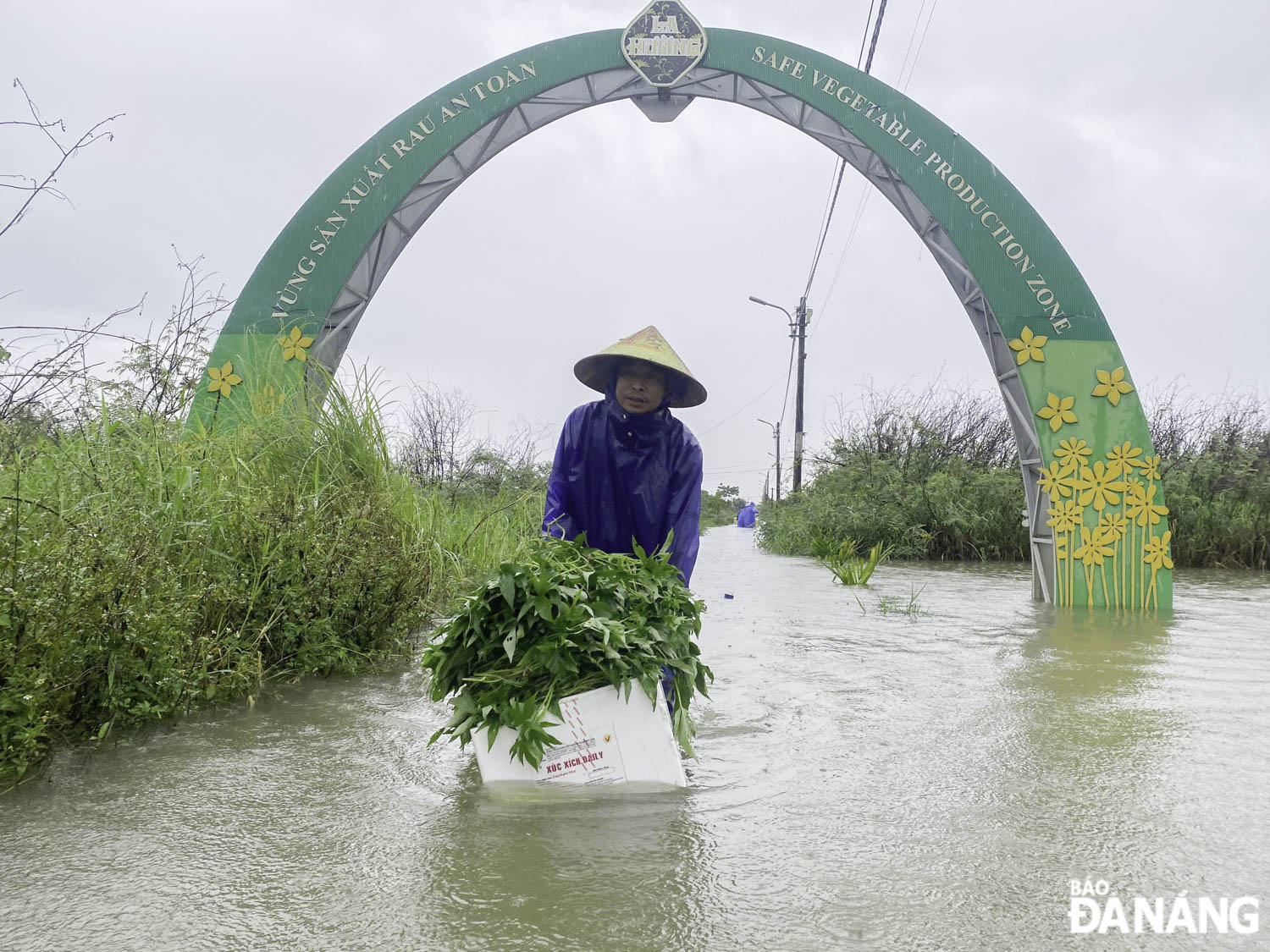
Prolonged heavy rains caused by Typhoon No. 1 have submerged many hectares of vegetable crops in the La Huong vegetable-producing area. In the photo, taken on June 12th, many farmers are trying to salvage their crops from the floodwaters. |
Accordingly, for rice crops, all resources should be mobilized to clear waterways to facilitate rapid drainage and save the summer-autumn rice crop from flooding. Water levels should be adjusted to ensure the rice plants do not fall over. For rice fields with a lot of mud clinging to the leaves, water should be sprayed to wash away the mud, allowing the rice plants to photosynthesize.
After the floodwaters recede, clean the fields and replant dead rice seedlings by thinning from clumps of rice with many tillers in the field and from fields of the same variety in higher areas that were not flooded. At the same time, apply root-stimulating fertilizer to help the plants recover quickly and promote rice growth and development (super Humic can be used at a dosage of 50-100g per 500m² plot … ) or spray biological preparations/super phosphate fertilizer, at the dosage recommended by the manufacturer.
Local authorities and farmers should monitor the fields and, upon observing that young roots have emerged, promptly apply the first topdressing fertilizer (for rice fields 10-12 days after sowing): 2kg Urea + 3kg Potassium + 2kg DAP/500m2 plot, or the second topdressing (25-30 days after sowing): 3kg Urea + 3kg NPK/500m2 plot.
Meanwhile, for vegetable crops, it is necessary to clear the drainage channels and prevent prolonged waterlogging in the fields, which can cause root rot. For fields that have been flooded for a short time and are planted with young vegetable crops that have the potential to recover, it is necessary to quickly drain the water from the field, spray fungicides to prevent root rot; combine this with KH products, super phosphate, etc., for supplementary care and fertilization when the weather is favorable to help the plants recover quickly.
Farmers should absolutely avoid applying nitrogen fertilizers to diseased and unrecovered crops; when applying fertilizers or spraying pesticides on vegetables, ensure the correct concentration, dosage, and waiting period. For severely affected areas where harvesting is impossible, clean the fields and proactively prepare the land for replanting suitable short-term vegetable crops.
For fruit trees, it is necessary to dig ditches and drainage channels in orchards prone to flooding. In addition, prune diseased branches, suckers, and overgrown branches at the base and within the canopy to improve air circulation and reduce pest and disease problems.
The City's Department of Agriculture requests that localities disseminate guidance notices to farmers; technical staff should coordinate with communes, wards, and agricultural cooperatives in districts and counties to guide farmers on proper care and appropriate treatment measures to quickly restore affected crop areas.
BAO LAM - TRAN TRUC
Source: https://baodanang.vn/kinhte/202506/huong-dan-cham-care-cay-trong-do-anh-huong-boi-con-bao-so-1-4009696/
![[Photo] Prime Minister Pham Minh Chinh presides over a meeting on private sector economic development.](/_next/image?url=https%3A%2F%2Fvphoto.vietnam.vn%2Fthumb%2F1200x675%2Fvietnam%2Fresource%2FIMAGE%2F2025%2F12%2F20%2F1766237501876_thiet-ke-chua-co-ten-40-png.webp&w=3840&q=75)

![[Photo] Prime Minister Pham Minh Chinh presides over the conference announcing the establishment of the International Finance Centre in Vietnam.](/_next/image?url=https%3A%2F%2Fvphoto.vietnam.vn%2Fthumb%2F1200x675%2Fvietnam%2Fresource%2FIMAGE%2F2025%2F12%2F21%2F1766309817714_ndo_br_dsc-3400-jpg.webp&w=3840&q=75)







































































Comment (0)