

Overlapping regulations
Speaking at the seminar "Laws in Financial Activities Regarding Transfer, Capital Contribution, and Investment in Real Estate Projects in Vietnam," Mr. Tran Son Vu, Chairman of the Association for Research and Consulting on Legal Policies for Investment Activities in Vietnam, stated that the real estate market is facing the need for strong restructuring after a period of significant fluctuations.
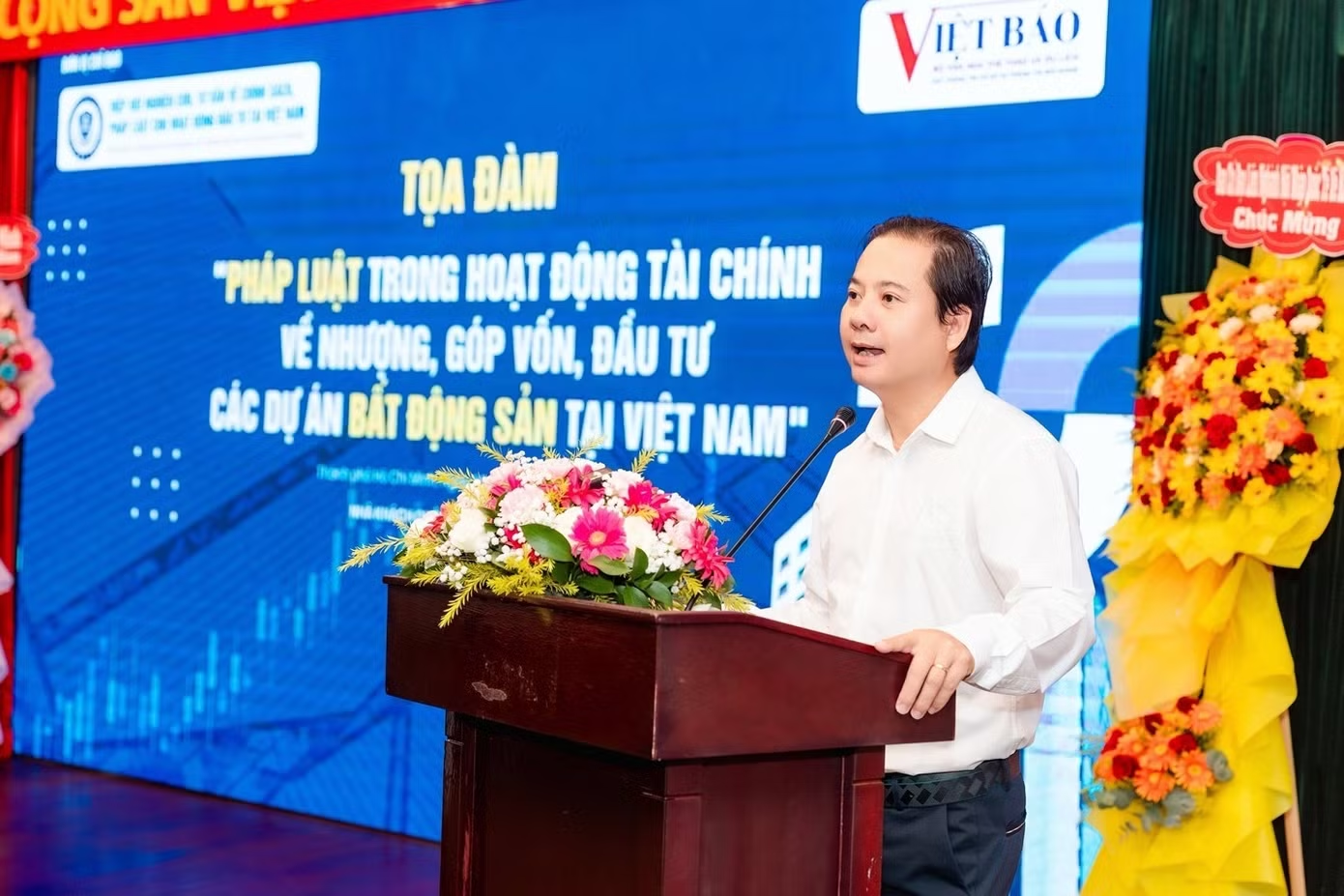
According to Mr. Vu, perfecting the legal framework related to project transfers, capital contributions, and fundraising activities will not only help businesses overcome difficulties but also contribute to creating a more transparent, safe, and sustainable investment environment.
"The market needs a clear and consistent legal framework to ensure the legitimate rights of the State, businesses, and investors, while also improving the efficiency of land resource utilization in the new development phase," Mr. Vu said.
Meanwhile, Mr. Bui Dang Dung, former Deputy Chairman of the National Assembly 's Finance and Budget Committee, assessed that the new regulations have contributed to increasing transparency in project transfers, creating a legal basis for market restructuring and attracting domestic and international investment capital.
However, Mr. Dung also pointed out that the overlapping regulations between the Land Law, Investment Law, Housing Law, and Real Estate Business Law remain a major bottleneck. Many projects, even those requiring transfer or restructuring, still face prolonged processing times due to differences in the application of the law by the competent authorities.
Therefore, Mr. Dung proposed studying a mechanism that would allow credit institutions to act as guarantors or set up escrow accounts. Accordingly, funds from the buyer could be directly deducted to pay land tax obligations to the State on behalf of the seller. This solution would help unblock projects stalled due to the previous investor's inability to pay taxes, while ensuring the State collects taxes correctly and completely.
At the same time, it is necessary to quickly finalize the legal framework for the development of real estate investment trusts (REITs) and private equity funds. These will provide a solid financial foundation, acting as professional buyers to consolidate fragmented projects through equity transfers, reducing excessive dependence on bank credit.

"Administrative procedures after the transfer need to be simplified. The process of changing the investor on the investment certificate and land ownership certificate should be implemented through a one-stop mechanism, shortening the waiting time so that capital can flow into the project's reconstruction sooner," Mr. Dung said.
What should we do?
Similarly, Mr. Le Hoang Chau, Chairman of the Ho Chi Minh City Real Estate Association, said that the entire political system is currently very determined to remove obstacles for projects. However, the regulation that projects wishing to transfer ownership entirely or partially must fulfill their financial obligations is causing difficulties for businesses.
To acquire clean land, businesses have to invest a huge amount of capital. By the time they start implementation, many investors run out of money because the law requires that projects must have land ownership certificates to be eligible for loans. Therefore, many investors are forced to sell their projects prematurely.
However, when project transfers encounter difficulties, businesses circumvent the rules by transferring company shares. In this case, the "core" of the business changes, and the new owner is essentially the buyer of the project. This loophole isn't inherently wrong because the law doesn't prohibit transferring company shares, but it does carry some risks later on.
According to lawyer Truong Anh Tu, Chairman of TAT Law Firm, real estate mergers and acquisitions (M&A) are no longer simply about transferring assets, but in many cases have become about transferring the entire legal framework of a project. This is also why legal aspects are becoming the first filter for capital flows.
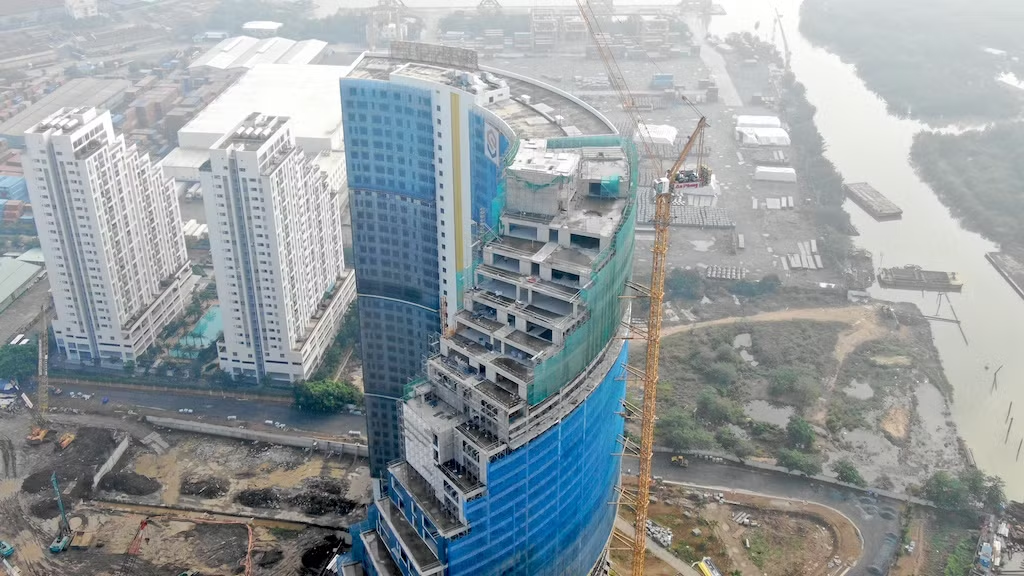
"Previously, credit institutions were primarily interested in the value of collateral, but now they want to know how the land use rights were acquired, to what extent financial obligations have been fulfilled, whether the project involves public assets, and whether those property rights are capable of maintaining stability in the event of changes in the legal environment," lawyer Tú said.
Therefore, during the due diligence process for M&A, legal risks begin to be directly reflected in the transaction value. A project with a complex legal history will be subject to a deeper discount. A project that has not yet fulfilled its financial obligations will take longer to access funding. A project with an unclear legal history will undergo a more rigorous and lengthy due diligence process.
According to Mr. Tú, what the market is currently lacking is not necessarily land or cash flow. Investors are only truly ready for the long term when they clearly understand their rights, their obligations, and whether those rights will remain protected after many years.
"That's also why the biggest story in the real estate M&A market is no longer about the race to own more land, but about building more transparent, stable, and reliable property rights. That's the most profound change happening in the Vietnamese real estate market today," lawyer Tú said.
Source: https://tienphong.vn/huong-di-nao-cho-ma-bat-dong-san-post1847834.tpo

































![[Photo] Reception to welcome General Secretary and President To Lam and his wife on their State visit to the Philippines](https://vphoto.vietnam.vn/thumb/1200x675/vietnam/resource/IMAGE/2026/06/01/1780295488620_vna-potal-chieu-dai-chao-mung-tong-bi-thu-chu-tich-nuoc-to-lam-va-phu-nhan-tham-cap-nha-nuoc-toi-philippines-8798060-7855-jpg.webp)





































































Comment (0)