

Hong Giang was praised for getting into university, but felt disappointed because it was her seventh choice, something she filled out "just for the sake of it" and didn't really like.
A week ago, Giang, from Nam Dinh province, came to Hanoi to enroll in the Educational Science program. The atmosphere at the university was lively, welcoming students, but Giang didn't feel comfortable. This wasn't the major or the university she had hoped to be accepted into.
When applying for admission, Giang listed her first three choices for the Communication, Sociology, and Political Science majors at the Academy of Journalism and Communication. The female student said she had liked the school for a long time, but with only 23 points in the C15 subject combination (Literature, Mathematics, Social Sciences) in the high school graduation exam, she couldn't get admitted.
Giang also failed to get into her next three choices at the University of Labour and Social Affairs. These majors all had cut-off scores above 22.85 for the D01 combination (Mathematics, Literature, English), but Giang only achieved 21.9 points.
"In the end, I got accepted into the Educational Science program without being able to picture what I'll be like in the next four years or what I can do after graduation," Giang sighed, saying.
Bao Nam, from Bac Giang province, was also unhappy about being accepted into the Electrical and Electronic Engineering Technology program. Having scored nearly 25 points on the A00 group graduation exam (Mathematics, Physics, Chemistry), Nam applied to the Mathematics Education program at Thai Nguyen University of Education, but was not accepted.
"There were also some schools with similar admission scores for teacher training programs, but they were too far from home. Plus, with encouragement from my family, I ended up putting electrical and electronics engineering as my second choice," Nam explained, adding that he doesn't regret it yet but "still feels disappointed because becoming a teacher has been my childhood dream."
On student forums, many similar posts received thousands of interactions. Some users shared that after studying at university for 3-4 years, they still found it unsuitable and had to drop out to switch to another major. Others advised candidates to just study to get a bachelor's degree and then figure things out later.
While there are no specific statistics on the percentage of students admitted to or studying majors that do not match their preferences, a 2019 survey by the Ho Chi Minh City Center for Human Resource Demand Forecasting and Labor Market Information found that approximately 60% of students chose the wrong major, and 75% lacked understanding of their chosen field.
Having to study a major they don't like puts many students in a difficult position, caught between the dilemma of "leaving it would be a shame, but staying would be a burden."
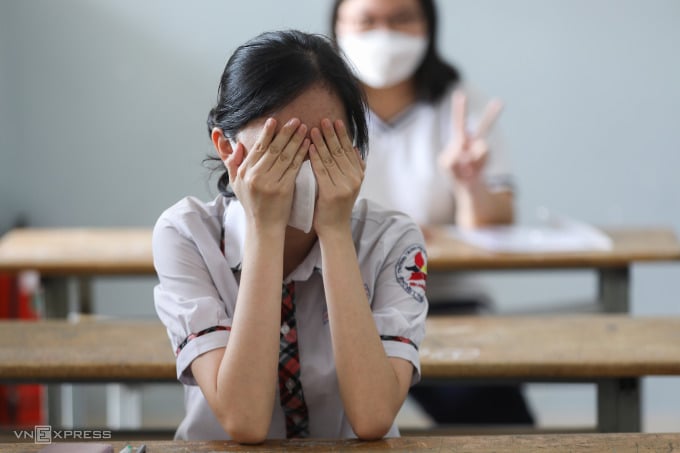
Students taking the 2022 high school graduation exam in Ho Chi Minh City. Photo: Quynh Tran
Ngoc Lan, 26 years old, from Hai Duong province, initially applied to the Accounting and Auditing program at the National Economics University after failing to get into the Medical program at Hanoi Medical University two years prior. Discouraged, Lan neglected her studies, achieving a GPA of only 2.8/4 and consistently ranking last in her class for the first two years.
"It wasn't serious enough to warrant an academic warning, but at that time I felt very hopeless and thought about dropping out of economics and retaking the medical school entrance exam for the third time," Lan recalled.
Giang and Nam are currently feeling uncertain about whether they should continue pursuing the majors they were admitted to. Giang said that, according to her estimates, the tuition fee for one year at the school is about 11 million VND. While her family can afford this amount, the female student worries, "What if I study for four years and end up working in a different field? Wouldn't that be a waste of money?"
Nam, on the other hand, is worried about tuition fees. If he enrolls in a teacher training program, he will be exempt from this fee and receive an additional 3.63 million VND for living expenses. From a situation where his family barely needed to support him, Nam now faces tuition fees of 20 million VND per year.
"My parents keep saying it's okay, but I'm quite worried about having to study a major I don't like, and the tuition isn't cheap," Nam said.
Mr. Lam Trieu Nghi, Principal of Nguyen Thuong Hien High School in Ho Chi Minh City, said he had often heard former students share and complain about having to study unwanted majors in university. However, he believes that first and foremost, students should clarify the concept of what they truly love, avoiding the temptation to "look at the grass on the other side of the fence," following trends or being influenced by family and society without relying on their own abilities.
In August 2020, the British Council published research on young people in Vietnam (aged 16-30). Only 16% of the 1,200 respondents said they chose their current field of study because they believed it was the most suitable path to achieving their desired career. Over 64% chose their field based on interest, 31% based it on job opportunities, 20% found it financially suitable, and 18% chose their field of study because family, friends liked it or teachers advised them to.
"Some students choose randomly from the start, so they end up studying a major they don't like; but there are also students who get into their desired major, only to find out after studying that it's not a good fit," shared Mr. Le Xuan Thanh, Head of the Political and Student Affairs Department at the Hanoi University of Mining and Geology. According to Mr. Thanh, just because a student likes a particular major doesn't mean they have the ability to study it.
Ngoc Lan admitted this. After two years of being at the bottom of the class, she wondered, "Do you even know what studying medicine is like to say you like it?" and conversely, "Do you even know what accounting and auditing are to hate it?". When she changed her attitude, Lan realized that much of the knowledge she learned about accounting and auditing was very interesting and useful.
"Economics wasn't my initial choice, but it changed my life. Now, if you asked if I would still study medicine, I would refuse because, having thoroughly understood it, I realize I'm not suited for it," said the woman in her third year as a PhD student in Finance and Accounting at the University of Bristol, England.
Therefore, Lan believes that students should spend more time on their current field of study to better understand it and assess its suitability. According to her, not everything we initially imagine about the field and ourselves is correct; it takes time to understand and adjust.
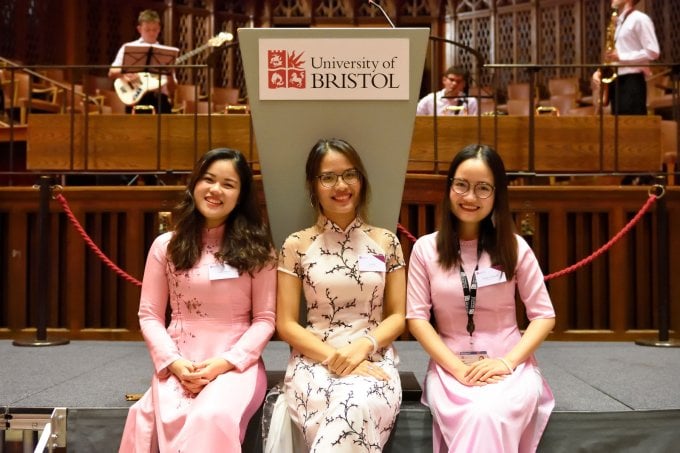
Ngoc Lan (right) and two Vietnamese students at the University of Bristol, in late 2019. Photo: University of Bristol
Teachers say they discourage freshmen from dropping out or retaking exams immediately because it's costly in terms of money and time. Instead, students can find more positive solutions such as applying to change majors, pursuing a double degree, or actively participating in clubs and professional activities in their field of interest.
Associate Professor Bui Duc Trieu, Head of the Training Management Department at the National Economics University, said that each year, the university has about 400 students registering for two programs simultaneously. According to Professor Trieu, regulations vary from university to university, but basically, if students meet the entrance requirements of their chosen majors, they will be given the opportunity to pursue their preferred subjects and majors.
If students realize that their chosen field of study is unsuitable in terms of interests and abilities, that it's difficult to find a job, and that they can't switch fields, they should consider dropping out and retaking the entrance exams.
Furthermore, Mr. Trieu emphasized the effectiveness of career guidance starting from the secondary school level. He argued that for students to have a thorough understanding of their chosen field of study, the synchronized participation of the entire society is necessary. Secondary schools have the advantage of being close to students, making it convenient to answer questions, share information, and provide advice. Universities provide in-depth information about fields of study and training programs.
Faced with a fait accompli, Bao Nam said he would "open his heart" to the field of Electrical and Electronic Engineering Technology. According to Nam, even if he doesn't become a high school teacher, he still has the opportunity to become a university lecturer.
"I heard that if students do well in their studies, they can be retained by the university. This might be my new goal to fulfill my desire to teach," Nam said, adding that after settling in, he will work as a math tutor, both to earn extra money for his studies and to satisfy his passion.
As for Hong Giang, she attended her first day of classes. She said the school offers general education courses in the first year, before students are divided into specializations. Giang said she will research thoroughly, listen to advice from senior students, and then make a choice.
"I don't want to choose randomly again," Giang said.
Thanh Hang
Source link



![[Photo] The heat at the fireworks display site on the opening night of the Da Nang International Fireworks Festival 2026](https://vphoto.vietnam.vn/thumb/1200x675/vietnam/resource/IMAGE/2026/05/27/1779889741485_ndo_br_z7872039145157-fecaba5112f39e8352544099d7ef4738-5140-jpg.webp)
![[Photo] Life on both banks of the river returns to its bustling pace on the day the Long Bien Bridge opens to traffic.](https://vphoto.vietnam.vn/thumb/1200x675/vietnam/resource/IMAGE/2026/05/28/1779949763708_cau-long-bien-minh-duy-7-3610-jpg.webp)










































































































Comment (0)