

The total investment for the North-South high-speed railway project is estimated at over 67 billion USD. This is a significant amount, but according to assessments by specialized agencies and experts, mobilizing the funds will not be a major obstacle.
State budget is the main source of funding. Regarding the proposed investment plan for the entire 1,541km line, Mr. Chu Van Tuan, Deputy Director of the Railway Project Management Board ( Ministry of Transport ), stated that the average investment per kilometer is approximately 43 million USD. This figure is lower than Indonesia's investment per kilometer for the line that opened in 2023 (approximately 52 million USD/km) and is at an average level compared to other countries worldwide. 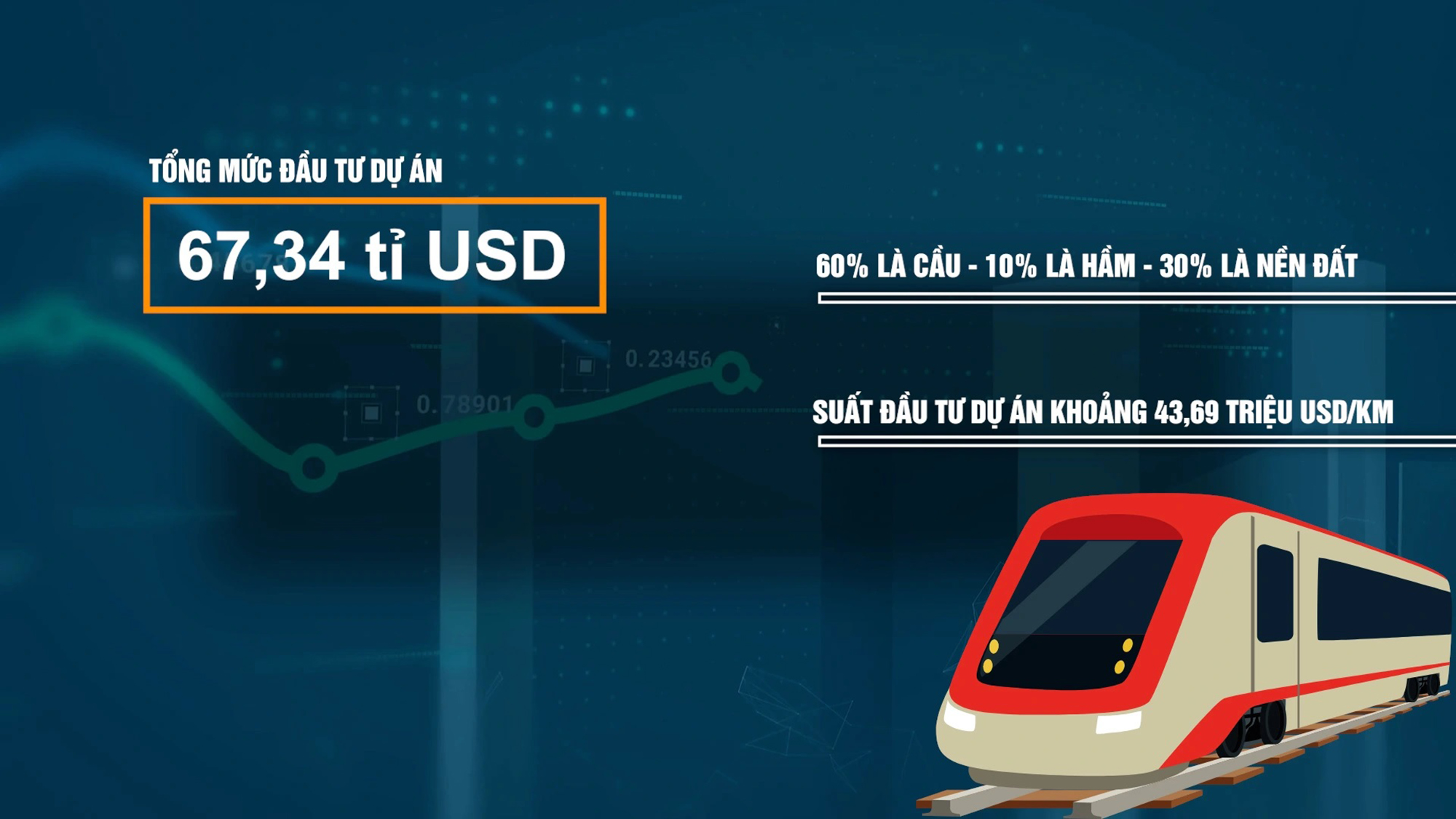 Regarding the issue of capital mobilization, international experience shows that, to ensure feasibility, state budget capital needs to play a leading role. It is expected that capital will be mobilized from the state budget in medium-term periods and from ODA funds (in cases where the loan has fewer strings attached and lower costs than domestic mobilization). "During the operation process, we will encourage socialized investment in service and commercial areas at the stations, with businesses paying infrastructure rental fees to the State," Mr. Tuan said. Mr. Tuan also stated that, according to aggregated data from the medium-term public investment plan for the 2021-2025 period, the investment capital for the expressway system alone is approximately 450 trillion VND, equivalent to 18 billion USD (about 3.6 billion USD/year). After 2027, when the expressway system is basically completed, the aforementioned public investment capital can be shifted to prioritize railway projects, especially high-speed rail. The project is expected to commence in 2027 and be completed in 2035, requiring an average annual investment of approximately US$5.6 billion. This amount is equivalent to 0.98% of GDP, not significantly higher than the ratio of capital/GDP allocated from the central budget for investment in expressways during the 2021-2025 period (US$3.6 billion/year, equivalent to 0.84% of GDP in 2023). This ratio does not include ODA loans or capital mobilized from local budgets. It is clear that funding for the project is not a major obstacle. There is no fear of falling into a "debt trap." According to Mr. Nguyen Van Phuc, former Deputy Chairman of the National Assembly's Economic Committee, the question of where the resources will come from was raised by National Assembly deputies in 2010, including himself. "At that time, the total investment for the project was estimated at $56 billion, while the economic context was very difficult. But after nearly 14 years, our potential has changed," Mr. Phuc said. Citing the experiences of Japan, China, and Indonesia, all of which decided to invest in their first railway lines when their GDP per capita was not yet high, Mr. Phuc shared that, according to research by the World Bank, this is the appropriate time to build a high-speed railway in Vietnam. "We are not afraid of falling into a 'debt trap' and can mobilize budget capital, government bonds, local capital, and other state capital sources," Mr. Phuc affirmed. Considering the project's large scale, complex technology, and significant investment resources, National Assembly Deputy Pham Van Thinh (National Assembly Economic Committee) argued that the mobilization of funds needs careful consideration to ensure feasibility. "For example, the state budget will fund land acquisition. Since the state has undertaken this, there is no reason for delays," Mr. Thinh said. Meanwhile, according to economic expert Dr. Nguyen Duc Kien, the project is an opportunity to use public investment to attract private investment. "A preparatory phase is needed to allow Vietnamese businesses to proactively participate in the construction of the entire line, except for things that require hiring foreign design or supervision," Mr. Kien suggested. Exploiting land resources: According to Mr. Tran Thien Canh, Director of the Vietnam Railway Department, based on preliminary calculations and proposed research plans, the central government budget for the North-South high-speed railway line will be approximately 46 billion USD (accounting for over 68% of the total investment). This capital will be allocated in medium-term periods for infrastructure construction, land clearance, and other costs. Approximately 21 billion USD in ODA loans (accounting for nearly 32% of the total investment) will be used to purchase vehicles and equipment. Mr. Nguyen Ngoc Dong, former Deputy Minister of Transport, stated that the general principle worldwide is that for high-value public railway projects with large infrastructure, the State plays a leading role. Private enterprises, on the other hand, will perform better in transportation services. The investment could be studied in a way that the State invests in infrastructure and leases it out. Private enterprises would invest in locomotives, carriages, and other transportation-related equipment. "In South Korea, private enterprises assigned to operate annually pay 34% of their revenue to the State," Mr. Dong cited as an example, while noting that for State capital, it must be clarified how central or local capital will be used. When the project is under construction, localities along the route can exploit land resources and develop the economy and urban areas around the stations, so localities must have a certain responsibility to contribute to the investment in the line, at least for land clearance in their areas. Expecting large revenues from TOD, the Ministry of Transport stated that, according to a preliminary assessment by the Ministry of Finance , by 2030 the project will fully meet the three criteria regarding public debt safety, government debt, and national debt. There are two criteria regarding direct government debt repayment and budget deficit that have slightly increased compared to the targets set in the 10-year socio-economic development strategy for the period 2021-2030. Specifically, direct debt repayment is approximately 33-34% of GDP (higher than the target of 25% of GDP), and the average budget deficit is 4.1% (higher than the target of 3%). Nevertheless, after the project is put into operation, urban areas and commercial services will be formed around the stations with a Transport-Oriented Development (TOD) model (expected to develop TOD at 23 stations along the line, with an average scale of approximately 330 hectares per location). Calculations by the international consultants reviewing the project, provided by the Ministry of Planning and Investment, estimate revenue from land use and commercial exploitation at approximately US$39 billion. This revenue will contribute to improving all indicators of public debt safety, direct debt repayment, and budget deficit. Director of the Railway Department, Tran Thien Canh, shared that countries with developed high-speed railways all apply the TOD (Transit-Oriented Development) model: "Experience shows that TOD planning must be done beforehand. Only after the railway is invested in and put into operation will added value be generated. At that time, stakeholders will participate and invest in real estate development. What needs to be done is to continue researching the institutionalization of TOD."
Source: https://www.baogiaothong.vn/huy-dong-hon-67-ty-do-lam-duong-sat-toc-do-cao-the-nao-192241003224401895.htmThe consultants preparing the pre-feasibility study report estimated the total investment for the project at approximately $67.34 billion.
At a press conference on October 1st, Deputy Minister of Transport Nguyen Danh Huy stated that the government will develop a plan to mobilize domestic capital and, depending on its financial capacity, may issue domestic bonds or borrow from abroad. If borrowing from abroad is necessary, it must come with preferential conditions, minimal restrictions, and the most significant condition is the transfer of technology to Vietnam. "This project demonstrates the Party's strong political determination and is a key project that requires prioritized investment. The Ministry of Transport is continuing to work with relevant agencies to identify issues more clearly and ensure feasibility," the Deputy Minister said.
The draft of the revised Railway Law, currently under development, outlines the following direction: Based on the national railway plan, including high-speed rail, localities will allocate land around national railway stations for TOD (Transit-Oriented Development) projects. These TOD projects will be implemented by the locality, using local funds for land acquisition and auctions. After deducting expenses, the surplus value will be distributed as follows: the locality will retain 50% and transfer 50% to the central government for railway investment.
![[Image] Hanoi's urban life under the challenge of a "scorching hot" environment](https://vphoto.vietnam.vn/thumb/1200x675/vietnam/resource/IMAGE/2026/05/25/1779706979265_nang-nong-t5-2026-minh-duy-7-4636-jpg.webp)
![[Image] Close-up view of the interchange connecting the two expressways and Long Thanh Airport.](https://vphoto.vietnam.vn/thumb/1200x675/vietnam/resource/IMAGE/2026/05/25/1779703378210_ndo_br_z7863716673926-224453a31600126cce10622af6290afd-4549-jpg.webp)
















































































Comment (0)