

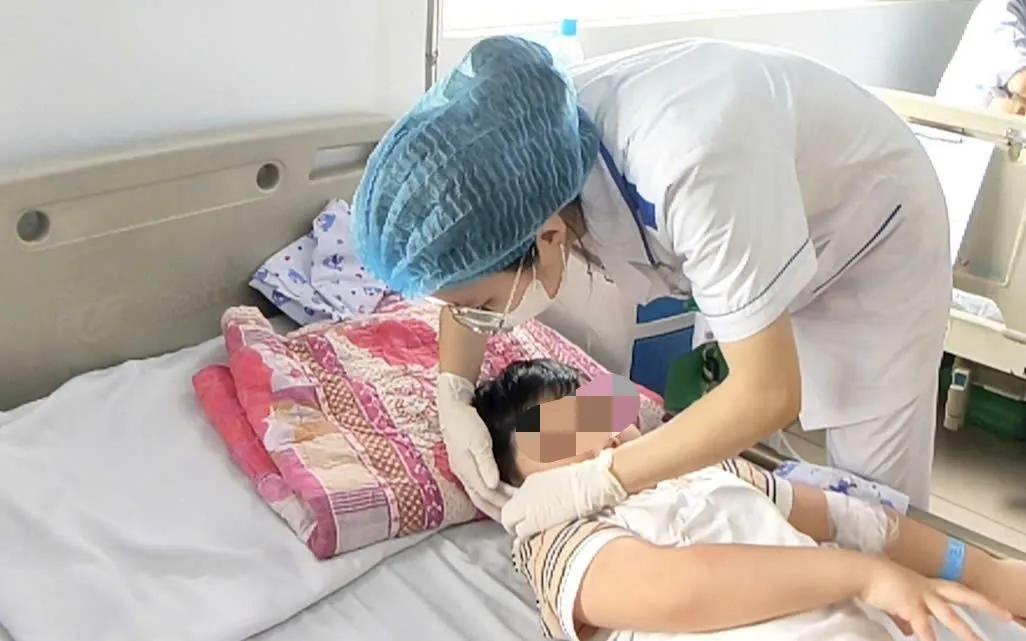
Photo: BVCC
The National Hospital for Tropical Diseases recently admitted and treated a 6-year-old patient, NV, residing in Lao Cai , who suffered from congenital preauricular fistula in both ears.
Upon reviewing the patient's medical history, doctors noted that the child's grandfather, father, and older brother had all suffered from this defect and had undergone surgery to remove the fistula. Patient V. is the fourth member of the family to show symptoms of the disease.
According to family members, the two fistulas in front of the child's ears frequently secreted a white, foul-smelling discharge and caused itching when blocked. Concerned about the risk of recurrent infection, as had happened to the older brother, the family took the child for surgery early.
According to Dr. Trinh Thuy Lien, a specialist in Ear, Nose, and Throat, the team completely removed the fistula tract and the associated cartilage membrane to minimize the risk of recurrence.
After more than an hour of surgery, the operation was successful. One day after the procedure, the child was alert, had no fever, the surgical wound was dry and clean, there was little pain, and no need for painkillers.
According to doctors, a preauricular fistula is a benign congenital defect formed by the incomplete fusion of the external ear structures during the fetal stage. The defect manifests as a small hole in front of the earlobe, which may extend deep inside.
Some cases are associated with genetic factors. This defect is noted to have a tendency to be inherited in an autosomal dominant manner, but its expression is not uniform among family members.
Although benign, preauricular fistulas still carry the risk of infection, abscess, and inflammation of the auricular cartilage if discharge accumulates for a long time.
Doctors advise that if children show signs of foul-smelling discharge, swelling, pain, or recurrent inflammation in the area in front of the ear, families should take them to a specialized medical facility for timely examination and treatment. The most appropriate time for surgery is when the lesion is no longer acutely inflamed.
Source: https://vtv.vn/hy-huu-gia-dinh-3-the-he-mac-ro-luan-nhi-100260526150517125.htm

![[Photo] General Secretary and President To Lam presides over the meeting to approve the draft report on the results of the second inspection by the Politburo of the Standing Committee of the Hanoi City Party Committee.](https://vphoto.vietnam.vn/thumb/1200x675/vietnam/resource/IMAGE/2026/05/26/1779789811432_a2-bnd-4430-9620-jpg.webp)








































































Comment (0)