

Semiconductors are one of the most important supporting industrial materials, playing a fundamental role in the development of many key industries such as electronics, information technology, telecommunications, automotive, medical devices, and defense.
For many years, when discussing the semiconductor industry in Vietnam, people have often talked about FDI inflows, modern factories owned by foreign corporations, and the limited role of domestic businesses in the value chain. This reality has raised a big question: When will Vietnam have a chip factory invested in, operated, and technologically mastered by Vietnamese people?
CT Semiconductor – a member of CT Group – is seeking an answer to that question with a challenging choice: building a semiconductor chip manufacturing, packaging, testing, and processing plant (OSAT/ATP) owned and operated by Vietnamese people, from design to operation, from human resources to technology.
The aspiration to step out of the "comfort zone" of Vietnam's semiconductor industry.
According to Wan Azmi, Chief Operating Officer of CT Semiconductor, the biggest concern for domestic semiconductor manufacturers today is the fact that most chip factories in Vietnam are owned by FDI companies. Vietnamese people are mainly involved in simple stages of production, with little opportunity to access core technologies, and even less chance of mastering the value chain.
"Serial semiconductor technology self-reliance cannot simply stop at leasing land or supplying labor," shared Mr. Wan Azmi. That is also why CT Semiconductor decided to pursue the more challenging path: investing in a purely Vietnamese semiconductor factory, gradually building endogenous capacity for the chip industry.

At a networking event between leading global technology corporations and Vietnamese executives in the field of Industry 4.0 core technologies held in Ho Chi Minh City, Mr. Wan Azmi stated that his company has submitted an investment application and is awaiting evaluation from relevant authorities. The planned factory will cover an area of approximately 20,000 m², comprising four floors, and will carry out all processes for manufacturing, packaging, testing, and semiconductor chip processing.
This decision required enormous resources. To build the complete operating system alone, CT Semiconductor invested approximately 2,400 billion VND; the cost of importing equipment for the factory construction amounted to about 2,200 billion VND, not including auxiliary items and other technology costs. “Investing in semiconductors is a long-term, high-risk investment, but if we don’t start, Vietnam will forever be left out of the game,” Mr. Wan Azmi stated frankly.
In this context, new state policies, especially the National Assembly's Resolution on piloting special mechanisms and policies for the development of science and technology, innovation, and digital transformation, are considered a crucial impetus. The Resolution allows for financial support to build the first semiconductor factory serving research, training, and chip production, with support up to 30% of the total investment capital, a maximum of 10,000 billion VND. However, CT Semiconductor affirms that it will not wait for policy, but will proactively take a step ahead.
A purely Vietnamese chip factory and the ambition to shape the semiconductor ecosystem.
CT Semiconductor's most concrete step is the ATP chip factory project in Binh Duong – the first semiconductor factory in Vietnam where Vietnamese technology is fully developed. The project is being implemented on an area of approximately 30,000 m² at the CT Group High-Tech Development Center in Thuan An City, Binh Duong Province, with the participation of Deputy Prime Minister Nguyen Chi Dung at the groundbreaking ceremony for the production line installation.
In phase 2, the project has a total investment of nearly $100 million, focusing on building cleanrooms that meet international standards, equipping them with modern machinery, and implementing smart factory management software. The factory is expected to be operational from Q4/2025 and reach a capacity of approximately 100 million chips per year by 2027.
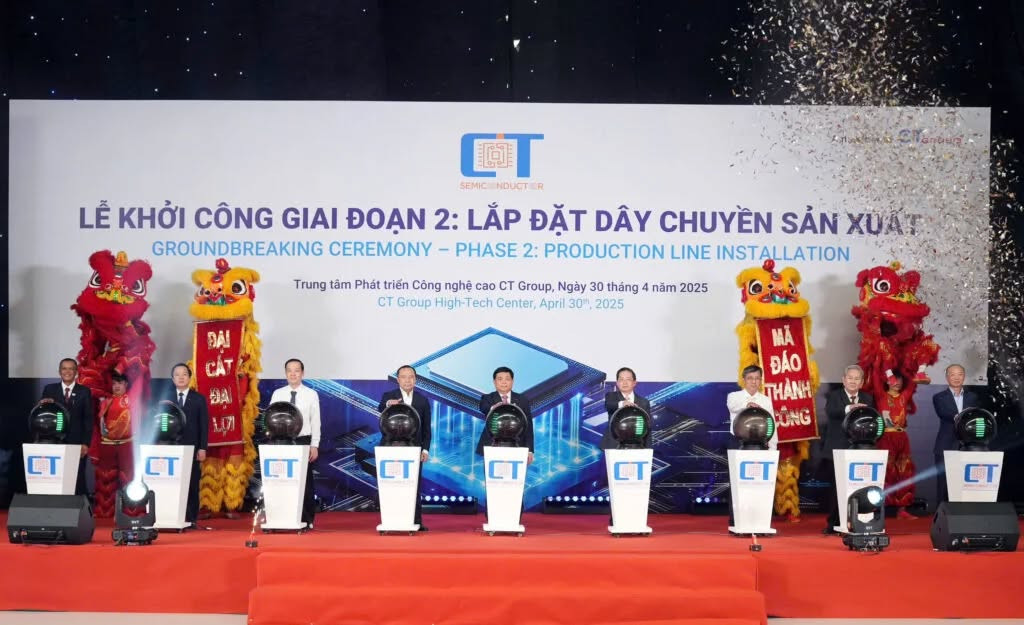
The project's iconic highlight is its closed-loop production line, from design to final production, operated using technology mastered by Vietnamese engineers. The factory design process involved consultation with a reputable international corporation – the same one that built most of TSMC's factories – along with a team of semiconductor experts with over 30 years of global experience.
Mr. Azmi Bin Wan Hussin Wan, Chief Operating Officer of CT Semiconductor, affirmed that by September 2025, the first batches of chips will be assembled, packaged, and tested entirely by a 100% Vietnamese-owned enterprise. “This is not only a milestone for CT Semiconductor, but also a milestone for the Vietnamese semiconductor industry,” he emphasized.
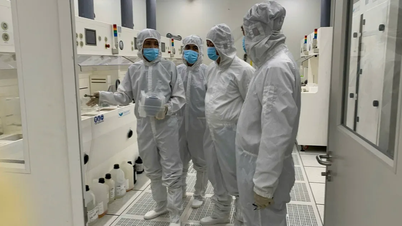
Alongside factory construction, CT Semiconductor is investing heavily in human resources – a vital element for the semiconductor industry. The company collaborates with leading global educational partners, including Arizona State University (USA), and also works with domestic universities to train personnel on-site. Trainees have access to modern production lines and work alongside experts from both within and outside the country.
According to Mr. Tran Kim Chung, Chairman of CT Group, CT Semiconductor's goal is not just to build a factory, but to establish a purely Vietnamese semiconductor enterprise, pioneering in mastering core technologies and changing the old approach that relies heavily on FDI. The company is committed to allocating more than 10% of its capital and revenue to R&D, focusing on advanced technologies such as GaN materials, photonics, chips for AI, 6G networks, and UAVs.
Together with the CT Innovation Hub in Ho Chi Minh City, a high-tech ecosystem owned and operated by Vietnamese people is gradually taking shape. This is not just the story of one enterprise, but a test of Vietnam's ability to enter the semiconductor industry using its own internal strength, intelligence, and aspiration for self-reliance.
Hiep Nguyen

Source: https://vietnamnet.vn/ct-semiconductor-va-khat-vong-lam-chu-nha-may-chip-made-by-vietnam-2477031.html




![[Image] Nearly 125,000 Hanoi students completed the Literature exam for the 10th grade entrance exam.](https://vphoto.vietnam.vn/thumb/1200x675/vietnam/resource/IMAGE/2026/05/30/1780117233041_ndo_br_thiet-ke-chua-co-ten-2-png.webp)



































































































Comment (0)