

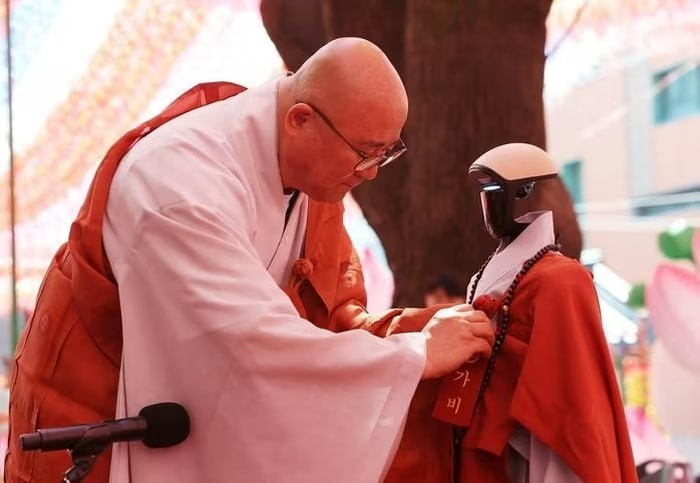
The recent appearance of the robot Gabi at Jogyesa Temple in Seoul, South Korea, has attracted much attention. During a ceremony organized by the Jogye Order of Korean Buddhism, the approximately 1.3-meter-tall humanoid robot was given the Dharma name "Gabi" and participated in the initiation ritual.
Some of the rules for robots are also interpreted in a way that is appropriate for the technological age, such as causing no harm, not lying, conserving energy, and not harming other robots.
This is not the first time technology has entered a temple. In Vietnam, in 2019, Giac Ngo Pagoda in Ho Chi Minh City launched the Giac Ngo 4.0 robot, capable of chanting scriptures, receiving questions, and answering approximately 3,000 questions related to Buddhism.
These phenomena can easily feel strange, even controversial. Can robots take refuge in Buddhism? Can machines chant scriptures? Does technology diminish the solemnity of a Buddhist monastery?
But looking at it from a broader perspective, the emergence of robots or AI reflects a reality: religious life is also facing the need to adapt to the digital age.
Over the years, religious spaces have changed significantly under the influence of technology. Dharma talks are livestreamed, scriptures are digitized, and retreats can be registered for online.
Young people learn about Buddhism through social media, podcasts, short videos , or meditation apps. Therefore, robots chanting scriptures or AI answering Buddhist questions are simply a further step in the process of technology becoming a tool to support the dissemination of Buddhist teachings.
A robot capable of answering basic questions about Buddhism could help newcomers to the faith feel less intimidated. A carefully constructed AI-assisted teaching system could assist in researching scriptures, explaining concepts, and recommending sermons tailored to individual needs.
For young people, who are accustomed to receiving information through digital devices, these formats can create initial curiosity, opening a door for them to enter the world of religious teachings in a more accessible way.
However, the very allure of technology also presents limitations that need to be clearly recognized. Robots lack "humanity" and experience. Meanwhile, the core of spiritual practice lies not in repeating a ritual, but in mindfulness.
A person who chants does so not only to produce sound, but also to listen, reflect on themselves, cultivate compassion, and develop the capacity for transformation.
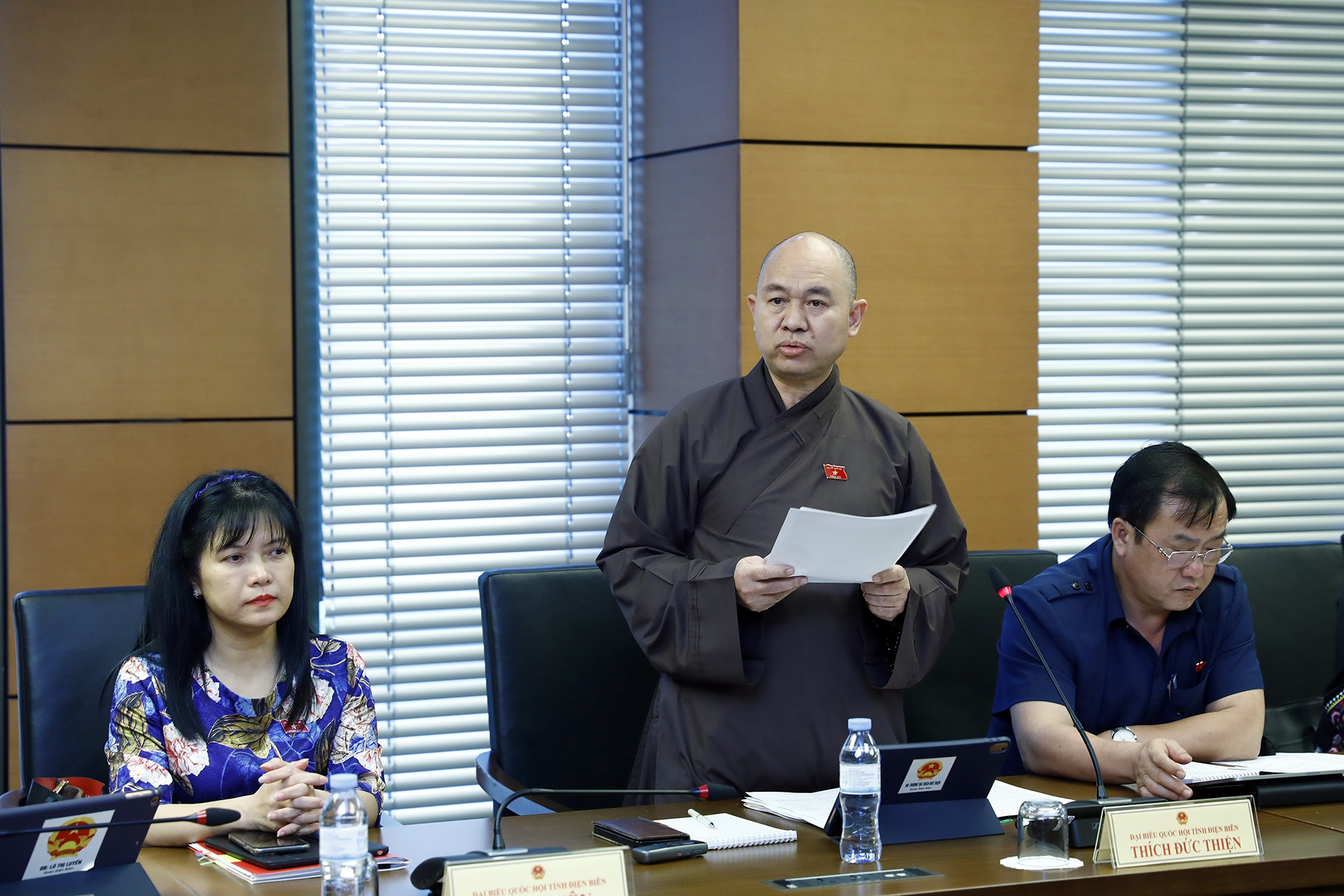
People go to temples not only to witness the rituals, but also to find inner peace, to learn to let go of attachments and desires, and to be more compassionate towards themselves and others. No matter how advanced technology becomes, these things still belong to human life experiences.
Therefore, the issue is not whether or not to introduce robots or AI into Buddhist spaces. The more important question is: what is the purpose of introducing them, to what extent, and who is responsible for the content that the technology transmits?
If AI is viewed solely as a tool to assist in research, guide newcomers, and remind them to practice good deeds, then it could be a useful means.
But if technology becomes the center of attention, turning rituals into performances, then the "sacred" aspect can easily be obscured by curiosity.
From the story of the robot Gabi in South Korea to the "little monk" of Enlightenment 4.0 in Ho Chi Minh City, it is clear that religion is not outside the flow of technology.
But religion should not be swept away solely by technological novelty. In Buddhism, all means ultimately need to guide people back to the fundamentals: reducing suffering, living mindfully, cultivating compassion, and becoming more responsible for their lives.
Ultimately, technology is merely a means to bring people to the threshold of faith. Crossing that threshold to practice mindfulness and live a life of awareness remains a personal endeavor.
Source: https://vietnamnet.vn/khi-ai-robot-tu-si-tiep-can-chon-thien-mon-2457067.html



























































































Comment (0)