

The exact time when humans will run out of metals is debated because it depends on many factors, such as the ability to mine at great depths and recycle them.
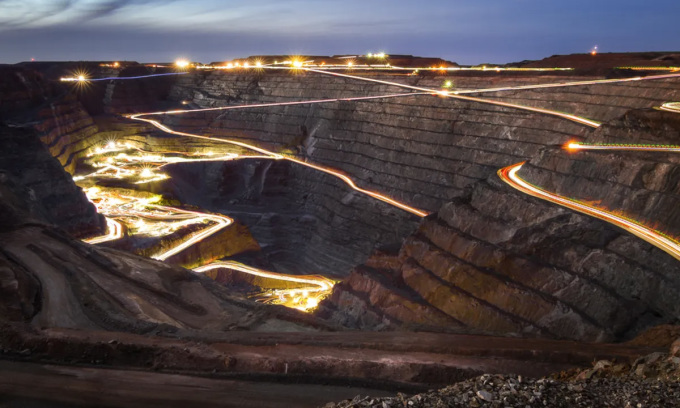
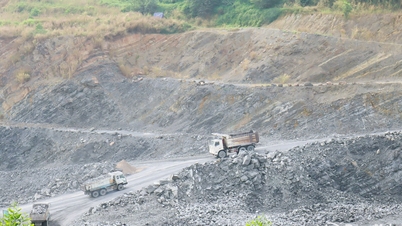
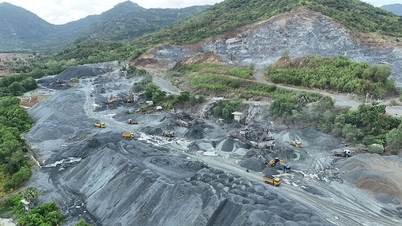
Humans are extracting and using minerals faster than they can regenerate. Photo: Christoph Schaarschmidt
Geological processes take thousands, even millions of years, to create mineral deposits. However, humans mine and use minerals faster than they can regenerate. According to some estimates, although still controversial, the supply of some metals could be depleted in less than 50 years, IFL Science reported on August 16.
Iron is the fourth most abundant element in the Earth's crust, although most of it remains deep underground and only a small fraction is accessible in the form of iron ore. In 2022, experts estimated that the Earth contained approximately 180 billion tons of raw iron ore, with a total iron content of about 85 billion tons. While this sounds abundant, it will not last forever.
Iron ore could be depleted by 2062, American environmental analyst Lester Brown wrote in his 2008 book , *Plan B 3.0: Mobilizing to Save Civilization* . He also argued that other important mineral resources such as lead and copper could be exhausted in the coming decades.
"Assuming an annual mining growth rate of 2%, according to the U.S. Geological Survey (USGS) data on economically recoverable reserves, the world has enough lead reserves for 17 years, tin for 19 years, copper for 25 years, iron ore for 54 years, and bauxite (a type of aluminum ore) for 68 years," Brown wrote.
However, this assertion is highly controversial. Other studies indicate that the likelihood of metal depletion is significantly lower than Brown's estimate. Furthermore, humans can recycle iron and related materials such as steel, meaning that the reserves in the Earth's crust are not the entirety of the Earth's resources.
The primary metal at risk of complete depletion within the next 100 years is copper, according to research by Theo Henckens, an expert at Utrecht University, published in Science Direct in 2021. Six other minerals are likely to be depleted within 100-200 years: antimony, gold, boron, silver, bismuth, and molybdenum. Additionally, nine minerals could be depleted within 200-1000 years: indium, chromium, zinc, nickel, tungsten, tin, rhenium, selenium, and cadmium.
Other scientists argue that mineral depletion is not a major concern. Some believe that humans have only scratched the surface of Earth's mineral resources. Most mined deposits are found at depths of only 300 meters in the Earth's crust, but they could still be located much deeper.
As technology continues to advance, it's possible that humans will be able to exploit these deep-sea reserves. However, the question is whether it's possible to extract them without harming the planet or humanity itself.
"Don't confuse mineral resources existing within the Earth with reserves – the portion of mineral resources that have been identified, quantified, and can be economically exploited. Some studies predict shortages based on statistics of reserves, meaning a very small fraction of the total resources that exist," said Lluis Fontboté, professor of Earth Sciences at the University of Geneva. He also noted that the real issue here is not the depletion of resources but the environmental and social impact of mining.
Thu Thao (According to IFL Science )
Source link
![[Photo] General Secretary and President To Lam presides over a meeting with the Central Organizing Committee.](https://vphoto.vietnam.vn/thumb/1200x675/vietnam/resource/IMAGE/2026/06/03/1780482764658_a1-bnd-4741-3342-jpg.webp)
![[Photo] First session of the 14th Congress of the Vietnam Trade Union](https://vphoto.vietnam.vn/thumb/1200x675/vietnam/resource/IMAGE/2026/06/03/1780465947883_ndo_br_img-3852-jpg.webp)


![[Photo] Secretary of the National Assembly Party Committee, Chairman of the National Assembly presides over the meeting of the Standing Committee and Executive Committee of the National Assembly Party Committee.](https://vphoto.vietnam.vn/thumb/1200x675/vietnam/resource/IMAGE/2026/06/03/1780480353201_ndo_br_bnd-2585-jpg.webp)




















































![[Video] Sunset at Lap An Lagoon – Where the sun sets over the fishing nets](https://vphoto.vietnam.vn/thumb/1200x675/vietnam/resource/IMAGE/2026/05/31/1780192137701_beach-landscape-sea-water-nature-grass-745871-pxhere-com.jpeg)






























Comment (0)