

Listen to the People
In many rural and urban areas of Tuyen Quang province these days, the story of merging villages and residential areas has become a lively topic of discussion at Party branch meetings, residential group meetings, and family meals. The majority of people express strong support for this policy.
Ms. Hoang Thi Hue, a Tay ethnic woman from Hoa An commune, said that consensus stems primarily from understanding. Everyone clearly sees that in a village that is too small and has too few inhabitants, public investment resources will be fragmented. When merged into a larger community, investment capital for roads, schools, health stations, and cultural centers will be concentrated. Infrastructure will be improved, and the quality of life for the people themselves will be enhanced.
Many people believe that reducing the number of part-time officials at the grassroots level not only saves state budget but also provides an opportunity to select truly capable and dedicated individuals to shoulder the common responsibilities.
In communes and wards throughout the province, to achieve strong consensus, a crucial factor is the serious implementation of listening to people's concerns and publicly presenting the restructuring plan so that people can contribute ideas, discuss, and agree on its implementation. Mr. Lo Minh Thang from Meo Vac commune shared that the merger plans, the naming of new villages, and the location of the central cultural center were all presented for public and democratic feedback. Legitimate concerns of the people regarding changes to personal information on identification documents (citizen identification cards, land ownership certificates, health insurance cards) were addressed by relevant agencies with commitments to support and facilitate the process at the grassroots level, avoiding cumbersome procedures, thus reassuring the people.
When all information is transparent, and the voices of the people are respected, all barriers of local parochialism are erased. People, who were previously "passive in implementing policies," have shifted to "actively offering suggestions," working with the government to find the best solutions when reorganizing villages and residential areas.
Heartwarming stories from the grassroots.
The policy of merging villages and residential areas is being planned and implemented urgently, systematically, and comprehensively by many localities in Tuyen Quang province. The most vivid evidence of the consensus in implementing Resolution No. 96/NQ-TU of the Provincial Party Committee and Plan No. 03 of the Provincial Steering Committee on the reorganization of villages and residential areas is the very practical actions taken at the commune and ward levels. These include organizing meetings to direct implementation at the commune and ward levels. Commune and ward officials directly visit residential areas to listen to concerns and study proposed names for the new villages and residential areas.
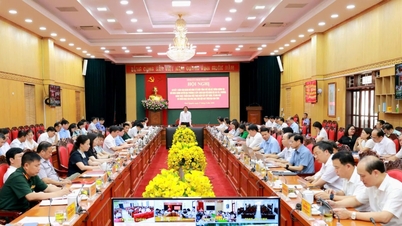
Specifically, on May 25th, the People's Committee of Nong Tien Ward held a conference to review and discuss plans for rearranging and merging residential areas in the ward. Mr. Pham Ngoc Hai, Chairman of the People's Committee of the ward, affirmed: Rearranging and merging residential areas is a key political task, requiring the synchronized and decisive involvement of the entire political system to meet the requirements of operating the two-tiered local government in the new phase.
Currently, Nong Tien ward has a natural area of 2,699 hectares with 4,176 households. Based on current regulations, the ward plans to merge and streamline the number of residential groups from 21 to 11. This is a necessary step to ensure the number of households meets the prescribed standards.
Meanwhile, in Pà Vầy Sủ commune, commune officials have been going directly to each village to hold meetings and listen to the opinions of the people. According to Mr. Dương Việt Hùng, Chairman of the People's Committee of Pà Vầy Sủ commune, Pà Vầy Sủ currently has 34 villages, and the commune expects to have 18 villages after the reorganization. Some village names will have to be replaced by new names after the merger, and everyone will miss them. However, for the sake of overall development, the village meetings, attended by commune officials, have democratically discussed, proposed, and contributed ideas, ultimately reaching a consensus on the merger and the new names.
Based on the high level of consensus and agreement from the villages and communes, the specialized agencies are directed to continue researching the determination of new administrative boundaries, selecting names for the merged residential areas that ensure historical and cultural elements, and especially a plan for arranging and resolving appropriate policies and benefits for the non-professional grassroots workers.
In Dong Van commune, the proposed plan is to reduce the number of villages from 69 to approximately 20. This is not simply a matter of streamlining the administrative apparatus, but also opens up the prospect of restructuring the socio-economic development space, especially tourism development. According to the proposed plan, four villages, namely Ma Pi Leng, Seo Xa Lung, Sa Lung, and Seo Sa Lung, will merge into one new village. After several meetings with residents, the majority agreed to retain the name Ma Pi Leng.
The new village center and cultural center will be located in Seo Sa Lung village. Comrade Dinh Ngoc Thiet, Party Secretary and Head of Seo Sa Lung village, explained that retaining the name Ma Pi Leng for the new village would be a significant advantage in developing community tourism, attracting visitors, and promoting local products. The people of the merged villages all support and unanimously agree to this proposal and request that higher authorities consider it.
The reorganization of villages and residential areas may cause initial disruptions, but with the solid foundation of the people's support, the reform and streamlining of the administrative apparatus will surely succeed. This favorable beginning is opening up new opportunities for development, igniting aspirations for progress from within each household and street corner, building a stronger and more civilized homeland.
Text and photos: Quang Hoa
Source: https://baotuyenquang.com.vn/xa-hoi/202605/khoi-dau-tu-long-dan-4f71ede/
![[Photo] Opening Ceremony of the National People's Council Conference on the Implementation of Directions and Tasks for the 2026-2031 Term](https://vphoto.vietnam.vn/thumb/1200x675/vietnam/resource/IMAGE/2026/05/28/1779939257690_ndo_br_bnd-1991-jpg.webp)


![[Image] Checking the security conditions at the exam site, ready for the 10th grade exam.](https://vphoto.vietnam.vn/thumb/1200x675/vietnam/resource/IMAGE/2026/05/28/1779943458889_z7872507660648-d764421a26e8cd7b61d70d142a48a685-jpg.webp)






































































Comment (0)