

This villa complex consists of 16 houses, completed in 1934. Initially, it served as a residence and retreat for professors from Lycée Yersin (now Da Lat College of Education), King Bao Dai, French officials, and military generals of the old regime.
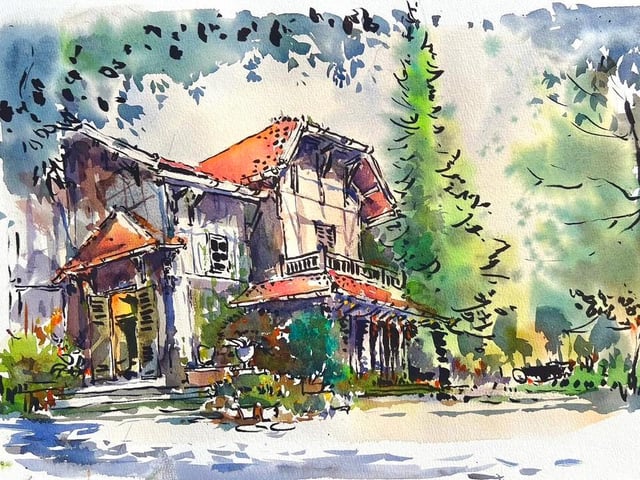
Villa No. 14 is the most typical example of the Colombage style, characterized by decorative wooden slats paneled on the exterior walls - a sketch by architect Phan Đình Trung.
After 1975, the villa complex was divided and expanded into a communal housing area for many families, then abandoned, leading to severe deterioration. During this period, some villas in the area were rumored to be "haunted." According to these rumors, at night, passersby would occasionally see a faint light emanating from the villas even without electricity, or a white cloth fluttering in the air, which would disappear upon closer inspection. They also heard laughter, talking, and intermittent weeping coming from inside the villas, or saw the ghost of a girl wandering inside, waving to passersby.
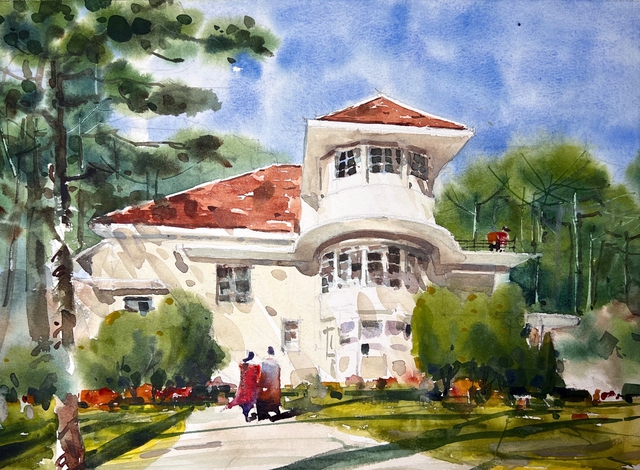
Villa No. 26 is strongly influenced by Art Deco architecture - a sketch by architect Duy Huynh.
In 2006, Cadasa leased 13 of these properties to turn them into a resort and renovated almost the entire interior, fortunately preserving the beauty of the exterior.

Villa No. 16 (designed by architect Jean Veyssere, construction began in 1930) is the oldest house in the area - sketch by architect Tran Xuan Hong.

A corner of the Cadasa old villa complex - Architect Nguyen Dinh Viet

The Cadasa old villa complex is the only place in Indochina that brings together so many different regional French architectural styles - sketch by Le Duy Luc.

A house in the Normandy style of Northern France with a steeply sloping roof for efficient rainwater drainage - a sketch by artist Pham Khoi.
Spanning approximately 6 hectares of pine forest, the Cadasa villa complex resembles a miniature France (a way for former French officials to ease their homesickness). Some villas feature exposed timber-frame structures (Colombage style), characteristic of Normandy in northern France. Others are reminiscent of Savoie in southeastern France, with steeply sloping roofs, large angled corners, and solid stone foundations. Some evoke the Basque Country of southwestern France, with sloping roofs extending to the ground and elaborate facades resembling ancient castles. Still others boast arched facades and large windows on multiple sides, reminiscent of Provence in southern France… Villa No. 16 (the Rose Villa), the former residence of architect Jean Veyssere, is the oldest villa (construction began in 1930).

This house, designed in the Log Cabin style, is constructed entirely from large, solid tree trunks – a sketch by architect Phan Gia Huu Tuan.

Afternoon sun in the Cadasa old villa area - a sketch by artist Tran Binh Minh

Moonlight in the Cadasa ancient villa - a sketch by architect Ha Vu.

Cadasa villa complex nestled amidst a pine forest - a sketch by architect Hoang Dung.
Although they are Western-style houses, the villas here have been designed to suit the climate of Da Lat. They have more and larger windows, and the eaves extend further to protect against rain. The binding agent is a mixture of lime and resin from the bời lời tree, which provides good waterproofing…

The Cadasa villa complex was once rumored to be "haunted" - a sketch by architect Phùng Thế Huy.
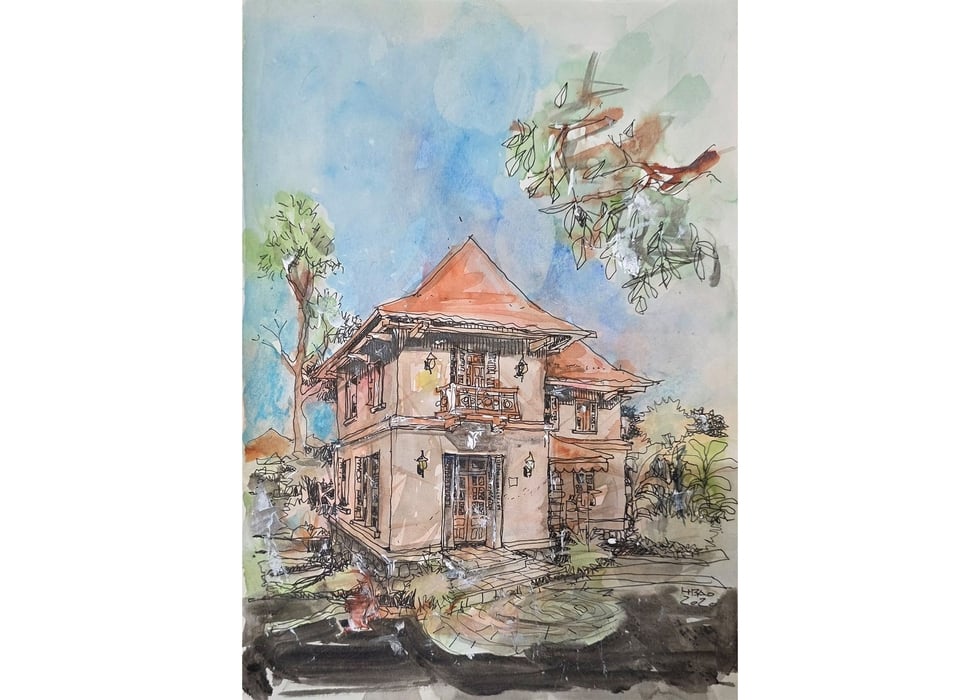
Villa No. 25 features the distinctive Savoie architectural style of southeastern France, highlighted by its large sloping roof - a sketch by architect Bui Hoang Bao.

Springtime in the Cadasa old villa area - a sketch by architect Hoang Dung.

This cluster of villas consists of 13 houses, completed in 1934 - sketch by artist Tran Binh Minh.

In 2006, Cadasa was renovated to become a resort - sketch by artist Tran Binh Minh.
If you want to take a stroll through early 20th-century French architecture, come here.
Source: https://thanhnien.vn/khu-biet-thu-co-cadasa-o-da-lat-va-loi-don-ma-am-185260530204241018.htm
























![[Photo] Reception to welcome General Secretary and President To Lam and his wife on their State visit to the Philippines](https://vphoto.vietnam.vn/thumb/1200x675/vietnam/resource/IMAGE/2026/06/01/1780295488620_vna-potal-chieu-dai-chao-mung-tong-bi-thu-chu-tich-nuoc-to-lam-va-phu-nhan-tham-cap-nha-nuoc-toi-philippines-8798060-7855-jpg.webp)
















































Comment (0)