

Lam Dong is operating an unprecedented governance model after its merger to become the province with the largest natural area in Vietnam (24,233.07 km2).
In the context of managing nearly 3.9 million people across a fragmented geographical area, digital transformation is no longer an option, but has become the "lifeblood" for the efficient operation of the two-tiered local government apparatus. By implementing a strategy of creating "accurate, complete, clean, and viable" data coupled with a seamless telecommunications infrastructure, Lam Dong is transforming its vast digital resource pool into a direct driving force for socio -economic breakthroughs, affirming its position as a smart, modern, and sustainable "heart" of the mountainous region in the era of integration.
Lesson 1: Building a "Digital Nervous System"
To prevent the administrative apparatus from being overwhelmed by the pressure of managing a record-breakingly large area after the merger, Lam Dong has established a new management philosophy: Data must be one step ahead.
From the "six clear principles" in governance to the strategy of building a telecommunications infrastructure with no "low-lying areas" and large "Green - Clean" data centers, the province is creating a sensitive "digital nervous system". This is not only a revolution in broadband network infrastructure but also a strategic step to enhance the capacity for public service delivery, making all operational decisions based on real, accurate, and transparent data.
Breaking through in telecommunications infrastructure - the foundation in the digital data era.
The merger of the three localities of Lam Dong, Binh Thuan, and Dak Nong is not simply about expanding administrative boundaries, but also about creating a new development space that encompasses the highlands, midlands, and coastal areas, and serves as a gateway connecting the Central Highlands with the Southern key economic region.
In this context, data is no longer just a management support tool but has become a strategic infrastructure, playing a crucial role in connecting all operational, production, and socio-economic development activities across the widest geographical area of the country.
For the newly established Lam Dong province, data is being viewed as a strategic infrastructure, playing a role equivalent to transportation, electricity, or irrigation. If roads connect geographical space, data connects administrative space; if physical infrastructure facilitates the flow of goods, data infrastructure facilitates the flow of information and development decisions.
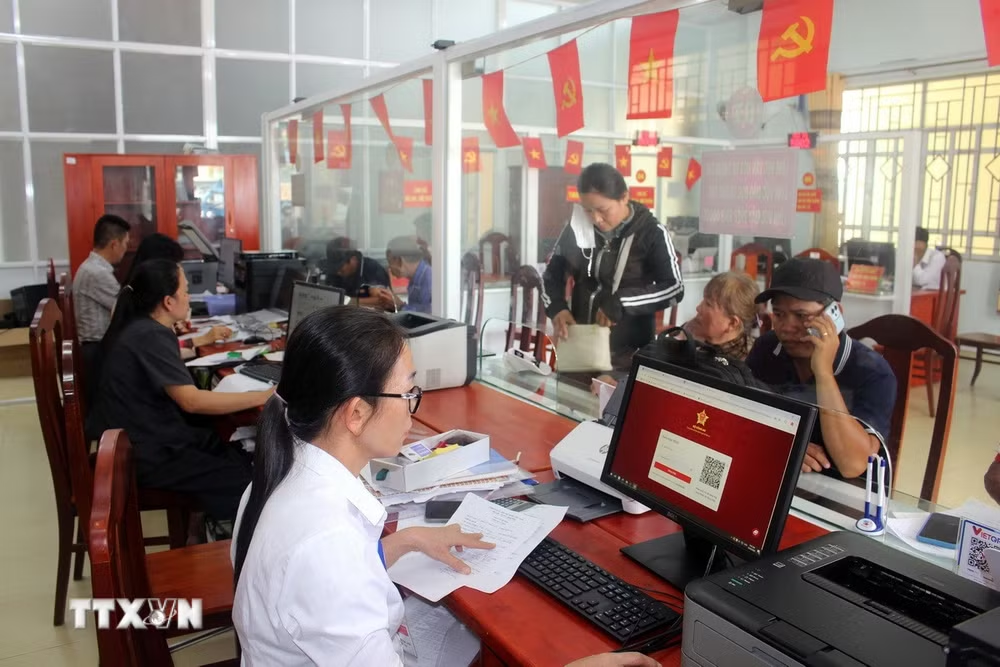
To prevent the administrative apparatus from becoming overwhelmed while managing 124 commune-level administrative units after the merger, the Standing Committee of the Lam Dong Provincial Party Committee agreed on the "6 clear" principles of management: clear person, clear task, clear time, clear responsibility, clear output, and clear authority. This mindset requires all public service activities to be "digitized" so that they can be accurately monitored and evaluated through a system of KPIs linked to each specific goal.
The shift from a plan-based approach to a goal-oriented and product-driven approach has created positive pressure, forcing departments, agencies, and localities to prioritize the creation of clean data.
To date, the province's data integration and sharing platform (LGSP) has processed nearly 2 million data transactions, seamlessly connecting with 22 central government systems.
"Living" figures such as 1.1 million land data cases matching the national database, or insurance verification rates reaching 99.71% and education sector data reaching 98.8%, are proof of using data to transparentize governance.
Lam Dong province has identified digital infrastructure as a priority. In urban centers like Da Lat, the province has implemented a policy of undergrounding all public service lines and cables to both preserve the aesthetic appeal of the heritage city and enhance network stability. Da Lat is positioned as a "creative core," where telecommunications infrastructure must meet international standards to support the development of the creative economy and smart tourism.
However, according to Tran Thanh Duy, Deputy Director of the Department of Science and Technology of Lam Dong province: The biggest challenge lies in remote and rural areas. To date, Lam Dong still has 101 residential clusters with weak or missing signal coverage. To resolve this "bottleneck," the province has issued a plan to build new or optimize 112 BTS station locations in 2026.
The goal is to completely eliminate telecommunications "backwaters," ensuring 100% of the population has mobile broadband coverage and 94.22% of households have FTTH fiber optic cable. “Even in the Phu Quy Special Economic Zone – where there is no direct fiber optic cable – the province has deployed microwave technology with a capacity of 13.7 Gbps and plans to upgrade it by another 4 Gbps to ensure smooth communication for the development of the marine economy and national defense,” Mr. Duy said.
Big Data and "Green-Clean" Data Centers
Discussing infrastructure strategy, the Director of the Department of Science and Technology of Lam Dong province, Vo Thanh Cong, affirmed that the province is focusing on the depth of digital data: “We are operating a Big Data center system using a centralized-redundant model, relocating and consolidating infrastructure from previous provinces to a single hub, helping to digitize all infrastructure maps for construction, transportation, and irrigation throughout the province. The goal is to create 'Green and Clean' data centers, ensuring sustainability and absolute security for the province's shared software system.”
This system currently has 98 physical servers, providing cloud-based virtualization services with 465 TB of storage capacity. This is the "brain" behind the deployment of the Shared Geospatial Database System (GIS) – a major undertaking that digitizes all infrastructure, transportation, and irrigation maps across the entire province.
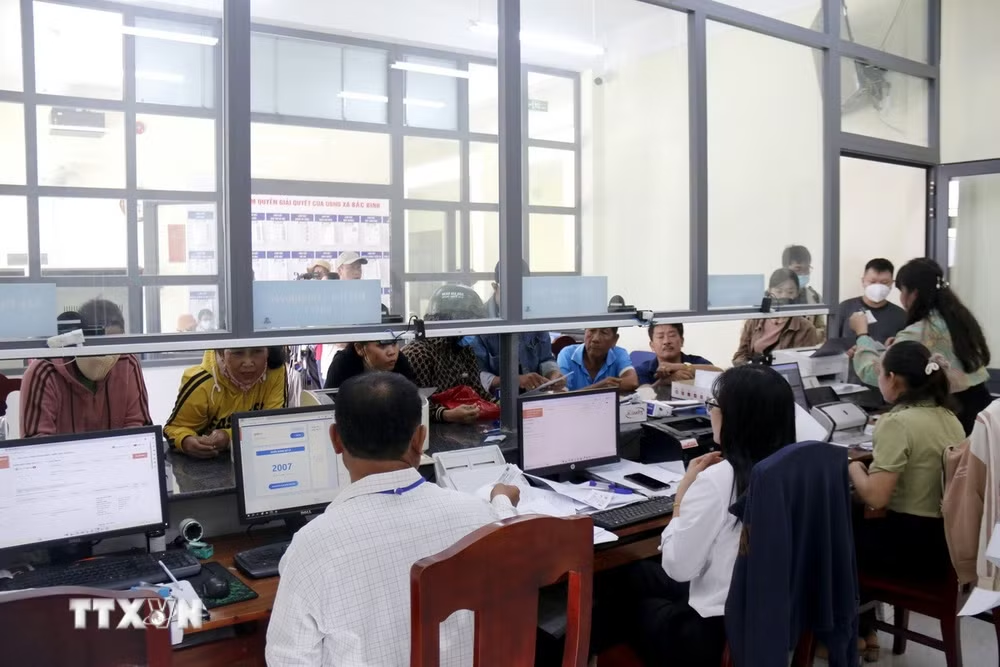
Once GIS is fully developed, every square meter of land and every road in the province will be managed transparently in a digital environment. The greatest value of the data system lies not in digitizing maps, but in its ability to generate more accurate development decisions.
When land, planning, transportation, population, and resource data are interconnected, the time required for surveying and preparing investments by businesses will be significantly shortened; infrastructure projects can choose more optimal options; and forecasting the needs of urban development, tourism, and agriculture will become more scientific.
Given its vast geographical area of over 24,000 km², building a "digital replica" of the entire province also helps the government significantly reduce administrative costs, improve resource monitoring capabilities, and respond quickly to natural disasters, forest fires, or fluctuations in the agricultural market.
A groundbreaking highlight is the integration of artificial intelligence (AI) into public service through the iKNOW platform in 124 communes and wards. Besides infrastructure, the human factor is crucial, Mr. Vo Thanh Cong emphasized: To enable people to master the technology, Lam Dong province organized an unprecedented training campaign: 19 training courses for over 11,000 officials.
The program is not limited to civil servants but also extends AI training to small and micro enterprises, helping them optimize productivity in the digital economy. iKNOW is an Intelligent Knowledge Platform being piloted by the Lam Dong Provincial Department of Science and Technology in collaboration with VNPT Lam Dong.
In addition, there is the "Digital Learning Resources Ecosystem and Smart Teaching Platform" program, which is being jointly implemented by the provincial education and science-technology sectors for primary education to narrow the gap in access to education;
The province is promoting the "Digital University" model through the comprehensive digitization of training programs and learning materials at higher education institutions in the area. Although not a training institution in the traditional sense, the "Digital Literacy Platform" has become a tool for widely disseminating digital skills to civil servants and citizens.
The development of a digital learning resource ecosystem and a smart teaching support platform, along with the "Digital Popular Education" movement, is how Lam Dong province is preparing resources for the future, bridging the technological gap between urban areas and even the most remote regions.
Final article: Numerical data with the potential for value change.
Source: https://www.vietnamplus.vn/kien-tao-he-than-kinh-so-post1113894.vnp































![[Photo] Reception to welcome General Secretary and President To Lam and his wife on their State visit to the Philippines](https://vphoto.vietnam.vn/thumb/1200x675/vietnam/resource/IMAGE/2026/06/01/1780295488620_vna-potal-chieu-dai-chao-mung-tong-bi-thu-chu-tich-nuoc-to-lam-va-phu-nhan-tham-cap-nha-nuoc-toi-philippines-8798060-7855-jpg.webp)

































































Comment (0)