

Yesterday (May 28th) was a busy day for experts and market analysts monitoring the US economy , as several data points from the world's number one economy were released. The most closely watched was the Personal Consumption Expenditures (PCE) index – a key measure of inflation that the Federal Reserve (Fed) pays close attention to. As expected by analysts, core PCE inflation in April reached 3.3%, remaining significantly higher than the Fed's 2% target.
While inflation remains high, US economic growth has slowed somewhat compared to initial expectations. Released concurrently with the PCE data, the country's first-quarter GDP growth was revised down to 1.6%, compared to the initial estimate of 2%. These data continue to show new warning signs for the US economy since the conflict in the Middle East erupted in late February.
Alongside this, consumer spending – one of the pillars of US economic growth – also showed less optimism. The consumer confidence index surveyed by the Conference Board fell to just over 93 points in April.
Among them, middle- and low-income consumers have the lowest confidence index, as they are heavily impacted by fluctuations in fuel supply due to tensions in the Middle East, with gasoline prices in the US having risen nearly 50% since the start of the conflict. Price volatility has led many to tighten their spending, and job prospects appear less optimistic than in previous months.
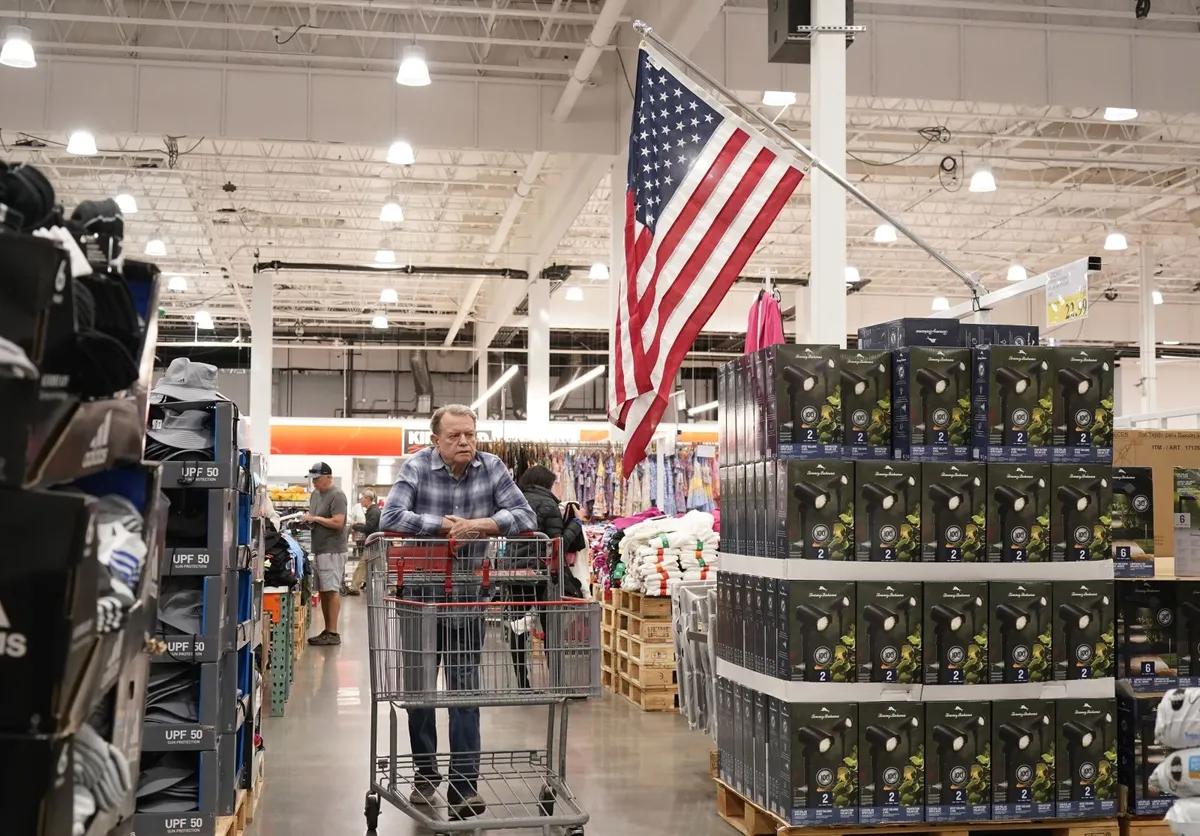
Consumers choose items to buy at a supermarket in California, USA. Photo: THX/VNA
Persistent inflation weighs heavily on American businesses.
The sharp rise in oil prices following the conflict in the Middle East is creating a ripple effect on the US economy. Not only gasoline, but everything from plastic packaging and transportation to food is experiencing price increases, forcing many businesses to pass these costs on to consumers.
In California, Emerald Packaging, a company specializing in plastic packaging for fruits and vegetables, is facing significant pressure from rising raw material costs. The company supplies packaging to numerous packers of lettuce, carrots, and potatoes across the United States.
Kevin Kelly, CEO of Emerald Packaging, said: "Since the war broke out, the price of plastic has doubled due to supply disruptions in the Middle East. But it's not just packaging that's gone up in price; transportation, cartons, ink, and labor have all increased. All of that ultimately passes on to the customer."
According to Emerald Packaging, much of the impact of the current price increases has yet to be fully reflected in US supermarkets. This means that consumer inflationary pressures may continue for some time to come.
The pressure is now spreading to the American agricultural sector as well. In Mississippi, Foot Print Farms, a farm that provides fresh food to the local community, reports that production costs have skyrocketed in just one year.
Cindy Ayers Elliott, CEO of Foot Print Farms, said: "The cost of fertilizer, fuel, labor, everything is going up. Seeds alone are now three times more expensive than last year. With everything increasing in price, we are forced to raise our selling prices as little as possible to stay afloat."
According to the US Department of Labor, food prices in April rose 3.2% year-on-year, while gasoline prices have increased by more than 50% since the Middle East conflict erupted. Experts at Fitch Ratings warn that if geopolitical tensions do not ease soon, inflationary pressure in the US will become even more difficult to bring down.
Olu Sonola, a US economist at Fitch Ratings, said: "If oil prices continue to remain high, so will gasoline and energy costs in the US. We've already seen the impact of this on inflation. Inflation will continue to rise. The overall consumer inflation index is currently still above 3%, and will move into the 4% range."
The impact is now beginning to become apparent in the daily lives of Americans. Gasoline prices exceeding $4 per gallon are forcing many families to cut back on non-essential expenses, buy less, or switch to cheaper products at the supermarket. According to the Conference Board, about two-thirds of American consumers say they have had to reduce spending because of rising prices.
The "K-shaped" economic picture of the US.
While the price surge stemming from the Middle East conflict is having a ripple effect throughout the entire supply chain, from factories and farms to the consumer's table, conversely, there are sectors that appear to be largely unaffected by geopolitical shifts.
The stock market is one such sector. In 2026, all three major Wall Street indices maintained impressive gains and set new records: the Dow Jones surpassed 50,000 points in February, the S&P 500 also crossed the 7,500 mark, and earlier this month, the Nasdaq index, which includes many key technology stocks, reached 26,000 points for the first time in history.
Technology is also a sector that has maintained growth compared to the overall economy, especially when looking at the race to develop artificial intelligence (AI). Among the top 7 technology companies – or the "Magnificent 7" – six have exceeded expectations in the first quarter of 2026. And four of them – Microsoft, Amazon, Alphabet, and Meta – have continued to announce massive investment plans for AI, with projected capital expenditures exceeding $700 billion.
The US economy has uneven growth drivers.
Clearly, there has been an uneven growth structure in the world's number one economy – what many experts have dubbed the "K-shaped economy," where large technology companies and wealthy stock investors thrive, while small and medium-sized enterprises – the "backbone" of the economy – and low-income workers struggle. Why does this unevenness exist?
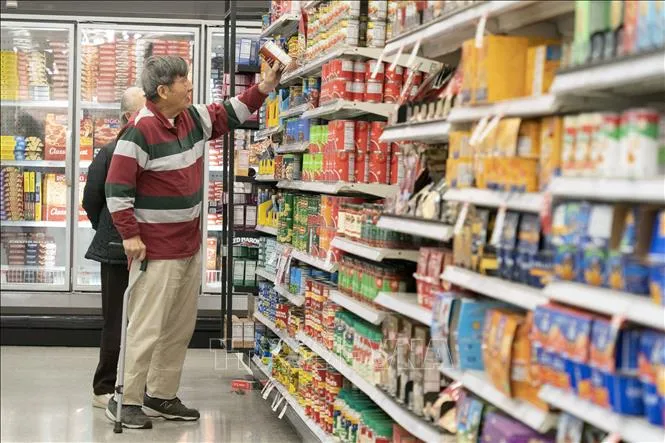
There is an unevenness in the growth structure of the world's number one economy. Photo: THX/TTXVN
According to experts, the growth impetus from strong investment plans in AI is real, and this sector is also creating tangible effects for the US economy. However, as money flows heavily into AI, many other economic sectors find it more difficult to access capital. At the same time, the trend of automation driven by AI also has a negative impact on the labor market.
Dr. Nguyen Minh Tuan, an economist at RSM Group in the US, assessed: "It's quite paradoxical that the very thing that is helping to sustain economic growth is also gradually putting pressure on the job market. AI is beginning to replace some office positions, professional services, and administration. We could see hundreds of thousands of jobs affected in the near future."
Beyond technology, consumer spending by the wealthy is also becoming a crucial support for the US economy. According to RSM, the wealthiest 40% of households now account for over 60% of total consumer spending, benefiting from the booming stock market and asset prices. As a result, US consumer spending data for April still showed a slight increase of 0.5% despite the impact of conflict on prices.
However, conversely, the high interest rate environment coupled with rising input costs is posing a significant challenge for many small businesses. According to the National Federation of Independent Businesses, small business optimism has fallen to its lowest level in nearly a year. Sectors such as food manufacturing are considered most sensitive to input costs, and this impact can easily be passed on to low-income consumers.
Professor Ken Foster, an agricultural economics expert at Purdue University, stated: "Fruits and vegetables are a product group where the production process consumes a lot of energy for transportation and storage. This is one of the areas where the impact of rising energy prices will be felt sooner in supermarkets."
With inflation remaining high due to the impact of energy prices, the US Federal Reserve (Fed) is not expected to have much room to lower interest rates to support growth.
"Rising energy prices are driving inflation up but are also slowing growth. This means the Fed's two biggest goals are now almost going in opposite directions. The data all suggests that now is not the right time for the Fed to abandon keeping interest rates high in the near future," commented Dr. Nguyen Minh Tuan, an economist at RSM Group in the US.
Overall, experts believe that the US economy can still be supported in the short term by technology money and the strength of the financial markets. However, the bigger question is how far these drivers will spread, given the widening gap between them and the rest of the economy, and the effects of geopolitical instability are unlikely to subside anytime soon.
Source: https://vtv.vn/kinh-te-my-ghi-nhan-nhieu-tin-hieu-canh-bao-100260529064226964.htm

![[Image] Pleasant weather helps students enter the 10th grade entrance exam with confidence.](https://vphoto.vietnam.vn/thumb/1200x675/vietnam/resource/IMAGE/2026/05/29/1780034401612_ngay-1-thi-lop-10-minh-duy-8-5009-jpg.webp)
![[Photo] Ba Lang An Lighthouse - the "eye of the sea" amidst the "rock museum" of Quang Ngai province.](https://vphoto.vietnam.vn/thumb/1200x675/vietnam/resource/IMAGE/2026/05/29/1780038698840_anh-man-hinh-2026-05-29-luc-14-10-42.png)

































































































Comment (0)